







Question: Problem 3 . A coffee shop manager realizes that demand for coffee is more elastic among students, and is trying to determine the optimal pricing
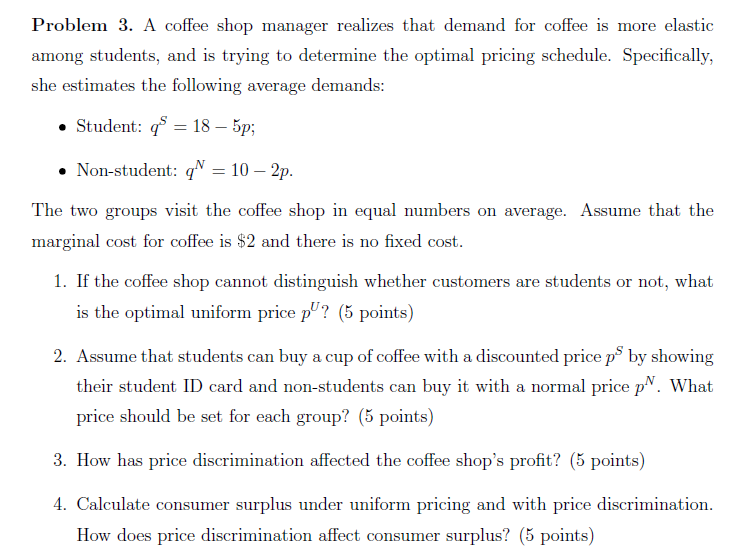
Problem A coffee shop manager realizes that demand for coffee is more elastic among students, and is trying to determine the optimal pricing schedule. Specifically, she estimates the following average demands:
Student: qS p ;
Nonstudent: qN p
The two groups visit the coffee shop in equal numbers on average. Assume that the marginal cost for coffee is $ and there is no fixed cost.
If the coffee shop cannot distinguish whether customers are students or not, what is the optimal uniform price pU points
Assume that students can buy a cup of coffee with a discounted price pS by showing their student ID card and nonstudents can buy it with a normal price pN What price should be set for each group? points
How has price discrimination affected the coffee shop's profit? points
Calculate consumer surplus under uniform pricing and with price discrimination. How does price discrimination affect consumer surplus? points
Step by Step Solution
There are 3 Steps involved in it
1 Expert Approved Answer
Step: 1 Unlock

Question Has Been Solved by an Expert!
Get step-by-step solutions from verified subject matter experts
Step: 2 Unlock
Step: 3 Unlock
 Study Help