







Question: Problem 3 Assume that we have a computer that stores a floating-point number in a 12-bit word with 1 bit for the sign, 5 bits
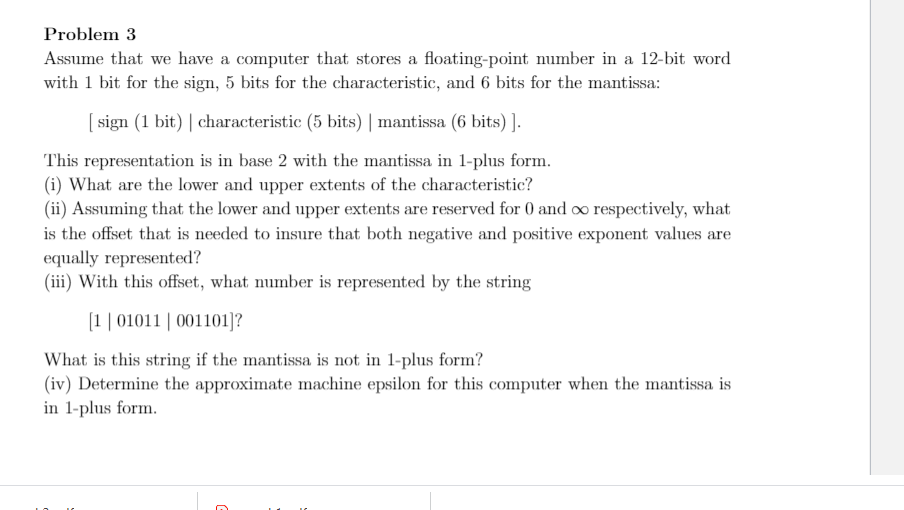
Problem 3 Assume that we have a computer that stores a floating-point number in a 12-bit word with 1 bit for the sign, 5 bits for the characteristic, and 6 bits for the mantissa: [sign (1 bit) characteristic (5 bits) | mantissa (6 bits) ]. This representation is in base 2 with the mantissa in 1-plus form. (i) What are the lower and upper extents of the characteristic? (ii) Assuming that the lower and upper extents are reserved for 0 and o respectively, what is the offset that is needed to insure that both negative and positive exponent values are equally represented? (iii) With this offset, what number is represented by the string [1 | 01011001101]? What is this string if the mantissa is not in 1-plus form? (iv) Determine the approximate machine epsilon for this computer when the mantissa is in 1-plus form. Problem 3 Assume that we have a computer that stores a floating-point number in a 12-bit word with 1 bit for the sign, 5 bits for the characteristic, and 6 bits for the mantissa: [sign (1 bit) characteristic (5 bits) | mantissa (6 bits) ]. This representation is in base 2 with the mantissa in 1-plus form. (i) What are the lower and upper extents of the characteristic? (ii) Assuming that the lower and upper extents are reserved for 0 and o respectively, what is the offset that is needed to insure that both negative and positive exponent values are equally represented? (iii) With this offset, what number is represented by the string [1 | 01011001101]? What is this string if the mantissa is not in 1-plus form? (iv) Determine the approximate machine epsilon for this computer when the mantissa is in 1-plus form
Step by Step Solution
There are 3 Steps involved in it

Get step-by-step solutions from verified subject matter experts
 Study Help