







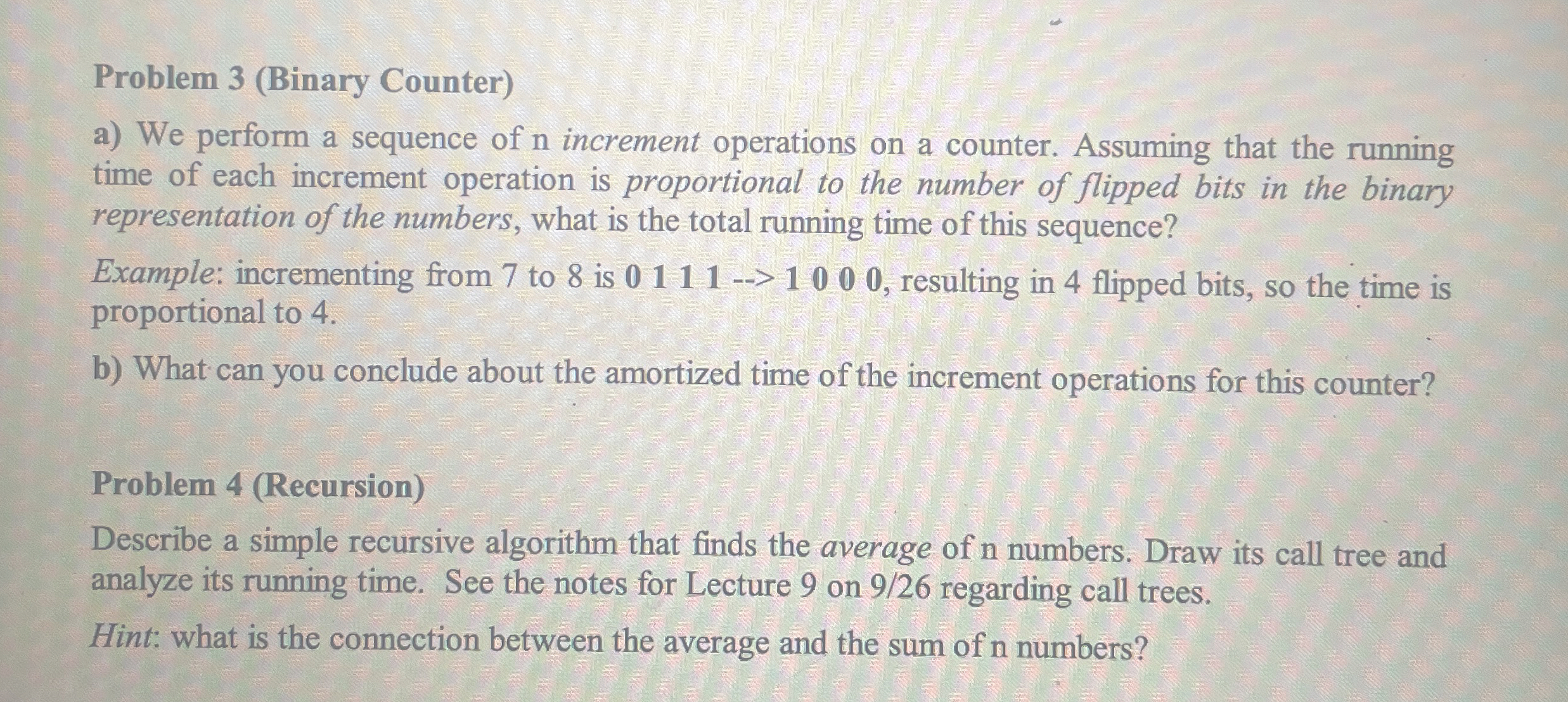
Question: Problem 3 ( Binary Counter ) a ) We perform a sequence of n increment operations on a counter. Assuming that the running time of
Problem Binary Counter
a We perform a sequence of n increment operations on a counter. Assuming that the running
time of each increment operation is proportional to the number of flipped bits in the binary
representation of the numbers, what is the total running time of this sequence?
Example: incrementing from to is resulting in flipped bits, so the time is
proportional to
b What can you conclude about the amortized time of the increment operations for this counter?
Problem Recursion
Describe a simple recursive algorithm that finds the average of n numbers. Draw its call tree and
analyze its running time. See the notes for Lecture on regarding call trees.
Hint: what is the connection between the average and the sum of n numbers?
Step by Step Solution
There are 3 Steps involved in it
1 Expert Approved Answer
Step: 1 Unlock

Question Has Been Solved by an Expert!
Get step-by-step solutions from verified subject matter experts
Step: 2 Unlock
Step: 3 Unlock
 Study Help