







Question: Problem 3 . , Consider the direct - sequence CDMA system as de - scribed in Lecture 1 5 . At the receiver suppose that
Problem Consider the directsequence CDMA system as de
scribed in Lecture At the receiver suppose that instead of using the local
code we instead use where is some fraction of a bit time,
ie the local code may be shifted one direction or the other. Compute the
degradation in to due to a nonzero at the output of the corre
lator for BPSK signaling. You may assume for the local code that adjacent
chips are equally likely to match or differ.
additional notes:Receiver CDMA Operations cont
Now, dots, is a constant over seconds.
Note that
So for User we get ideally
Where just denotes the constant value of at any time in the bit interval
which is either or in the given second interval.
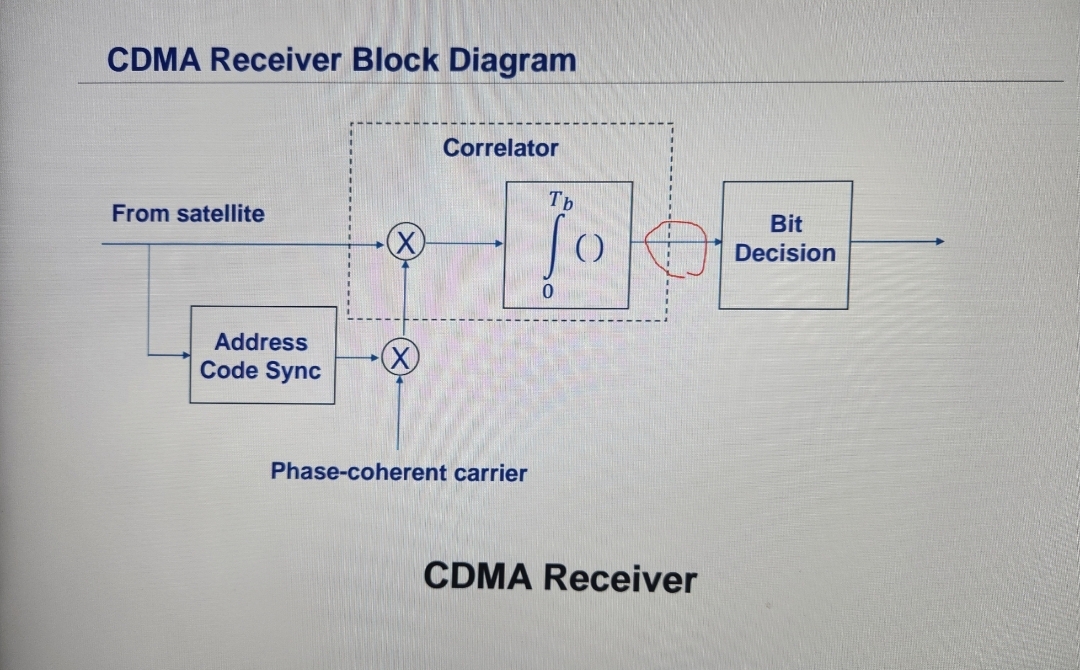
Each user repeats the above operations using their particular code.CDMA Receiver Block Diagram
CDMA Receiver
Step by Step Solution
There are 3 Steps involved in it
1 Expert Approved Answer
Step: 1 Unlock

Question Has Been Solved by an Expert!
Get step-by-step solutions from verified subject matter experts
Step: 2 Unlock
Step: 3 Unlock
 Study Help