







Question: Problem 3. Consider the Markov chain shown in Figure 2. Figure 2: Problem 3 Markov chain 1. Let the initial distribution be Pr(A) : Pr(B)
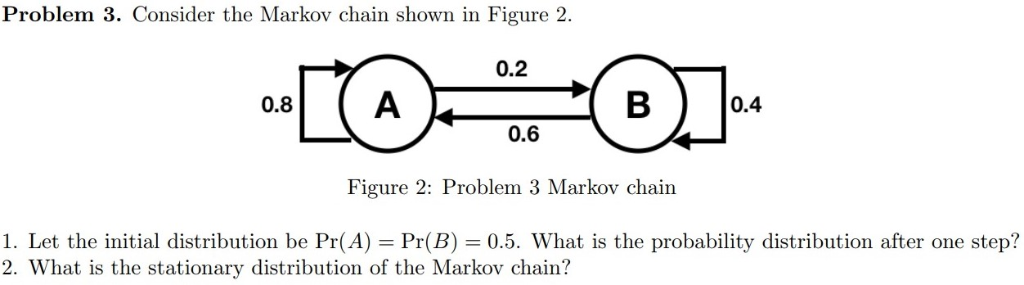
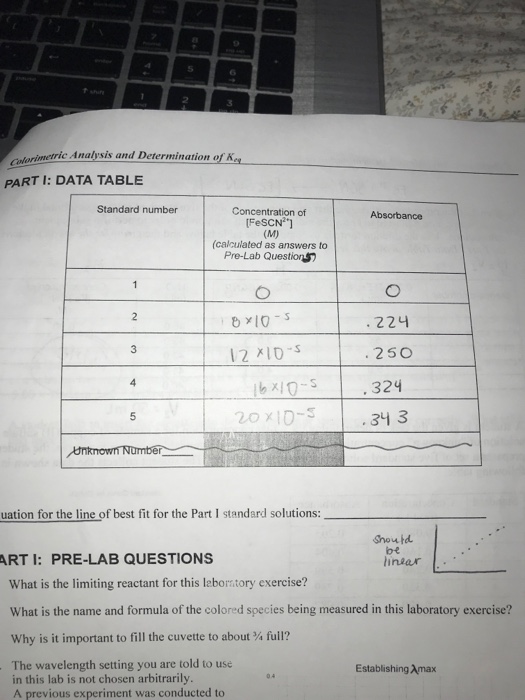
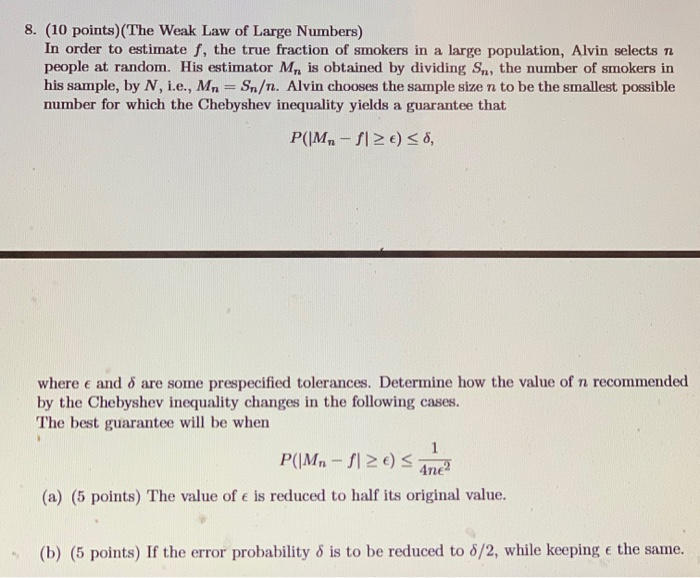
Problem 3. Consider the Markov chain shown in Figure 2. Figure 2: Problem 3 Markov chain 1. Let the initial distribution be Pr(A) : Pr(B) = 0.5. What is the probability distribution after one step? 2. What is the stationary distribution of the Markov chain? F chin Cofprimerric Analysis and Determination of Kay PART I: DATA TABLE Standard number Concentration of [FeSCN*] Absorbance (M) (calculated as answers to Pre-Lab Question O O B X 10 - 5 . 224 3 12 X 10-5 250 16 x10 -5 324 5 20 * 10-5 . 34 3 Unknown Number uation for the line of best fit for the Part I standard solutions: Should ART I: PRE-LAB QUESTIONS be linear What is the limiting reactant for this laboratory exercise? What is the name and formula of the colored species being measured in this laboratory exercise? Why is it important to fill the cuvette to about % full? The wavelength setting you are told to use Establishing Amax in this lab is not chosen arbitrarily. A previous experiment was conducted to8. (10 points) (The Weak Law of Large Numbers) In order to estimate f, the true fraction of smokers in a large population, Alvin selects n people at random. His estimator M,, is obtained by dividing S, the number of smokers in his sample, by N, i.e., Mn = Sn. Alvin chooses the sample size n to be the smallest possible number for which the Chebyshev inequality yields a guarantee that P(IMn - 51 2 () 56, where e and o are some prespecified tolerances. Determine how the value of n recommended by the Chebyshev inequality changes in the following cases. The best guarantee will be when P(IMn - f1 2 () - Ane? (a) (5 points) The value of e is reduced to half its original value. (b) (5 points) If the error probability o is to be reduced to 6/2, while keeping e the same
Step by Step Solution
There are 3 Steps involved in it

Get step-by-step solutions from verified subject matter experts
 Study Help