







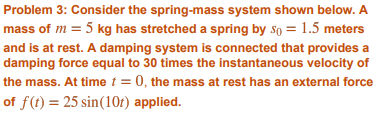
Question: Problem 3: Consider the spring-mass system shown below. A mass of m = 5 kg has stretched a spring by 5'1] = 1.5 meters and
![m = 5 kg has stretched a spring by 5'1] = 1.5](https://s3.amazonaws.com/si.experts.images/answers/2024/07/66882eda1a082_92266882eda022f1.jpg)

![mass. At time I = I]: the mass at rest has an](https://s3.amazonaws.com/si.experts.images/answers/2024/07/66882edae49ce_92266882edad4bba.jpg)


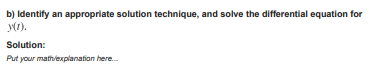
Problem 3: Consider the spring-mass system shown below. A mass of m = 5 kg has stretched a spring by 5'1] = 1.5 meters and Is at rest. A damping system is connected that provides a damping force equal to 3D times the instantaneous I.lelocity of the mass. At time I = I]: the mass at rest has an external force \"f fir} = 25 sinr) applied. \fa) Write a differential equation that models the mass location y(/)as a function of time. Solution: Put your math explanation here..bj Identify an appropriate solution technique, and solve the differential equation for Solution: Put your math/explanation here..\fd) What Is the steady-state solution of Wo)? Solution: Put your main/explanation here.e) Use the MATLAB dsolve() function to solve the differential equation and plot the solution on a new figure. The results provided by dsolve() and your solution from part (b) should match. Solution
Step by Step Solution
There are 3 Steps involved in it

Get step-by-step solutions from verified subject matter experts
 Study Help