





Question: Problem 3: Cost benefit analysis - 35 marks 1. Suppose that you are a public health policymaker (e.g., government official) and you are tasked with
Problem 3: Cost benefit analysis - 35 marks 1.
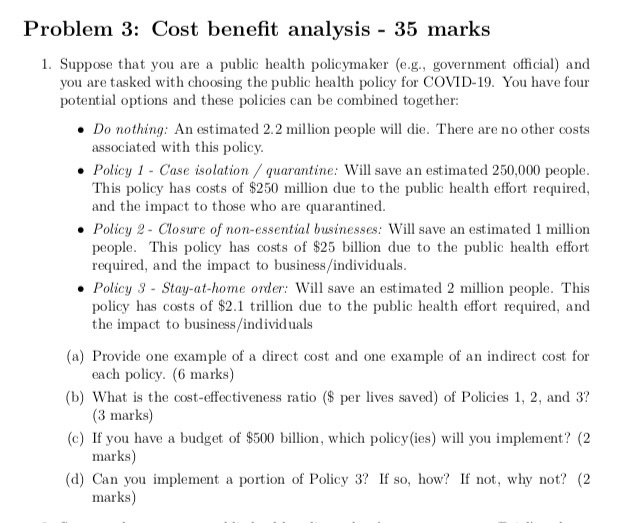
Problem 3: Cost benefit analysis - 35 marks 1. Suppose that you are a public health policymaker (e.g., government official) and you are tasked with choosing the public health policy for COVID-19. You have four potential options and these policies can be combined together: Do nothing: An estimated 2.2 million people will die. There are no other costs associated with this policy. Policy 1. Case isolation / quarantine: Will save an estimated 250,000 people, This policy has costs of $250 million due to the public health effort required, and the impact to those who are quarantined. Policy 2 - Closure of non-essential businesses: Will save an estimated 1 million people. This policy has costs of $25 billion due to the public health effort required, and the impact to business/individuals. Policy 3 - Stay-at-home order: Will save an estimated 2 million people. This policy has costs of $2.1 trillion due to the public health effort required, and the impact to business/individuals (a) Provide one example of a direct cost and one example of an indirect cost for each policy. (6 marks) (b) What is the cost-effectiveness ratio ($ per lives saved) of Policies 1, 2, and 3? (3 marks) (c) If you have a budget of $500 billion, which policy(ies) will you implement? (2 marks) (d) Can you implement a portion of Policy 3? If so, how? If not, why not? (2 marks)

Step by Step Solution

There are 3 Steps involved in it

1 Expert Approved Answer
Step: 1 Unlock blur-text-image

Question Has Been Solved by an Expert!

Get step-by-step solutions from verified subject matter experts

Step: 2 Unlock
Step: 3 Unlock

Students Have Also Explored These Related General Management Questions!