







Question: Problem 3 - Different particles pass through a spectrometer that uses a magnetic field of 5 T and an acceleration voltage of ( 2
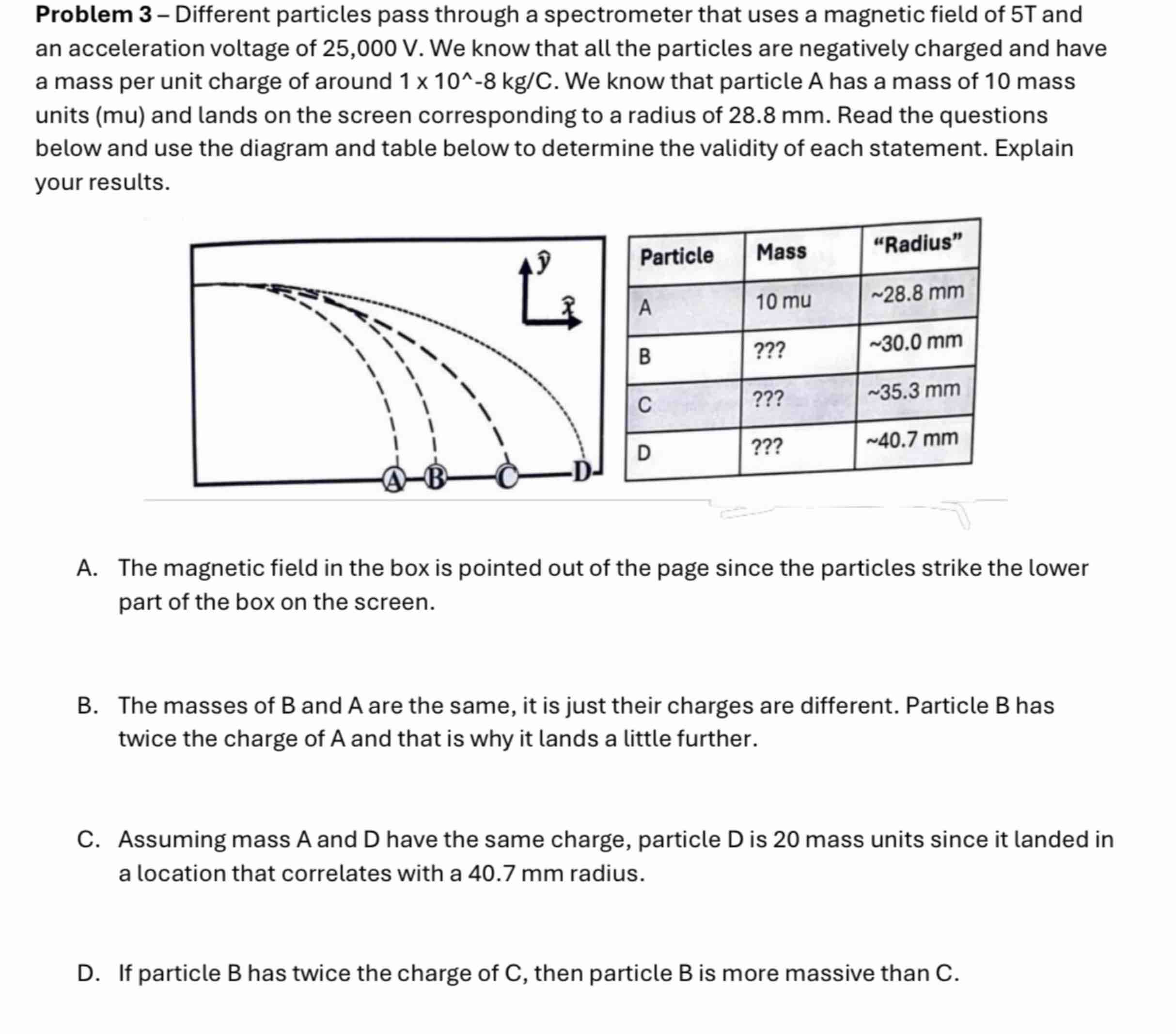
Problem Different particles pass through a spectrometer that uses a magnetic field of T and an acceleration voltage of mathrm~V We know that all the particles are negatively charged and have a mass per unit charge of around times wedgemathrm~kgmathrmC We know that particle A has a mass of mass units mu and lands on the screen corresponding to a radius of mm Read the questions below and use the diagram and table below to determine the validity of each statement. Explain your results.
A The magnetic field in the box is pointed out of the page since the particles strike the lower part of the box on the screen.
B The masses of B and A are the same, it is just their charges are different. Particle B has twice the charge of A and that is why it lands a little further.
C Assuming mass A and D have the same charge, particle D is mass units since it landed in a location that correlates with a mm radius.
D If particle B has twice the charge of C then particle B is more massive than C
Step by Step Solution
There are 3 Steps involved in it
1 Expert Approved Answer
Step: 1 Unlock

Question Has Been Solved by an Expert!
Get step-by-step solutions from verified subject matter experts
Step: 2 Unlock
Step: 3 Unlock
 Study Help