







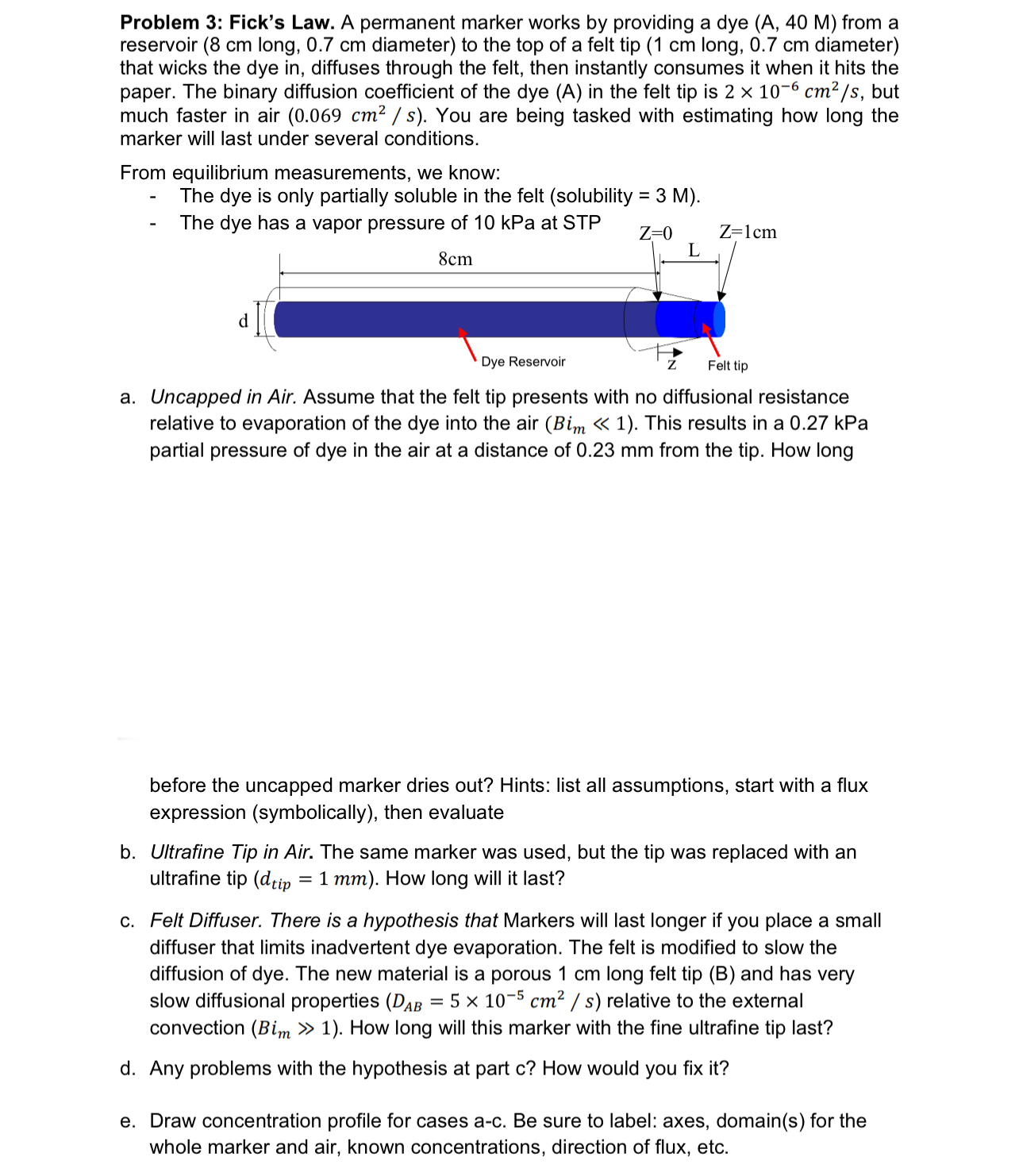
Question: Problem 3 : Fick's Law. A permanent marker works by providing a dye ( A , 4 0 M from a reservoir ( 8 c
Problem : Fick's Law. A permanent marker works by providing a dye A from a
reservoir long, diameter to the top of a felt tip long, diameter
that wicks the dye in diffuses through the felt, then instantly consumes it when it hits the
paper. The binary diffusion coefficient of the dye in the felt tip is but
much faster in air You are being tasked with estimating how long the
marker will last under several conditions.
From equilibrium measurements, we know:
The dye is only partially soluble in the felt solubility
The c
a Uncapped in Air. Assume that the felt tip presents with no diffusional resistance
relative to evaporation of the dye into the air This results in a kPa
partial pressure of dye in the air at a distance of from the tip. How long
before the uncapped marker dries out? Hints: list all assumptions, start with a flux
expression symbolically then evaluate
b Ultrafine Tip in Air. The same marker was used, but the tip was replaced with an
ultrafine tip How long will it last?
c Felt Diffuser. There is a hypothesis that Markers will last longer if you place a small
diffuser that limits inadvertent dye evaporation. The felt is modified to slow the
diffusion of dye. The new material is a porous long felt tip and has very
slow diffusional properties relative to the external
convection How long will this marker with the fine ultrafine tip last?
d Any problems with the hypothesis at part c How would you fix it
e Draw concentration profile for cases ac Be sure to label: axes, domains for the
whole marker and air, known concentrations, direction of flux, etc.
Step by Step Solution
There are 3 Steps involved in it
1 Expert Approved Answer
Step: 1 Unlock

Question Has Been Solved by an Expert!
Get step-by-step solutions from verified subject matter experts
Step: 2 Unlock
Step: 3 Unlock
 Study Help