







Question: Problem 3: Hopefully learning from Prof. Sty isn't like drinking from a... Firemen must exert significant forces to keep their fire hoses and nozzles under
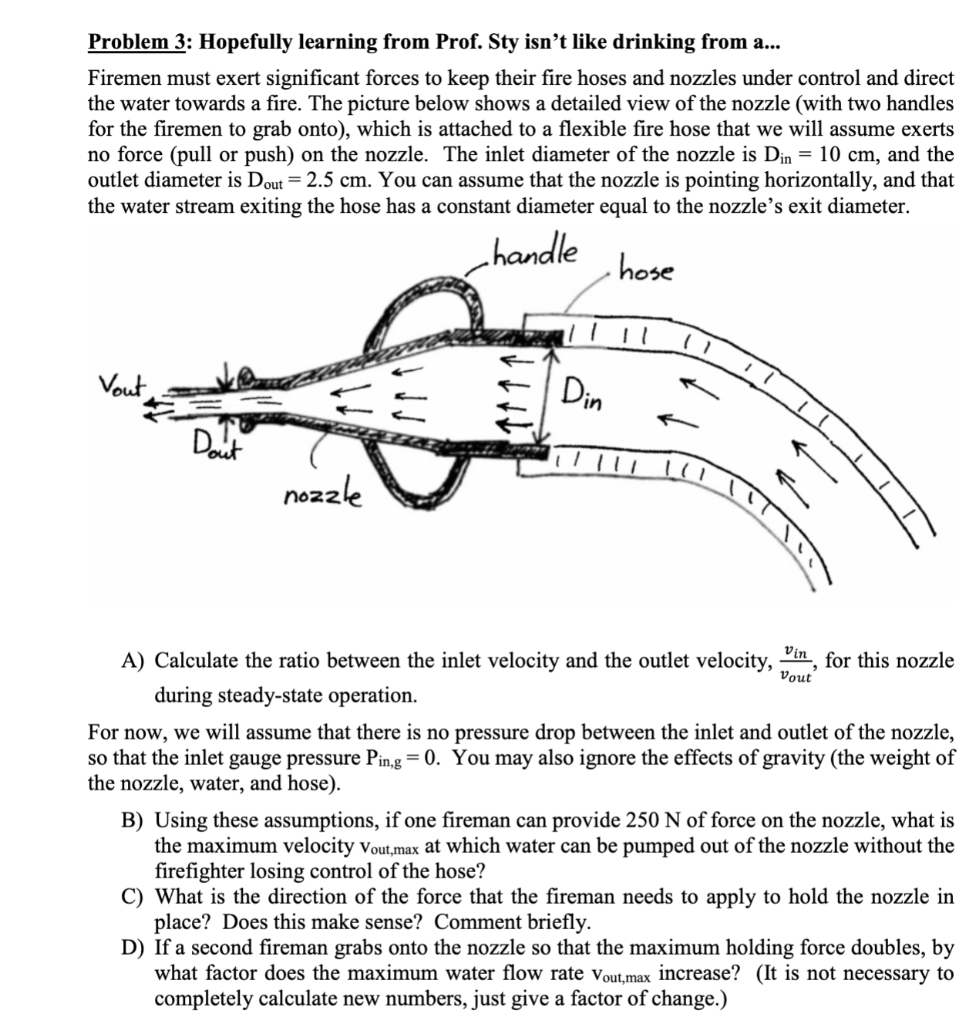
Problem 3: Hopefully learning from Prof. Sty isn't like drinking from a... Firemen must exert significant forces to keep their fire hoses and nozzles under control and direct the water towards a fire. The picture below shows a detailed view of the nozzle (with two handles for the firemen to grab onto), which is attached to a flexible fire hose that we will assume exerts no force (pull or push) on the nozzle. The inlet diameter of the nozzle is Din = 10 cm, and the outlet diameter is Dout = 2.5 cm. You can assume that the nozzle is pointing horizontally, and that the water stream exiting the hose has a constant diameter equal to the nozzles exit diameter. _handle hose T! 17 Vout Din Dout nozzle A) Calculate the ratio between the inlet velocity and the outlet velocity, Vin for this nozzle Vout during steady-state operation. For now, we will assume that there is no pressure drop between the inlet and outlet of the nozzle, so that the inlet gauge pressure Ping = 0. You may also ignore the effects of gravity (the weight of the nozzle, water, and hose). B) Using these assumptions, if one fireman can provide 250 N of force on the nozzle, what is the maximum velocity Vout,max at which water can be pumped out of the nozzle without the firefighter losing control of the hose? C) What is the direction of the force that the fireman needs to apply to hold the nozzle in place? Does this make sense ? Comment briefly. D) If a second fireman grabs onto the nozzle so that the maximum holding force doubles, by what factor does the maximum water flow rate Vout,max increase? (It is not necessary to completely calculate new numbers, just give a factor of change.)
Step by Step Solution
There are 3 Steps involved in it

Get step-by-step solutions from verified subject matter experts
 Study Help