



Question: Problem 3: In lab you're conducting an experiment to determine the coefficient of static friction between two materials when the materials are dry and when
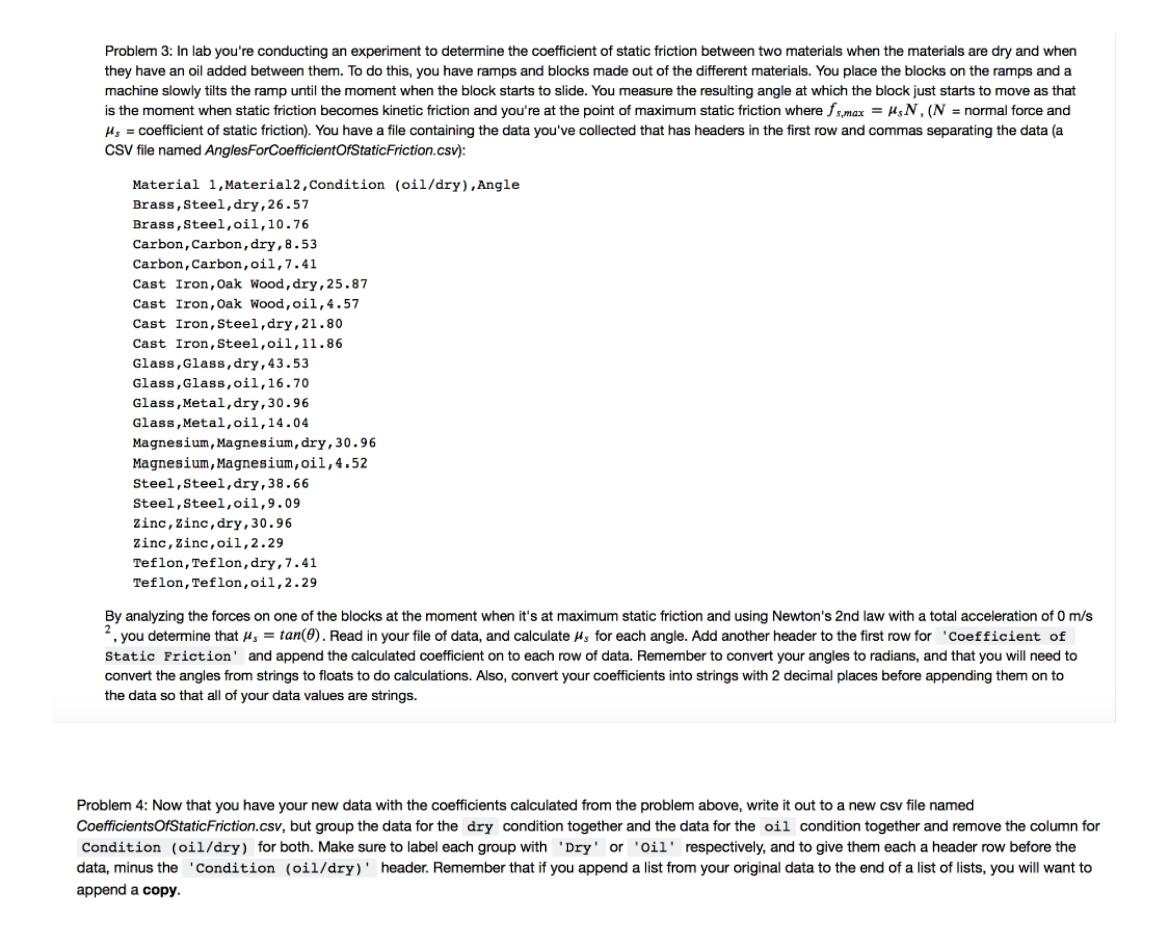 Problem 3: In lab you're conducting an experiment to determine the coefficient of static friction between two materials when the materials are dry and when they have an oil added between them. To do this, you have ramps and blocks made out of the different materials. You place the blocks on the ramps and a machine slowly tilts the ramp until the moment when the block starts to slide. You measure the resulting angle at which the block just starts to move as that is the moment when static friction becomes kinetic friction and you're at the point of maximum static friction where , ( = normal force and = coefficient of static friction). You have a file containing the data you've collected that has headers in the first row and commas separating the data (a CSV file named AnglesForCoefficientOfStaticFriction.csv):
Material 1,Material2,Condition (oil/dry),Angle
Brass,Steel,dry,26.57
Brass,Steel,oil,10.76
Carbon,Carbon,dry,8.53
Carbon,Carbon,oil,7.41
Cast Iron,Oak Wood,dry,25.87
Cast Iron,Oak Wood,oil,4.57
Cast Iron,Steel,dry,21.80
Cast Iron,Steel,oil,11.86
Glass,Glass,dry,43.53
Glass,Glass,oil,16.70
Glass,Metal,dry,30.96
Glass,Metal,oil,14.04
Magnesium,Magnesium,dry,30.96
Magnesium,Magnesium,oil,4.52
Steel,Steel,dry,38.66
Steel,Steel,oil,9.09
Zinc,Zinc,dry,30.96
Zinc,Zinc,oil,2.29
Teflon,Teflon,dry,7.41
Teflon,Teflon,oil,2.29
By analyzing the forces on one of the blocks at the moment when it's at maximum static friction and using Newton's 2nd law with a total acceleration of 0 m/s , you determine that . Read in your file of data, and calculate for each angle. Add another header to the first row for 'Coefficient of Static Friction' and append the calculated coefficient on to each row of data. Remember to convert your angles to radians, and that you will need to convert the angles from strings to floats to do calculations. Also, convert your coefficients into strings with 2 decimal places before appending them on to the data so that all of your data values are strings. , = 2 = ()
Problem 4: Now that you have your new data with the coefficients calculated from the problem above, write it out to a new csv file named CoefficientsOfStaticFriction.csv, but group the data for the dry condition together and the data for the oil condition together and remove the column for Condition (oil/dry) for both. Make sure to label each group with 'Dry' or 'Oil' respectively, and to give them each a header row before the data, minus the 'Condition (oil/dry)' header. Remember that if you append a list from your original data to the end of a list of lists, you will want to append a copy.
PLEASE USE PYTHON AND SPYDER THANK YOU
Problem 3: In lab you're conducting an experiment to determine the coefficient of static friction between two materials when the materials are dry and when they have an oil added between them. To do this, you have ramps and blocks made out of the different materials. You place the blocks on the ramps and a machine slowly tilts the ramp until the moment when the block starts to slide. You measure the resulting angle at which the block just starts to move as that is the moment when static friction becomes kinetic friction and you're at the point of maximum static friction where s max = HEN, (N = normal force and Mg = coefficient of static friction). You have a file containing the data you've collected that has headers in the first row and commas separating the data (a CSV file named AnglesForCoefficientOfStaticFriction.csv): Material 1, Material2, Condition (oil/dry), Angle Brass, Steel, dry,26.57 Brass, Steel, oil, 10.76 Carbon, Carbon, dry, 8.53 Carbon, Carbon,oil, 7.41 Cast Iron, Oak Wood, dry, 25.87 Cast Iron, Oak Wood, oil, 4.57 Cast Iron, Steel, dry, 21.80 Cast Iron, Steel,oil, 11.86 Glass, Glass, dry, 43.53 Glass, Glass, oil, 16.70 Glass, Metal, dry, 30.96 Glass, Metal,oil,14.04 Magnesium, Magnesium, dry, 30.96 Magnesium, Magnesium, oil, 4.52 Steel,Steel, dry,38.66 Steel, Steel, oil, 9.09 Zinc, Zinc, dry, 30.96 Zinc, Zinc, oil, 2.29 Teflon, Teflon, dry, 7.41 Teflon, Teflon,oil, 2.29 By analyzing the forces on one of the blocks at the moment when it's at maximum static friction and using Newton's 2nd law with a total acceleration of O m/s 2. you determine that is = tan(O). Read in your file of data, and calculate , for each angle. Add another header to the first row for 'Coefficient of Static Friction and append the calculated coefficient on to each row of data. Remember to convert your angles to radians, and that you will need to convert the angles from strings to floats to do calculations. Also, convert your coefficients into strings with 2 decimal places before appending them on to the data so that all of your data values are strings. Problem 4: Now that you have your new data with the coefficients calculated from the problem above, write it out to a new csv file named CoefficientsOfStaticFriction.csv, but group the data for the dry condition together and the data for the oil condition together and remove the column for Condition (oil/dry) for both. Make sure to label each group with 'Dry' or 'Oil' respectively, and to give them each a header row before the data, minus the 'Condition (oil/dry)' header. Remember that if you append a list from your original data to the end of a list of lists, you will want to append a copy Problem 3: In lab you're conducting an experiment to determine the coefficient of static friction between two materials when the materials are dry and when they have an oil added between them. To do this, you have ramps and blocks made out of the different materials. You place the blocks on the ramps and a machine slowly tilts the ramp until the moment when the block starts to slide. You measure the resulting angle at which the block just starts to move as that is the moment when static friction becomes kinetic friction and you're at the point of maximum static friction where s max = HEN, (N = normal force and Mg = coefficient of static friction). You have a file containing the data you've collected that has headers in the first row and commas separating the data (a CSV file named AnglesForCoefficientOfStaticFriction.csv): Material 1, Material2, Condition (oil/dry), Angle Brass, Steel, dry,26.57 Brass, Steel, oil, 10.76 Carbon, Carbon, dry, 8.53 Carbon, Carbon,oil, 7.41 Cast Iron, Oak Wood, dry, 25.87 Cast Iron, Oak Wood, oil, 4.57 Cast Iron, Steel, dry, 21.80 Cast Iron, Steel,oil, 11.86 Glass, Glass, dry, 43.53 Glass, Glass, oil, 16.70 Glass, Metal, dry, 30.96 Glass, Metal,oil,14.04 Magnesium, Magnesium, dry, 30.96 Magnesium, Magnesium, oil, 4.52 Steel,Steel, dry,38.66 Steel, Steel, oil, 9.09 Zinc, Zinc, dry, 30.96 Zinc, Zinc, oil, 2.29 Teflon, Teflon, dry, 7.41 Teflon, Teflon,oil, 2.29 By analyzing the forces on one of the blocks at the moment when it's at maximum static friction and using Newton's 2nd law with a total acceleration of O m/s 2. you determine that is = tan(O). Read in your file of data, and calculate , for each angle. Add another header to the first row for 'Coefficient of Static Friction and append the calculated coefficient on to each row of data. Remember to convert your angles to radians, and that you will need to convert the angles from strings to floats to do calculations. Also, convert your coefficients into strings with 2 decimal places before appending them on to the data so that all of your data values are strings. Problem 4: Now that you have your new data with the coefficients calculated from the problem above, write it out to a new csv file named CoefficientsOfStaticFriction.csv, but group the data for the dry condition together and the data for the oil condition together and remove the column for Condition (oil/dry) for both. Make sure to label each group with 'Dry' or 'Oil' respectively, and to give them each a header row before the data, minus the 'Condition (oil/dry)' header. Remember that if you append a list from your original data to the end of a list of lists, you will want to append a copy
Step by Step Solution
There are 3 Steps involved in it

Get step-by-step solutions from verified subject matter experts