







Question: Problem 3: Macro Effects of a Lockdown [25 marks] In this pmblem you will analyse the macro effects of a lockdown through the lens of
![Problem 3: Macro Effects of a Lockdown [25 marks] In this](https://dsd5zvtm8ll6.cloudfront.net/si.experts.images/questions/2024/09/66f8375027445_12066f8375001c44.jpg)
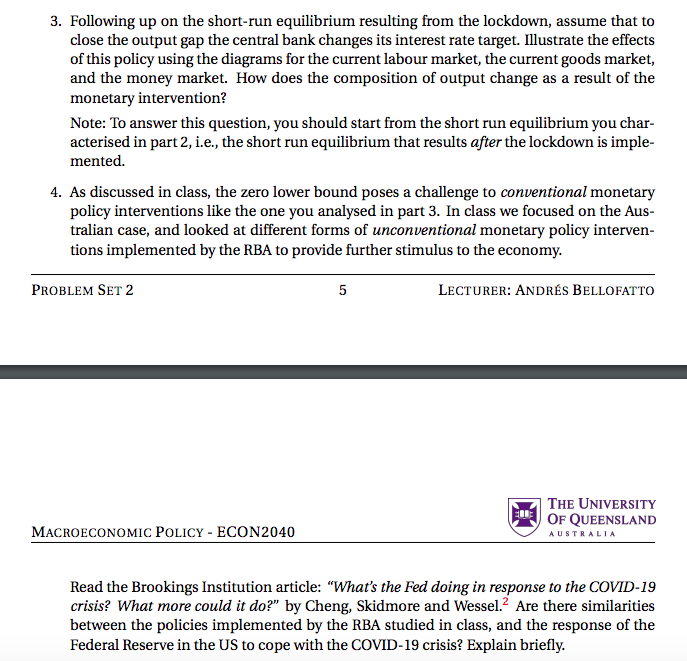
Problem 3: Macro Effects of a Lockdown [25 marks] In this pmblem you will analyse the macro effects of a lockdown through the lens of the REC model studied in class. Suppose that to contain a pandemic crisis. the government shuts down a number of sectors in the economy The sectors affected by the shutdown are those that require close contact with customers. like restaurants, sports and recreation. and hospitality. This policy has two key implications. First. it reduces the supply of labour by the households. as workers within accted sectors cannot work as much as much as they would desire. Second. the lockdown reduces aggregate demand. This is mainly because households in affected sec- tors experience a reduction in labour income. so they consume less. Assume throughout this pmblem that the corresponding drop in aggregate demand is larger than arty potential drop in aseesate supply 1. Consider the closed economy REC model with money studied in class. Assuming that prices are exible. analyse the effect of the lockdown on the equilibrium values of em- ployment. output. the real wage. the real interest rate. and the aggregate price level. Use the equilibrium diagrams for the current labour market. the current goods market. and the money market to answer this question. 2. Now assume that the price level isred. and that the central bank follows an interest rate target. Analyse the short run equilibrium after the lockdown assuming that the central bank does not change its interest rate target. Use the diagrams for the current labour market. the current goods market. and the money market to answer this question. Show that the lockdown results in a negative output gap. 3. Following up on the short-run equilibrium resulting from the lockdown, assume that to close the output gap the central bank changes its interest rate target. Illustrate the effects of this policy using the diagrams for the current labour market, the current goods market, and the money market. How does the composition of output change as a result of the monetary intervention? Note: To answer this question, you should start from the short run equilibrium you char- acterised in part 2, i.e., the short run equilibrium that results after the lockdown is imple- mented. 4. As discussed in class, the zero lower bound poses a challenge to conventional monetary policy interventions like the one you analysed in part 3. In class we focused on the Aus- tralian case, and looked at different forms of unconventional monetary policy interven- tions implemented by the RBA to provide further stimulus to the economy PROBLEM SET 2 5 LECTURER: ANDRES BELLOFATTO THE UNIVERSITY MACROECONOMIC POLICY - ECON2040 OF QUEENSLAND AUSTRALIA Read the Brookings Institution article: "What's the Fed doing in response to the COVID-19 crisis? What more could it do?" by Cheng, Skidmore and Wessel. Are there similarities between the policies implemented by the RBA studied in class, and the response of the Federal Reserve in the US to cope with the COVID-19 crisis? Explain briefly
Step by Step Solution
There are 3 Steps involved in it

Get step-by-step solutions from verified subject matter experts
 Study Help