







Question: Problem 3. Means and Correlations. a. Here we consider mobile phone usage by Alice. Let us model her phone usage as follows: First we
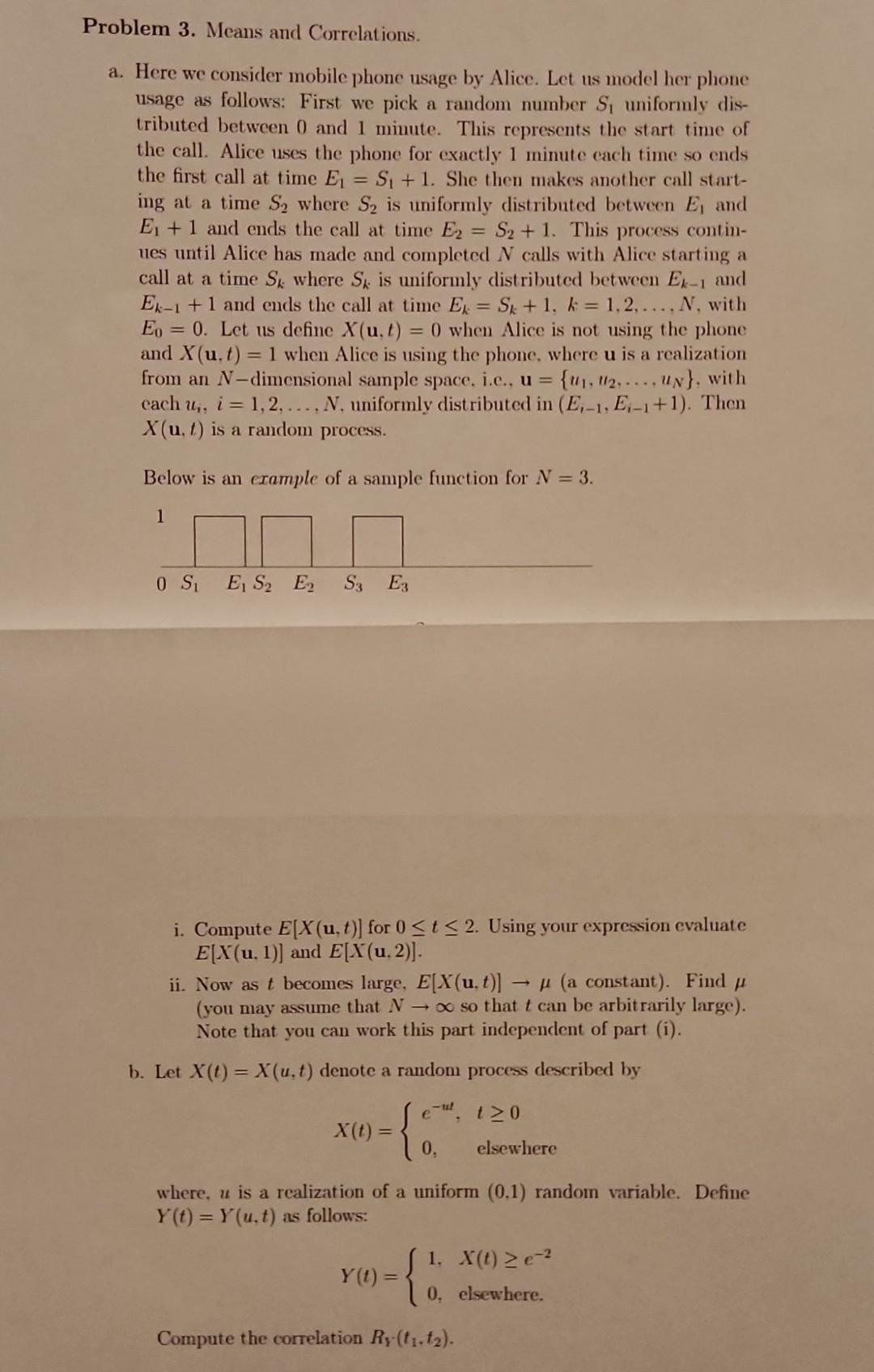
Problem 3. Means and Correlations. a. Here we consider mobile phone usage by Alice. Let us model her phone usage as follows: First we pick a random number S uniformly dis- tributed between 0 and 1 minute. This represents the start time of the call. Alice uses the phone for exactly 1 minute each time so ends the first call at time E = S +1. She then makes another call start- ing at a time S where S2 is uniformly distributed between E, and E+1 and ends the call at time E2 S+1. This process contin- ues until Alice has made and completed N calls with Alice starting a call at a time S where S is uniformly distributed between Ek-1 and Ek-1+1 and ends the call at time Ek Sk + 1, k = 1, 2,..., N, with Eo = 0. Let us define X(u,t) = 0 when Alice is not using the phone and X(u,t) = 1 when Alice is using the phone, where u is a realization from an N-dimensional sample space, i.e., u = {1, 2, UN}, with cach u,, i = 1, 2,..., N. uniformly distributed in (E,-1, E-1+1). Then X(u, t) is a random process. Below is an example of a sample function for N = 3. 1 0 S E S2 E2 S3 E3 i. Compute E[X(u, t)] for 0t 2. Using your expression evaluate ELX (u. 1)] and E[X(u. 2)]. ii. Now as t becomes large, E[X(u. t)] (a constant). Find (you may assume that N so that t can be arbitrarily large). Note that you can work this part independent of part (i). b. Let X(t) = X(u,t) denote a random process described by e- 0. t0 elsewhere x(t) = { where, u is a realization of a uniform (0.1) random variable. Define Y(t) =Y(u,t) as follows: Y(t) = ={0 1. X(t) e 0, elsewhere. Compute the correlation Ry (11.12).
Step by Step Solution
There are 3 Steps involved in it

Get step-by-step solutions from verified subject matter experts
 Study Help