







Question: Problem 3. Read section 15.2 in the book and answer the following questions: 1. What-is the matrix chain multiplication problem? Describe it in your own
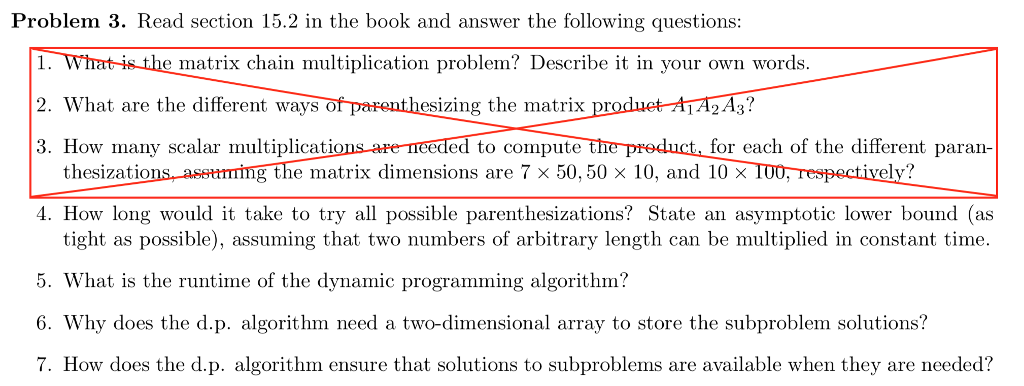
Problem 3. Read section 15.2 in the book and answer the following questions: 1. What-is the matrix chain multiplication problem? Describe it in your own words. 2. What are the different ways o 3. How many scalar multiplicationsareneeed to compute the product, for each of the different paran esizing the matrix produet-ATagAsi thesiza ions-Wettmmg the matrix dimensions are 7 50.50 10, and 10T00 respectively 4. How long would it take to try all possible parenthesizations? State an asymptotic lower bound (as tight as possible), assuming that two numbers of arbitrary length can be multiplied in constant time. 5. What is the runtime of the dynamic programming algorithm? 6. Why does the d.p. algorithm need a two-dimensional array to store the subproblem solutions? 7. How does the d.p. algorithm ensure that solutions to subproblems are available when they are needed? Problem 3. Read section 15.2 in the book and answer the following questions: 1. What-is the matrix chain multiplication problem? Describe it in your own words. 2. What are the different ways o 3. How many scalar multiplicationsareneeed to compute the product, for each of the different paran esizing the matrix produet-ATagAsi thesiza ions-Wettmmg the matrix dimensions are 7 50.50 10, and 10T00 respectively 4. How long would it take to try all possible parenthesizations? State an asymptotic lower bound (as tight as possible), assuming that two numbers of arbitrary length can be multiplied in constant time. 5. What is the runtime of the dynamic programming algorithm? 6. Why does the d.p. algorithm need a two-dimensional array to store the subproblem solutions? 7. How does the d.p. algorithm ensure that solutions to subproblems are available when they are needed
Step by Step Solution
There are 3 Steps involved in it

Get step-by-step solutions from verified subject matter experts
 Study Help