







Question: Problem 3. Sampling and estimation of sums. We have a box with k balls; k of them are white and & - k are red.
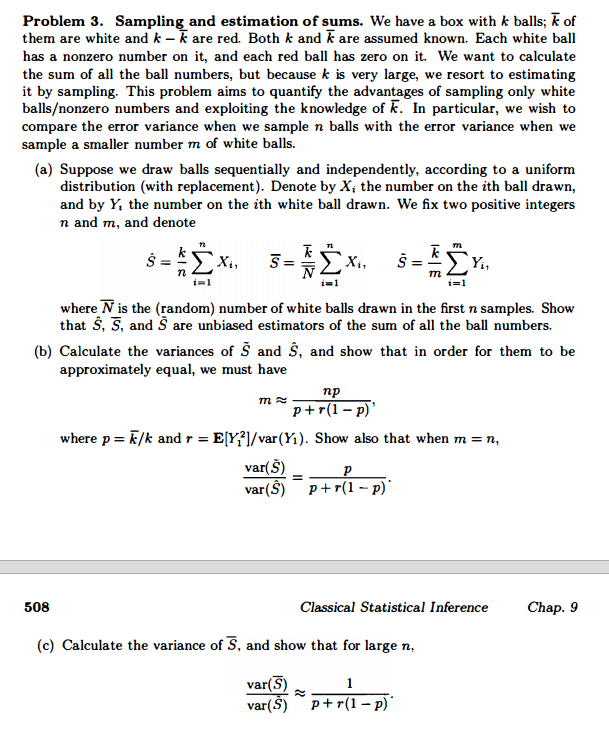
Problem 3. Sampling and estimation of sums. We have a box with k balls; k of them are white and & - k are red. Both k and k are assumed known. Each white ball has a nonzero number on it, and each red ball has zero on it. We want to calculate the sum of all the ball numbers, but because & is very large, we resort to estimating it by sampling. This problem aims to quantify the advantages of sampling only white ballsonzero numbers and exploiting the knowledge of k. In particular, we wish to compare the error variance when we sample n balls with the error variance when we sample a smaller number m of white balls. (a) Suppose we draw balls sequentially and independently, according to a uniform distribution (with replacement). Denote by X, the number on the ith ball drawn, and by Y, the number on the ith white ball drawn. We fix two positive integers n and m, and denote S = KS n Xi, S = Xi, S i=l m Yi where N is the (random) number of white balls drawn in the first n samples. Show that S, S, and S are unbiased estimators of the sum of all the ball numbers. (b) Calculate the variances of S and S, and show that in order for them to be approximately equal, we must have np p+ r(1 - p) where p = k/k and r = E[Y?]/var(Yi). Show also that when m = n, var(S) P var (S) ptr(1 - p) 508 Classical Statistical Inference Chap. 9 (c) Calculate the variance of S, and show that for large n, var(S) var(S) ptr(1 - p)
Step by Step Solution
There are 3 Steps involved in it

Get step-by-step solutions from verified subject matter experts
 Study Help