







Question: Problem 3: Solow Model with No Technological Change [40 pts] Assume that we live in an imaginary world where there are two countries: Cocoloco and
![Problem 3: Solow Model with No Technological Change [40 pts] Assume](https://dsd5zvtm8ll6.cloudfront.net/si.experts.images/questions/2024/09/66f6be7a8a19a_65066f6be7a5fccb.jpg)
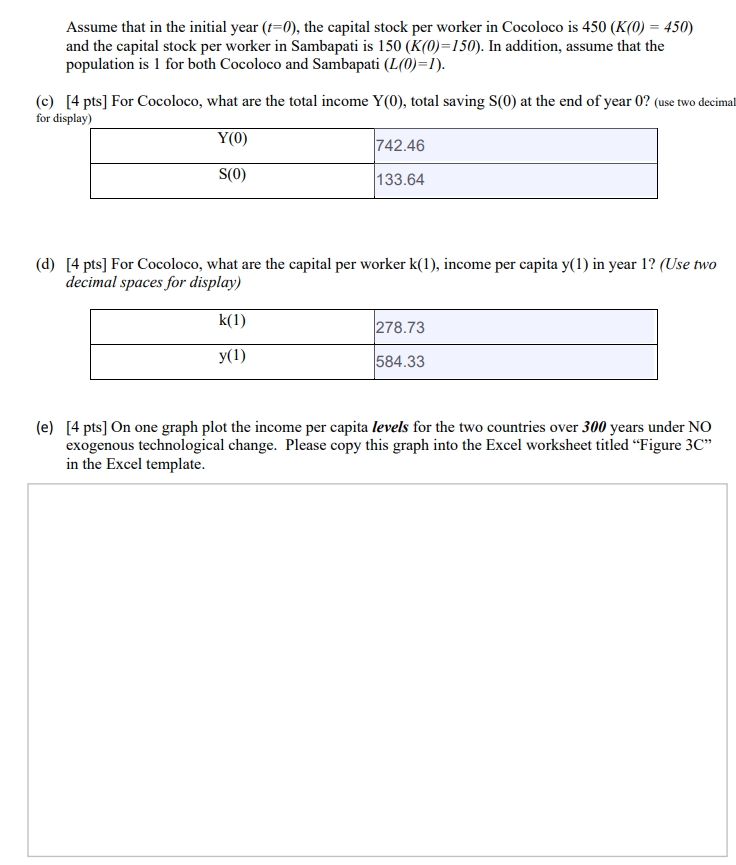
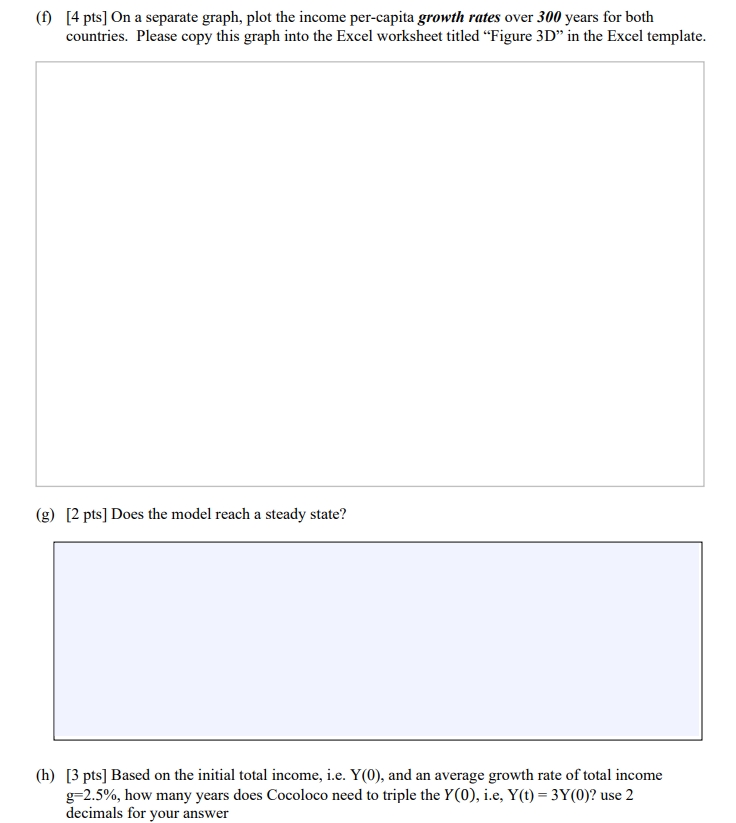
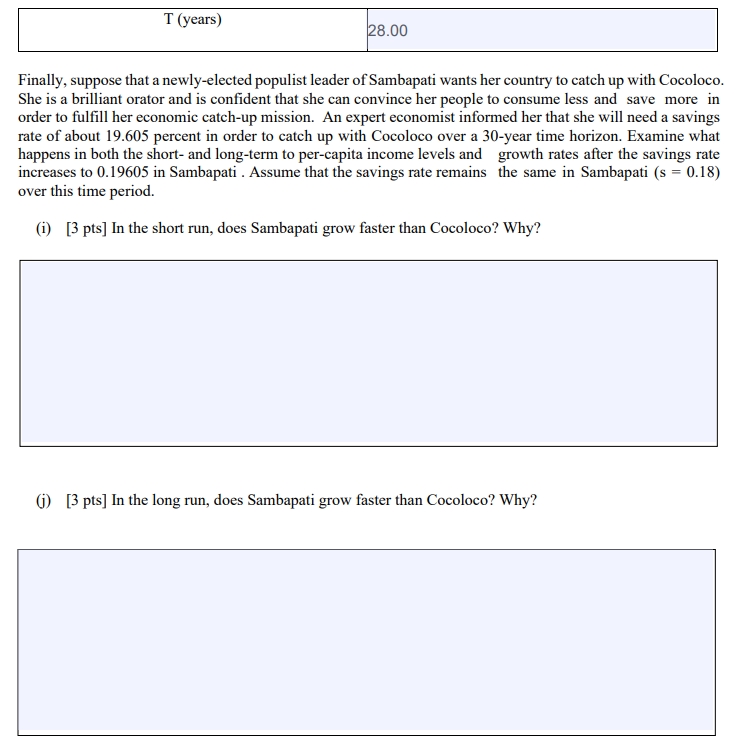
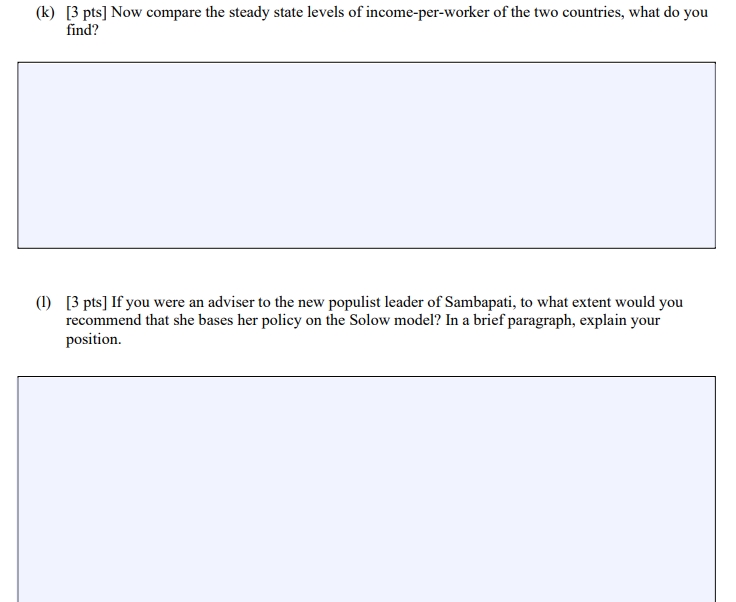
Problem 3: Solow Model with No Technological Change [40 pts] Assume that we live in an imaginary world where there are two countries: Cocoloco and Sambapati. These two countries have the same population size, population growth, depreciation rate and production function. But Cocoloco has a larger capital stock than Sambapati. Output in both countries is produced according to the following constant-returns-to-scale production function that lies at the heart of the standard Solow growth model: Y(t) = 35[K(t) ]0.5 [L(t) ]0.5 where Y(t) is the aggregate output in year t, K(t) is the capital in year t, and L(t) is the labor in year t. Assume that the savings rate is 18% (s = 0.18), the population grows at a rate of 0.9 % per year (n = 0.009), and capital depreciates at a rate of 1.6% per year (d = 0.016). (a) [3 pts] Express the production function in per capita terms (i.e., derive an expression for y as a function of k, where y indicates output-to-labor ratio, and k is the capital-to-labor ratio). Just type the final expression. (non-math format is enough, for example a=(b*1/3)*c^(2/3)) y = 35k^0.5 (b) [4 pts ]What are the steady state levels of capital per worker (kSS) and income per worker(y$$)? (use two decimals for display) Iss 63,504.00 ySS 8,820.00Assume that in the initial year (=0), the capital stock per worker in Cocoloco is 450 (K(0) = 450) and the capital stock per worker in Sambapati is 150 (K(0)=150). In addition, assume that the population is 1 for both Cocoloco and Sambapati (L(0)=1). for display) (c) [4 pts] For Cocoloco, what are the total income Y(0), total saving S(0) at the end of year 0? (use two decima Y(0) 742.46 S(0) 133.64 (d) [4 pts] For Cocoloco, what are the capital per worker k(1), income per capita y(1) in year 1? (Use two decimal spaces for display k(1) 278.73 y(1) 584.33 (e) [4 pts] On one graph plot the income per capita levels for the two countries over 300 years under NO exogenous technological change. Please copy this graph into the Excel worksheet titled "Figure 3C" in the Excel template.(f) [4 pts] On a separate graph, plot the income per-capita growth rates over 300 years for both countries. Please copy this graph into the Excel worksheet titled "Figure 3D" in the Excel template. (g) [2 pts] Does the model reach a steady state? (h) [3 pts] Based on the initial total income, i.e. Y(0), and an average growth rate of total income g 2.5%, how many years does Cocoloco need to triple the Y(0), i.e, Y(t) = 3Y(0)? use 2 decimals for your answerT (years) 28.00 Finally, suppose that a newly-elected populist leader of Sambapati wants her country to catch up with Cocoloco. She is a brilliant orator and is confident that she can convince her people to consume less and save more in order to fulfill her economic catch-up mission. An expert economist informed her that she will need a savings rate of about 19.605 percent in order to catch up with Cocoloco over a 30-year time horizon. Examine what happens in both the short- and long-term to per-capita income levels and growth rates after the savings rate increases to 0.19605 in Sambapati . Assume that the savings rate remains the same in Sambapati (s = 0.18) over this time period. (i) [3 pts] In the short run, does Sambapati grow faster than Cocoloco? Why? (i) [3 pts] In the long run, does Sambapati grow faster than Cocoloco? Why?(k) [3 pts] Now compare the steady state levels of income-per-worker of the two countries, what do you find? (1) [3 pts] If you were an adviser to the new populist leader of Sambapati, to what extent would you recommend that she bases her policy on the Solow model? In a brief paragraph, explain your position
Step by Step Solution
There are 3 Steps involved in it

Get step-by-step solutions from verified subject matter experts
 Study Help