







Question: Problem 3 Suppose this world has only two countries that can make steel. Country A's steel makers have a marginal cost of $80 per ton.
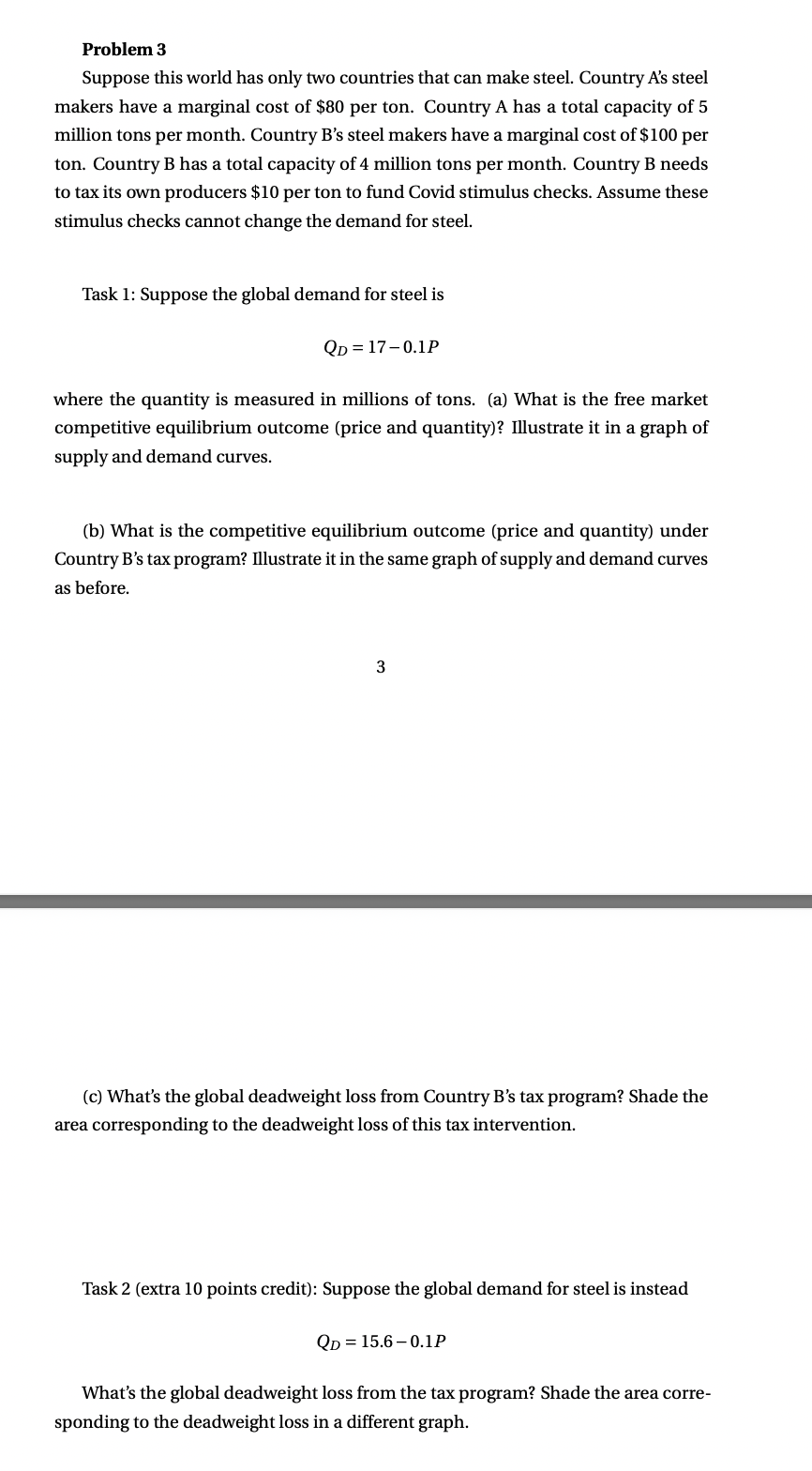
Problem 3 Suppose this world has only two countries that can make steel. Country A's steel makers have a marginal cost of $80 per ton. Country A has a total capacity of 5 million tons per month. Country B's steel makers have a marginal cost of $100 per ton. Country B has a total capacity of 4 million tons per month. Country B needs to tax its own producers $10 per ton to fund Covid stimulus checks. Assume these stimulus checks cannot change the demand for steel. Task 1: Suppose the global demand for steel is QD = 17-0.1P where the quantity is measured in millions of tons. (a) What is the free market competitive equilibrium outcome (price and quantity)? Illustrate it in a graph of supply and demand curves. (b) What is the competitive equilibrium outcome (price and quantity) under Country B's tax program? Illustrate it in the same graph of supply and demand curves as before. 3 (c) What's the global deadweight loss from Country B's tax program? Shade the area corresponding to the deadweight loss of this tax intervention. Task 2 (extra 10 points credit): Suppose the global demand for steel is instead QD = 15.6 -0.1P What's the global deadweight loss from the tax program? Shade the area corre- sponding to the deadweight loss in a different graph. Problem 3 Suppose this world has only two countries that can make steel. Country A's steel makers have a marginal cost of $80 per ton. Country A has a total capacity of 5 million tons per month. Country B's steel makers have a marginal cost of $100 per ton. Country B has a total capacity of 4 million tons per month. Country B needs to tax its own producers $10 per ton to fund Covid stimulus checks. Assume these stimulus checks cannot change the demand for steel. Task 1: Suppose the global demand for steel is QD = 17-0.1P where the quantity is measured in millions of tons. (a) What is the free market competitive equilibrium outcome (price and quantity)? Illustrate it in a graph of supply and demand curves. (b) What is the competitive equilibrium outcome (price and quantity) under Country B's tax program? Illustrate it in the same graph of supply and demand curves as before. 3 (c) What's the global deadweight loss from Country B's tax program? Shade the area corresponding to the deadweight loss of this tax intervention. Task 2 (extra 10 points credit): Suppose the global demand for steel is instead QD = 15.6 -0.1P What's the global deadweight loss from the tax program? Shade the area corre- sponding to the deadweight loss in a different graph
Step by Step Solution
There are 3 Steps involved in it

Get step-by-step solutions from verified subject matter experts
 Study Help