







Question: Problem 3: Temperature can be converted from Celsius (C) and Fahrenheit (F) to Kelvin (K) by using the following relation: T(K) = T(C) +273.15. T(K)5/9
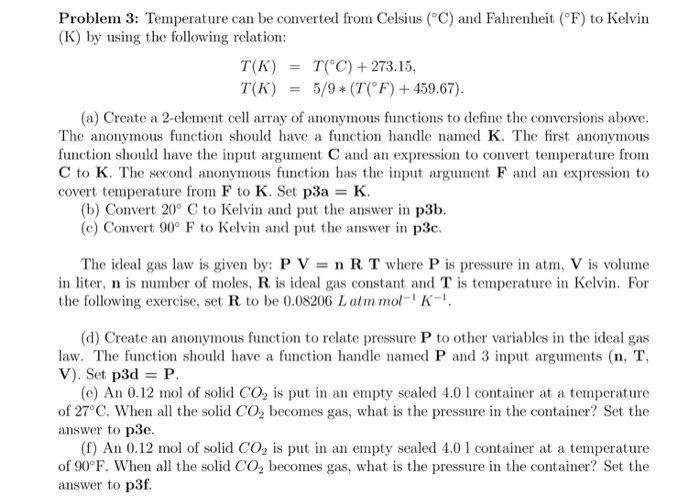
Problem 3: Temperature can be converted from Celsius (C) and Fahrenheit (F) to Kelvin (K) by using the following relation: T(K) = T(C) +273.15. T(K)5/9 * (T( F459.67) (a) Create a 2-element cell array of anonymous functions to define the conversions above The anonymous function should have a function handle named K. The first anonymous function should have the input argument C and an expressio to covert temperature from C to K. The second anonymous function has the input argument F and an expression to covert temperature from F to K. Set p3a- K b) Convert 20 C to Kelvin and put the answer in p3b (c) Convert 90 F to Kelvin and put the answer in p3c The ideal gas law is given by: PV-nR T where P is pressure in atm, V is volume in liter, n is number of moles, R is ideal gas constant and T is temperature in Kelvin. For the following exercise, set R to be 0.08206 Latrnnol-1 K-1. (d) Create an anonymous function to relate pressure P to other variables in the ideal gas law. The function should have a function handle named P and 3 input arguments (n, T, V). Set p3d P (e) An 0.12 mol of solid CO2 is put in an empty sealed 4.0 1 container at a temperature of 27C. When all the solid CO2 becomes gas, what is the pressure in the container? Set the answer to p3e (f) An 0.12 mol of solid CO2 is put in an empty sealed 4.0 1 container at a temperature of 90F. When all the solid CO2 becomes gas, what is the pressure in the container? Set the answer to p3f
Step by Step Solution
There are 3 Steps involved in it

Get step-by-step solutions from verified subject matter experts
 Study Help