







Question: Problem 3: This problem is not making a political/environmental statement. This is me (Professor Teixeira) trying to stop relying on news sources to tell me
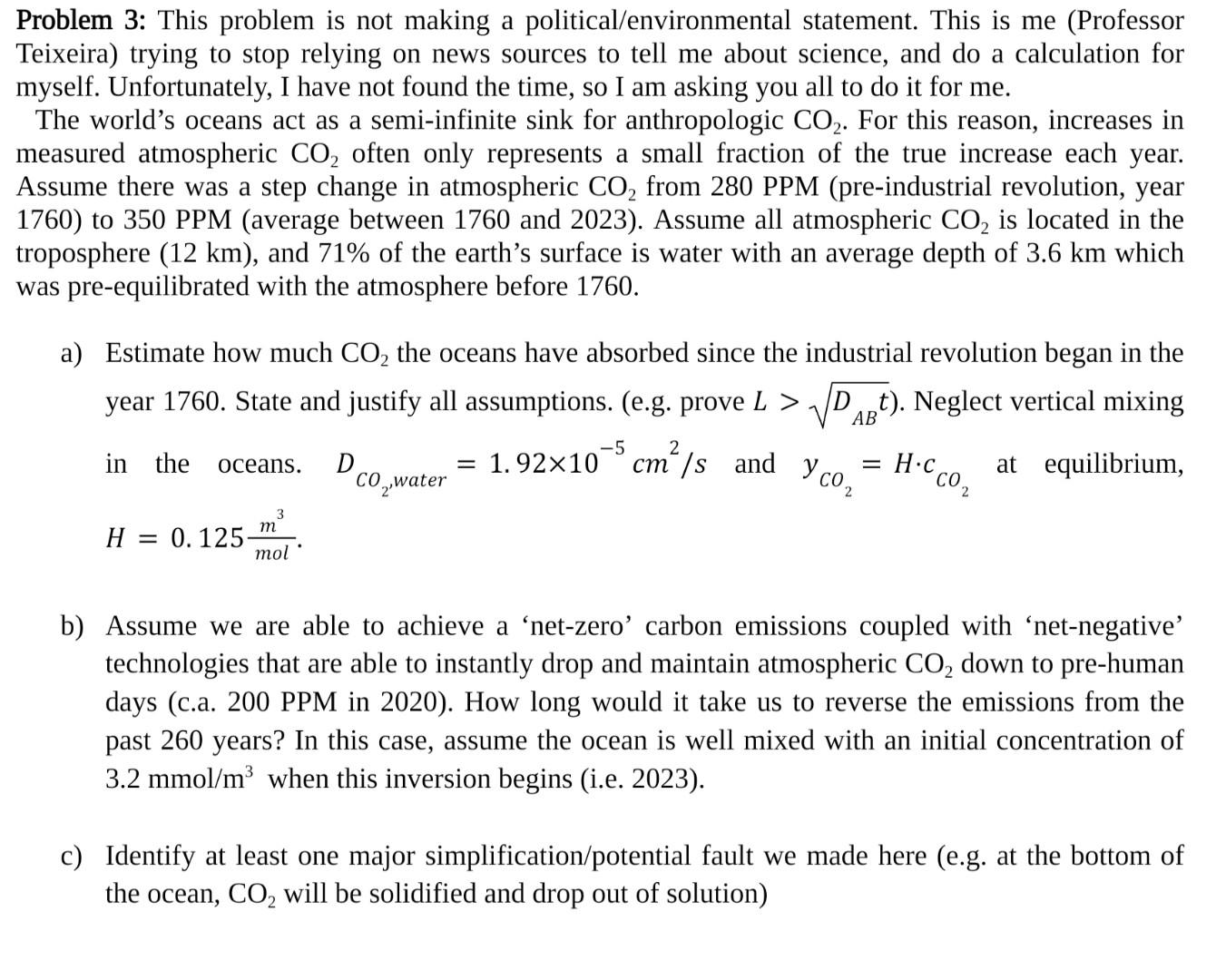
Problem 3: This problem is not making a political/environmental statement. This is me (Professor Teixeira) trying to stop relying on news sources to tell me about science, and do a calculation for myself. Unfortunately, I have not found the time, so I am asking you all to do it for me. The world's oceans act as a semi-infinite sink for anthropologic CO2. For this reason, increases in measured atmospheric CO2 often only represents a small fraction of the true increase each year. Assume there was a step change in atmospheric CO2 from 280 PPM (pre-industrial revolution, year 1760) to 350 PPM (average between 1760 and 2023). Assume all atmospheric CO2 is located in the troposphere (12km), and 71% of the earth's surface is water with an average depth of 3.6km which was pre-equilibrated with the atmosphere before 1760 . a) Estimate how much CO2 the oceans have absorbed since the industrial revolution began in the year 1760. State and justify all assumptions. (e.g. prove L>DABt ). Neglect vertical mixing H=0.125molm3 b) Assume we are able to achieve a 'net-zero' carbon emissions coupled with 'net-negative' technologies that are able to instantly drop and maintain atmospheric CO2 down to pre-human days (c.a. 200 PPM in 2020). How long would it take us to reverse the emissions from the past 260 years? In this case, assume the ocean is well mixed with an initial concentration of 3.2mmol/m3 when this inversion begins (i.e. 2023). c) Identify at least one major simplification/potential fault we made here (e.g. at the bottom of the ocean, CO2 will be solidified and drop out of solution)
Step by Step Solution
There are 3 Steps involved in it

Get step-by-step solutions from verified subject matter experts
 Study Help