







Question: Problem 3: True/False 1. The difference between unit sales price and unit variable cost is the total contribution margin. 2. A relatively low margin of
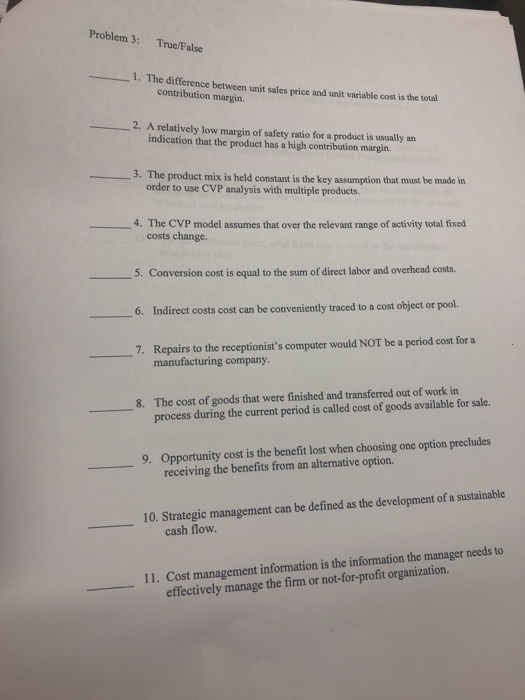
Problem 3: True/False 1. The difference between unit sales price and unit variable cost is the total contribution margin. 2. A relatively low margin of safety ratio for a product is usually an indication that the product has a high contribution margin. 3. The product mix is held constant is the key assumption that must be made in order to use CVP analysis with multiple products. 4. The CVP model assumes that over the relevant range of activity total fixed costs change. 5. Conversion cost is equal to the sum of direct labor and overhead costs. 6. Indirect costs cost can be conveniently traced to a cost object or pool 7. Repairs to the receptionist's computer would NOT be a period cost for a manufacturing company The cost of goods that were finished and transferred out of work in process during the current period is called cost of goods available for sale. 8. Opportunity cost is the benefit lost when choosing one option precludes receiving the benefits from an alternative option. 9. 10. Strategic management can be defined as the development of a sustainable cash flow 11. Cost management information is the information the manager needs to effectively manage the firm or not-for-profit organization
Step by Step Solution
There are 3 Steps involved in it

Get step-by-step solutions from verified subject matter experts
 Study Help