







Question: Problem 3D (Cartesian coordinate system) take the side of each square to be 0.1.) Moody Diagram, i.e. Friction Factor as a function of the Reynolds
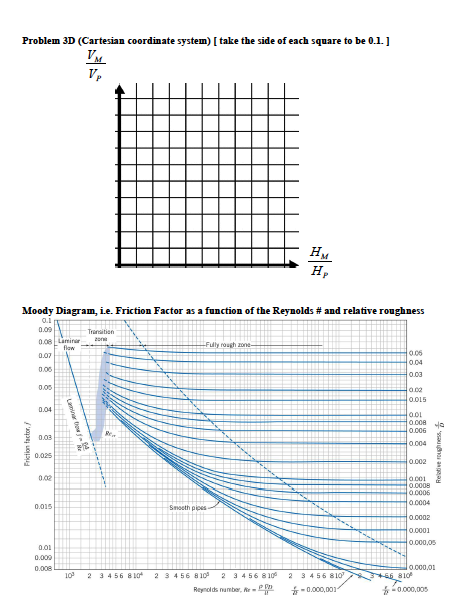
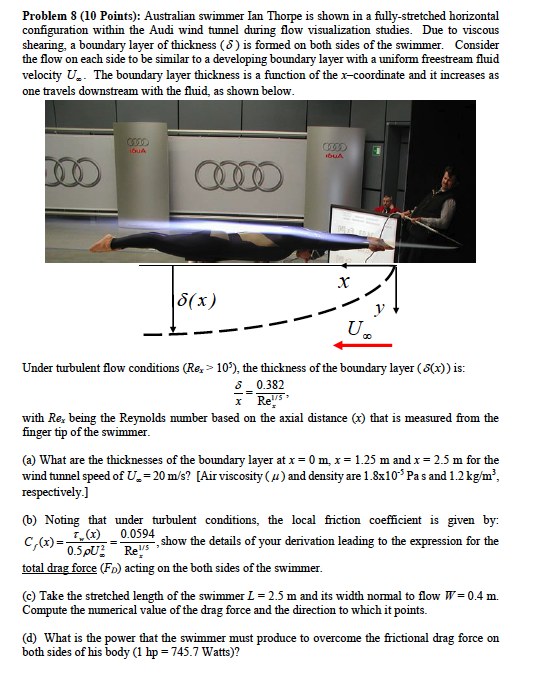
Problem 3D (Cartesian coordinate system) take the side of each square to be 0.1.) Moody Diagram, i.e. Friction Factor as a function of the Reynolds # and relative roughness 0.00 Fully rough one 10.05 Joo OOLS 0.000 0.01 10 5 2 3456 810 23 456 8 10 23 456 81 Reyndis number Re-P 2 3 456810 -0.000,001 000001 6 810 000.00 Problem 8 (10 Points): Australian swimmer Ian Thorpe is shown in a fully-stretched horizontal configuration within the Audi wind tunnel during flow visualization studies. Due to viscous shearing, a boundary layer of thickness (8) is formed on both sides of the swimmer. Consider the flow on each side to be similar to a developing boundary layer with a uniform freestream fluid velocity U. The boundary layer thickness is a function of the x-coordinate and it increases as one travels downstream with the fluid, as shown below. CD 8(x) Under turbulent flow conditions (Re, > 10), the thickness of the boundary layer ( 8(x)) is: 0.382 * Reis with Roy being the Reynolds number based on the axial distance (x) that is measured from the finger tip of the swimmer. (a) What are the thicknesses of the boundary layer at x = 0 m x= 1.25 m and x = 2.5 m for the wind tunnel speed of U.-20 m/s? [Air viscosity (u) and density are 1.8x10* Pas and 1.2 kg/m', respectively.] (b) Noting that under turbulent conditions, the local friction coefficient is given by: (*) 0.5pU? show the details of your derivation leading to the expression for the Res total drag force (FD) acting on the both sides of the swimmer (c) Take the stretched length of the swimmer L=25 m and its width normal to flow -0.4 m. Compute the numerical value of the drag force and the direction to which it points. 0.0594 C,(*)-5. () (d) What is the power that the swimmer must produce to overcome the frictional drag force on both sides of his body (1 hp = 745.7 Watts)? Problem 3D (Cartesian coordinate system) take the side of each square to be 0.1.) Moody Diagram, i.e. Friction Factor as a function of the Reynolds # and relative roughness 0.00 Fully rough one 10.05 Joo OOLS 0.000 0.01 10 5 2 3456 810 23 456 8 10 23 456 81 Reyndis number Re-P 2 3 456810 -0.000,001 000001 6 810 000.00 Problem 8 (10 Points): Australian swimmer Ian Thorpe is shown in a fully-stretched horizontal configuration within the Audi wind tunnel during flow visualization studies. Due to viscous shearing, a boundary layer of thickness (8) is formed on both sides of the swimmer. Consider the flow on each side to be similar to a developing boundary layer with a uniform freestream fluid velocity U. The boundary layer thickness is a function of the x-coordinate and it increases as one travels downstream with the fluid, as shown below. CD 8(x) Under turbulent flow conditions (Re, > 10), the thickness of the boundary layer ( 8(x)) is: 0.382 * Reis with Roy being the Reynolds number based on the axial distance (x) that is measured from the finger tip of the swimmer. (a) What are the thicknesses of the boundary layer at x = 0 m x= 1.25 m and x = 2.5 m for the wind tunnel speed of U.-20 m/s? [Air viscosity (u) and density are 1.8x10* Pas and 1.2 kg/m', respectively.] (b) Noting that under turbulent conditions, the local friction coefficient is given by: (*) 0.5pU? show the details of your derivation leading to the expression for the Res total drag force (FD) acting on the both sides of the swimmer (c) Take the stretched length of the swimmer L=25 m and its width normal to flow -0.4 m. Compute the numerical value of the drag force and the direction to which it points. 0.0594 C,(*)-5. () (d) What is the power that the swimmer must produce to overcome the frictional drag force on both sides of his body (1 hp = 745.7 Watts)
Step by Step Solution
There are 3 Steps involved in it
1 Expert Approved Answer
Step: 1 Unlock

Question Has Been Solved by an Expert!
Get step-by-step solutions from verified subject matter experts
Step: 2 Unlock
Step: 3 Unlock
 Study Help