







Question: Problem 4 : ( 2 5 points ) Throughout this problem, assume the graphs are undirected and represented by adjacency lists. a . A graph
Problem : points
Throughout this problem, assume the graphs are undirected and represented by adjacency lists.
a A graph mathrmGmathrmVmathrmE is called bipartite if we can partition V into two nonoverlapping sets V and V where VVcup V such that every edge in G is between a node in V and a node in V Using on a graph traversal technique, write an algorithm that takes as input an undirected graph G and returns whether or not G is bipartite. Derive the time complexity of your algorithm.
b Same as part a except this time your algorithm has to check if the input graph is a full binary tree. Again, analyze the time complexity of your algorithm.
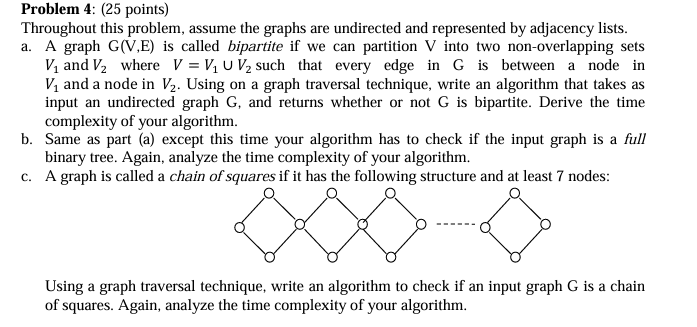
c A graph is called a chain of squares if it has the following structure and at least nodes:
Using a graph traversal technique, write an algorithm to check if an input graph G is a chain of squares. Again, analyze the time complexity of your algorithm.
Step by Step Solution
There are 3 Steps involved in it
1 Expert Approved Answer
Step: 1 Unlock

Question Has Been Solved by an Expert!
Get step-by-step solutions from verified subject matter experts
Step: 2 Unlock
Step: 3 Unlock
 Study Help