







Question: Problem 4. (24 points) Suppose that a1, d2, a3, d4, a5, 16, a7 are vectors in Rs such that the 5 x 7 matrix A
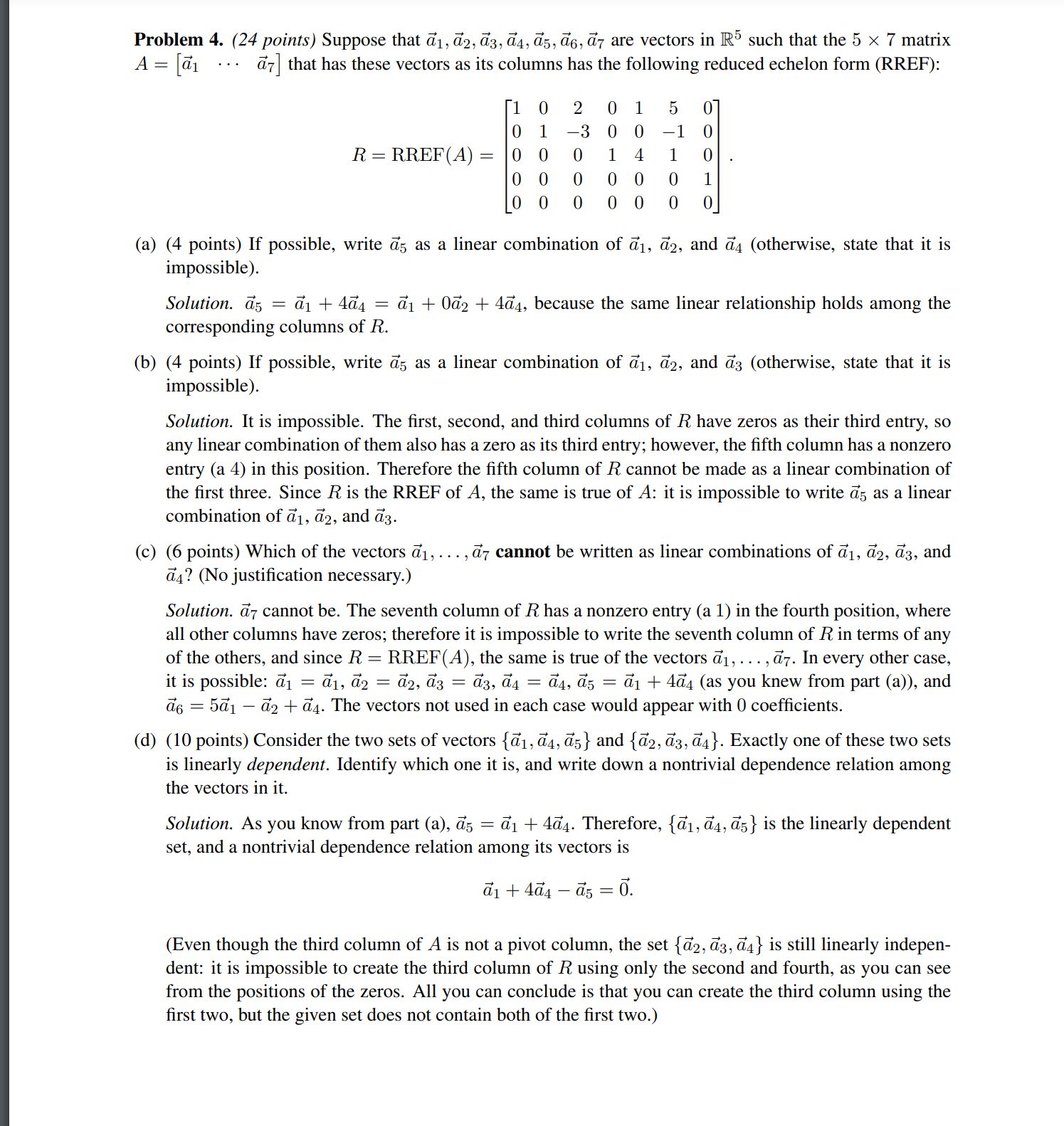
Problem 4. (24 points) Suppose that a1, d2, a3, d4, a5, 16, a7 are vectors in Rs such that the 5 x 7 matrix A = [al ... a7] that has these vectors as its columns has the following reduced echelon form (RREF): 10 2 01 5 0 1 -3 0 0 -1 0 R = RREF(A) = 0 0 01 4 1 0 0 0 0 0 0 0 0 0 0 0 0 0 (a) (4 points) If possible, write as as a linear combination of a1, a2, and a4 (otherwise, state that it is impossible). Solution. as = a1 + 4a4 = a1 + 0d2 + 404, because the same linear relationship holds among the corresponding columns of R. (b) (4 points) If possible, write as as a linear combination of a1, a2, and a3 (otherwise, state that it is impossible). Solution. It is impossible. The first, second, and third columns of R have zeros as their third entry, so any linear combination of them also has a zero as its third entry; however, the fifth column has a nonzero entry (a 4) in this position. Therefore the fifth column of R cannot be made as a linear combination of the first three. Since R is the RREF of A, the same is true of A: it is impossible to write a as a linear combination of a1, a2, and a3. (c) (6 points) Which of the vectors al, . . ., a7 cannot be written as linear combinations of a1, d2, a3, and a4? (No justification necessary.) Solution. a7 cannot be. The seventh column of R has a nonzero entry (a 1) in the fourth position, where all other columns have zeros; therefore it is impossible to write the seventh column of R in terms of any of the others, and since R = RREF(A), the same is true of the vectors a1, . . ., a7. In every other case, it is possible: a1 = d1, a2 = d2, a3 = 63, d4 = d4, as = al + 4a4 (as you knew from part (a)), and a6 = 5a1 - a2 + a4. The vectors not used in each case would appear with 0 coefficients. (d) (10 points) Consider the two sets of vectors {a1, d4, as } and {a2, a3, d4}. Exactly one of these two sets is linearly dependent. Identify which one it is, and write down a nontrivial dependence relation among the vectors in it. Solution. As you know from part (a), as = a1 + 4a4. Therefore, {a1, d4, as } is the linearly dependent set, and a nontrivial dependence relation among its vectors is a1 + 4a4 - a5 = 0. (Even though the third column of A is not a pivot column, the set {a2, a3, d4} is still linearly indepen dent: it is impossible to create the third column of R using only the second and fourth, as you can see from the positions of the zeros. All you can conclude is that you can create the third column using the first two, but the given set does not contain both of the first two.)
Step by Step Solution
There are 3 Steps involved in it

Get step-by-step solutions from verified subject matter experts
 Study Help