







Question: Problem 4 (3+3+2+2=10 points). A laminate material has been fabricated by hot rolling at 870C a stack of alternating Cu and Ni sheets, initially 400
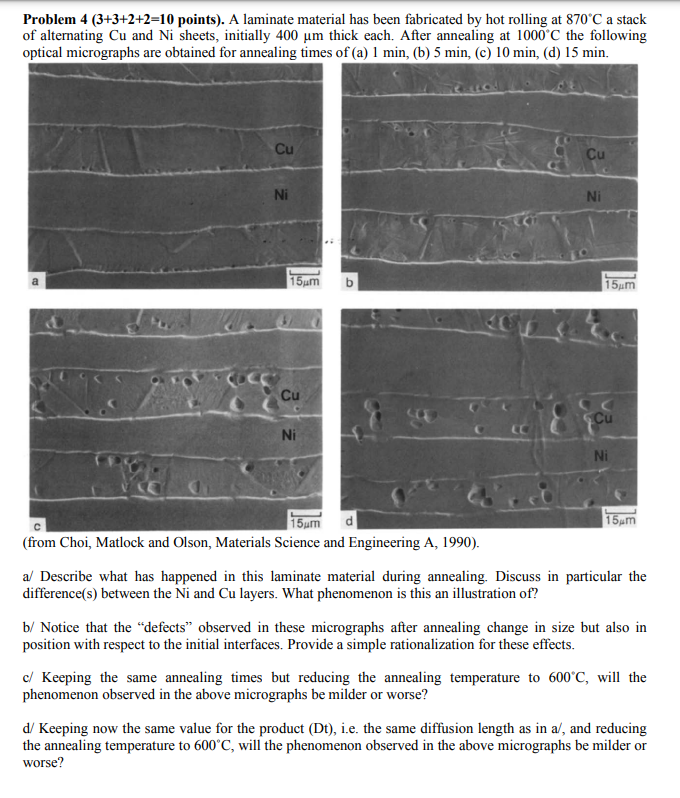
Problem 4 (3+3+2+2=10 points). A laminate material has been fabricated by hot rolling at 870C a stack of alternating Cu and Ni sheets, initially 400 um thick each. After annealing at 1000C the following optical micrographs are obtained for annealing times of (a) 1 min, (b) 5 min, (c) 10 min, (d) 15 min. Cu Cu Ni Ni 15m 15 m Cu Ni Ni 15um 15mm (from Choi, Matlock and Olson, Materials Science and Engineering A, 1990). al Describe what has happened in this laminate material during annealing. Discuss in particular the difference(s) between the Ni and Cu layers. What phenomenon is this an illustration of? b/Notice that the "defects observed in these micrographs after annealing change in size but also in position with respect to the initial interfaces. Provide a simple rationalization for these effects. c/ Keeping the same annealing times but reducing the annealing temperature to 600C, will the phenomenon observed in the above micrographs be milder or worse? d/ Keeping now the same value for the product (Dt), i.e. the same diffusion length as in al, and reducing the annealing temperature to 600C, will the phenomenon observed in the above micrographs be milder or worse
Step by Step Solution
There are 3 Steps involved in it

Get step-by-step solutions from verified subject matter experts
 Study Help