







Question: Problem 4 A and B are the only nodes on an Ethernet LAN implementing a BCSMA/CD protocol. All frames have duration (transmission delay) of T
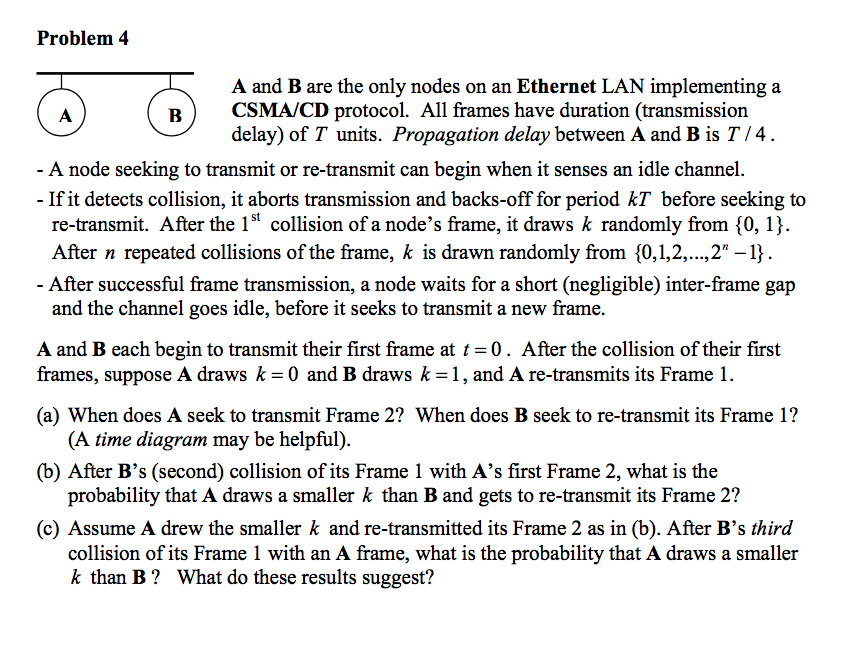
Problem 4 A and B are the only nodes on an Ethernet LAN implementing a BCSMA/CD protocol. All frames have duration (transmission delay) of T units. Propagation delay between A and B is T/4 A node seeking to transmit or re-transmit can begin when it senses an idle channel. - If it detects collision, it aborts transmission and backs-off for period kT before seeking to re-transmit. After the 1st collision of a node's frame, it draws k randomly from (0, 1}. After n repeated collisions of the frame, k is drawn randomly from (0,1,2,...,2" 1 After successful frame transmission, a node waits for a short (negligible) inter-frame gap and the channel goes idle, before it seeks to transmit a new frame. A and B each begin to transmit their first frame at t-0. After the collision of their first frames, suppose A draws k = 0 and B draws k-1 , and A re-transmits its Frame 1. (a) When does A seek to transmit Frame 2? When does B seek to re-transmit its Frame 1? (A time diagram may be helpful) probability that A draws a smaller k than B and gets to re-transmit its Frame 2? collision of its Frame 1 with an A frame, what is the probability that A draws a smaller (b) After B's (second) collision of its Frame 1 with A's first Frame 2, what is the (c) Assume A drew the smaller k and re-transmitted its Frame 2 as in (b). After B's third k than B? What do these results suggest? Problem 4 A and B are the only nodes on an Ethernet LAN implementing a BCSMA/CD protocol. All frames have duration (transmission delay) of T units. Propagation delay between A and B is T/4 A node seeking to transmit or re-transmit can begin when it senses an idle channel. - If it detects collision, it aborts transmission and backs-off for period kT before seeking to re-transmit. After the 1st collision of a node's frame, it draws k randomly from (0, 1}. After n repeated collisions of the frame, k is drawn randomly from (0,1,2,...,2" 1 After successful frame transmission, a node waits for a short (negligible) inter-frame gap and the channel goes idle, before it seeks to transmit a new frame. A and B each begin to transmit their first frame at t-0. After the collision of their first frames, suppose A draws k = 0 and B draws k-1 , and A re-transmits its Frame 1. (a) When does A seek to transmit Frame 2? When does B seek to re-transmit its Frame 1? (A time diagram may be helpful) probability that A draws a smaller k than B and gets to re-transmit its Frame 2? collision of its Frame 1 with an A frame, what is the probability that A draws a smaller (b) After B's (second) collision of its Frame 1 with A's first Frame 2, what is the (c) Assume A drew the smaller k and re-transmitted its Frame 2 as in (b). After B's third k than B? What do these results suggest
Step by Step Solution
There are 3 Steps involved in it

Get step-by-step solutions from verified subject matter experts
 Study Help