







Question: Problem 4. A CAN network operates with a nominal bit time of 8 us for a nominal bit rate of 125 Kb/s. Each bit time
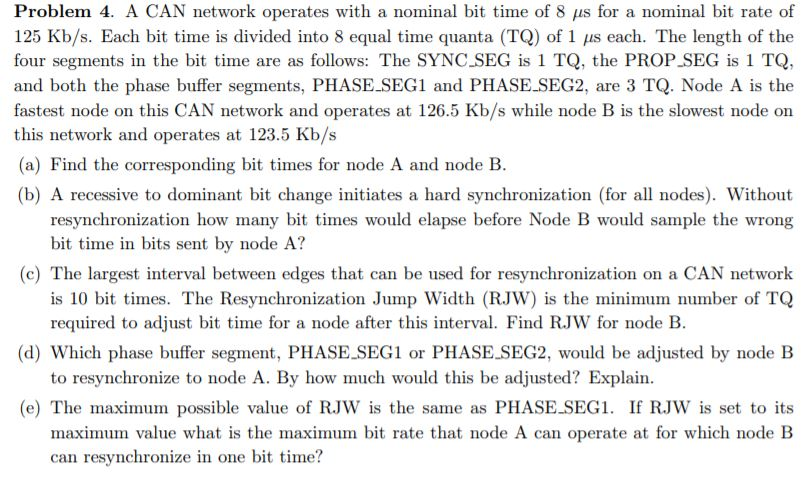
Problem 4. A CAN network operates with a nominal bit time of 8 us for a nominal bit rate of 125 Kb/s. Each bit time is divided into 8 equal time quanta (TQ) of 1 ?s each. The length of the four segments in the bit time are as follows: The SYNC.SEG is 1 TQ, the PROP SEG is 1 TQ, and both the phase buffer segments, PHASESEG1 and PHASE SEG2, are 3 TQ. Node A is the fastest node on this CAN network and operates at 126.5 Kb/s while node B is the slowest node orn this network and operates at 123.5 Kb/s (a) Find the corresponding bit times for node A and node B (b) A recessive to dominant bit change initiates a hard synchronization (for all nodes). Without resynchronization how many bit times would elapse before Node B would sample the wrong bit time in bits sent by node A? (c) The largest interval between edges that can be used for resynchronization on a CAN network is 10 bit times. The Resynchronization Jump Width (RJW) is the minimum number of TQ (d) Which phase buffer segment, PHASE SEG1 or PHASE SEG2, would be adjusted by node B (e) The maximum possible value of RJW is the same as PHASE SEG1. If RJW is set to its required to adjust bit time for a node after this interval. Find RJW for node B to resynchronize to node A. By how much would this be adjusted? Explain maximum value what is the maximum bit rate that node A can operate at for which node B can resvnchronize in one bit time? Problem 4. A CAN network operates with a nominal bit time of 8 us for a nominal bit rate of 125 Kb/s. Each bit time is divided into 8 equal time quanta (TQ) of 1 ?s each. The length of the four segments in the bit time are as follows: The SYNC.SEG is 1 TQ, the PROP SEG is 1 TQ, and both the phase buffer segments, PHASESEG1 and PHASE SEG2, are 3 TQ. Node A is the fastest node on this CAN network and operates at 126.5 Kb/s while node B is the slowest node orn this network and operates at 123.5 Kb/s (a) Find the corresponding bit times for node A and node B (b) A recessive to dominant bit change initiates a hard synchronization (for all nodes). Without resynchronization how many bit times would elapse before Node B would sample the wrong bit time in bits sent by node A? (c) The largest interval between edges that can be used for resynchronization on a CAN network is 10 bit times. The Resynchronization Jump Width (RJW) is the minimum number of TQ (d) Which phase buffer segment, PHASE SEG1 or PHASE SEG2, would be adjusted by node B (e) The maximum possible value of RJW is the same as PHASE SEG1. If RJW is set to its required to adjust bit time for a node after this interval. Find RJW for node B to resynchronize to node A. By how much would this be adjusted? Explain maximum value what is the maximum bit rate that node A can operate at for which node B can resvnchronize in one bit time
Step by Step Solution
There are 3 Steps involved in it

Get step-by-step solutions from verified subject matter experts
 Study Help