



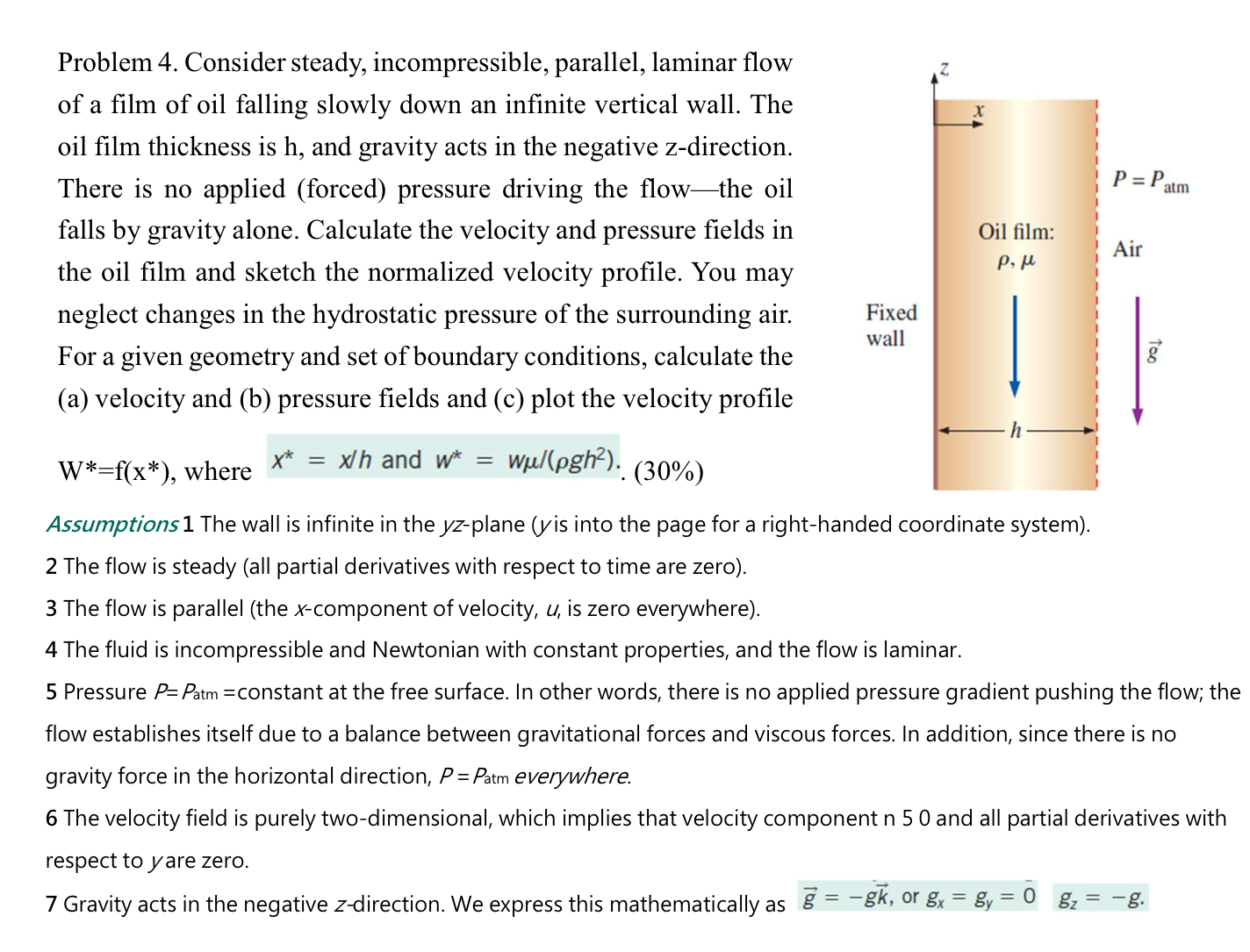
Question: Problem 4 . Consider steady, incompressible, parallel, laminar flow of a film of oil falling slowly down an infinite vertical wall. The oil film thickness
Problem Consider steady, incompressible, parallel, laminar flow of a film of oil falling slowly down an infinite vertical wall. The oil film thickness is h and gravity acts in the negative z direction. There is no applied forced pressure driving the flowthe oil falls by gravity alone. Calculate the velocity and pressure fields in the oil film and sketch the normalized velocity profile. You may neglect changes in the hydrostatic pressure of the surrounding air. For a given geometry and set of boundary conditions, calculate the a velocity and b pressure fields and c plot the velocity profile
mathrmWmathrmfleftmathrmxrighttext where
Assumptions The wall is infinite in the y z plane y is into the page for a righthanded coordinate system
The flow is steady all partial derivatives with respect to time are zero
The flow is parallel the x component of velocity, u is zero everywhere
The fluid is incompressible and Newtonian with constant properties, and the flow is laminar.
Pressure PPmathrmatm constant at the free surface. In other words, there is no applied pressure gradient pushing the flow; the flow establishes itself due to a balance between gravitational forces and viscous forces. In addition, since there is no gravity force in the horizontal direction, PPtext atm everywhere.
The velocity field is purely twodimensional, which implies that velocity component n and all partial derivatives with respect to y are zero.
Gravity acts in the negative z direction. We express this mathematically as vecgg veck or gxgyoverlinequad gzg
Step by Step Solution
There are 3 Steps involved in it
1 Expert Approved Answer
Step: 1 Unlock

Question Has Been Solved by an Expert!
Get step-by-step solutions from verified subject matter experts
Step: 2 Unlock
Step: 3 Unlock