







Question: Problem 4 Consider the stag hunt game played sequentially. For tractability, let's assume a population of three hunters. Two are required to hunt the
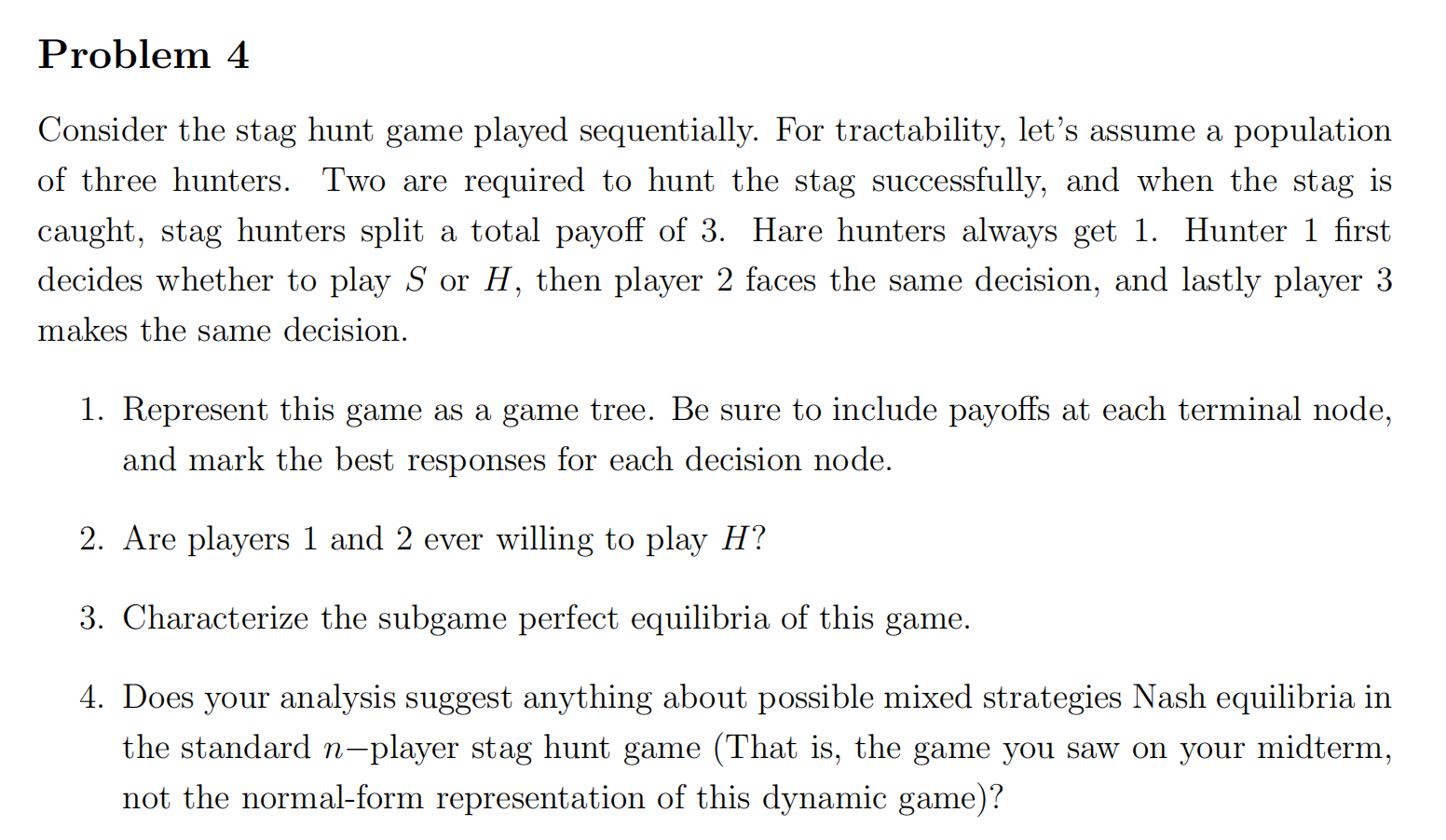
Problem 4 Consider the stag hunt game played sequentially. For tractability, let's assume a population of three hunters. Two are required to hunt the stag successfully, and when the stag is caught, stag hunters split a total payoff of 3. Hare hunters always get 1. Hunter 1 first decides whether to play S or H, then player 2 faces the same decision, and lastly player 3 makes the same decision. 1. Represent this game as a game tree. Be sure to include payoffs at each terminal node, and mark the best responses for each decision node. 2. Are players 1 and 2 ever willing to play H? 3. Characterize the subgame perfect equilibria of this game. 4. Does your analysis suggest anything about possible mixed strategies Nash equilibria in the standard n-player stag hunt game (That is, the game you saw on your midterm, not the normal-form representation of this dynamic game)?
Step by Step Solution
3.42 Rating (158 Votes )
There are 3 Steps involved in it
The game tree representation of the stag hunt game is as follows Copy 1 S H S H S H 33 01 01 10 10 A... View full answer

Get step-by-step solutions from verified subject matter experts
 Study Help