







Question: PROBLEM 4 Handling dates and times is common in data analytics. Sometimes dates and times are just given in nanoseconds from the epoch (1.e. January
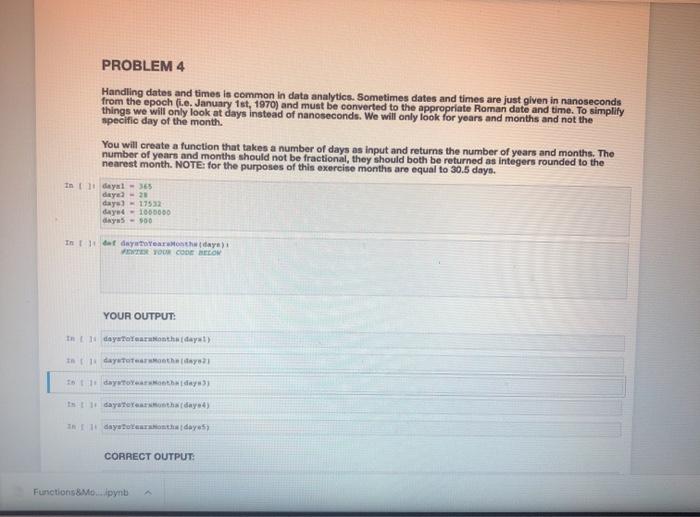
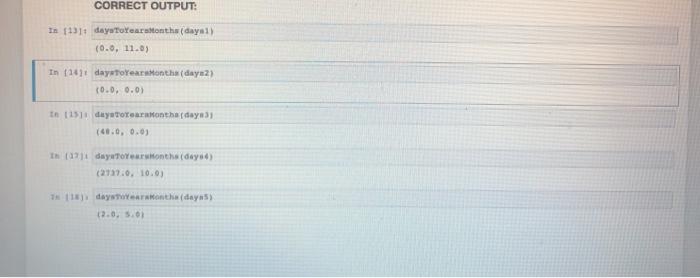
PROBLEM 4 Handling dates and times is common in data analytics. Sometimes dates and times are just given in nanoseconds from the epoch (1.e. January 1st, 1970) and must be converted to the appropriate Roman date and time. To simplify things we will only look at days instead of nanoseconds. We will only look for years and months and not the specific day of the month. You will create a function that takes a number of days as input and returns the number of years and months. The number of years and months should not be fractional, they should both be returned as integers rounded to the nearest month. NOTE: for the purposes of this exercise months are equal to 30.5 days. In 1 dayal - 365 day - 2 day) - 17533 day - 1000000 days5 - 900 In af dyrearth day) TE YOUR CODE BELOW YOUR OUTPUT: In L1 daytoyanthidae thday teeth to till daytoyarthdayu CORRECT OUTPUT: Functions Mynb CORRECT OUTPUT: In 11313 dayartorearstonths (days) (0.0, 11.0) In 1147 daystorear Month(daya2) (0.0, 0.0 tn 1151 dayaToreronthadaya In a dayToyeur onths ago) (2737.0. 10.0) Th11) daytoyeronthadaya) 12.0, 5.0
Step by Step Solution
There are 3 Steps involved in it

Get step-by-step solutions from verified subject matter experts
 Study Help