





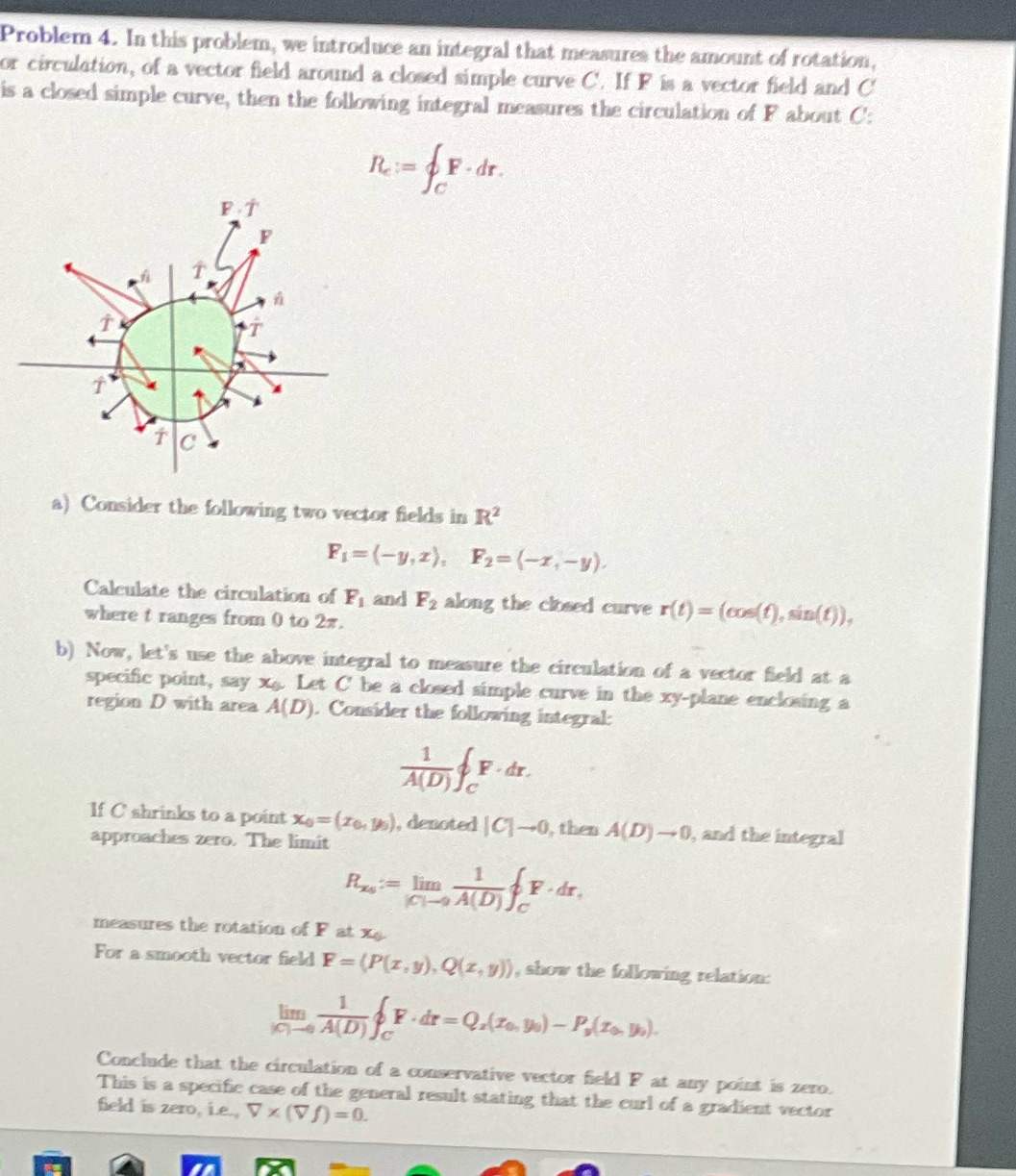
Question: Problem 4. In this problem, we introduce an integral that measures the amount of rotation, or circulation, of a vector field around a closed simple
Problem 4. In this problem, we introduce an
Problem 4. In this problem, we introduce an integral that measures the amount of rotation, or circulation, of a vector field around a closed simple curve C. If F is a vector field and C is a closed simple curve, then the following integral measures the circulation of F about C: R= OF . dr. a) Consider the following two vector fields in R? F1 = (-y,z), F2= (-z, -y) Calculate the circulation of F, and F2 along the closed curve r(1) = (cos(f), sin(t)), where t ranges from 0 to 27. b) Now, let's use the above integral to measure the circulation of a vector field at a specific point, say xe Let C be a closed simple curve in the xy-plane enclosing a region D with area A(D). Consider the following integral: { F . dr. A(D) JC If C shrinks to a point Xo= (re, us), denoted [ C]--0, then A(D)-0, and the integral approaches zero. The limit Rus = lim - / F . dr. CI- A(D) JC measures the rotation of F at xe For a smooth vector field F = (P(z, y), Q(z, y)), show the following relations 19- A(D) JC Conclude that the circulation of a conservative vector field F at any point is zero. This is a specific case of the general result stating that the curl of a gradient vector field is zero, Le., V x (VJ) =0

Step by Step Solution

There are 3 Steps involved in it

1 Expert Approved Answer
Step: 1 Unlock blur-text-image

Question Has Been Solved by an Expert!

Get step-by-step solutions from verified subject matter experts

Step: 2 Unlock
Step: 3 Unlock

Students Have Also Explored These Related Mathematics Questions!