







Question: Exercise 3. Read the subsection Flux Across a Simple Closed Plane Curve (p. 984 - 985). Explain what a simple closed curve is. The basic
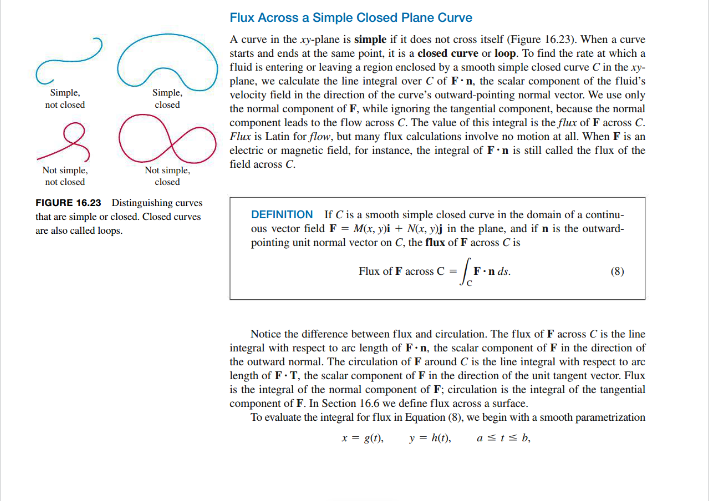
Exercise 3. Read the subsection "Flux Across a Simple Closed Plane Curve" (p. 984 - 985). Explain what a simple closed curve is. The basic idea behind flux is that it's measure how much of the vector field is "flowing out" of the closed loop. Imagine the velocity field of the surface of a pool of water. Imagine encircling a part of the pool (without disturbing the water), the flux measures the net amount of water that's leaving that encircled area.
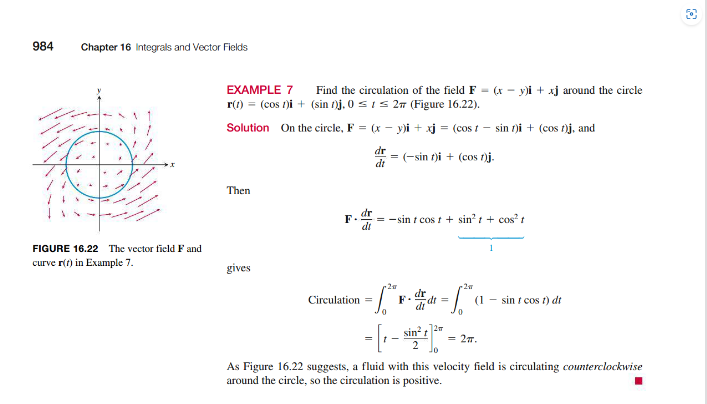
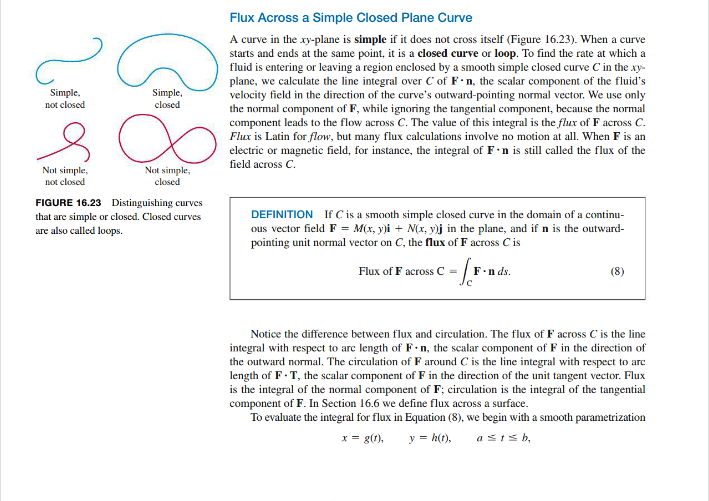
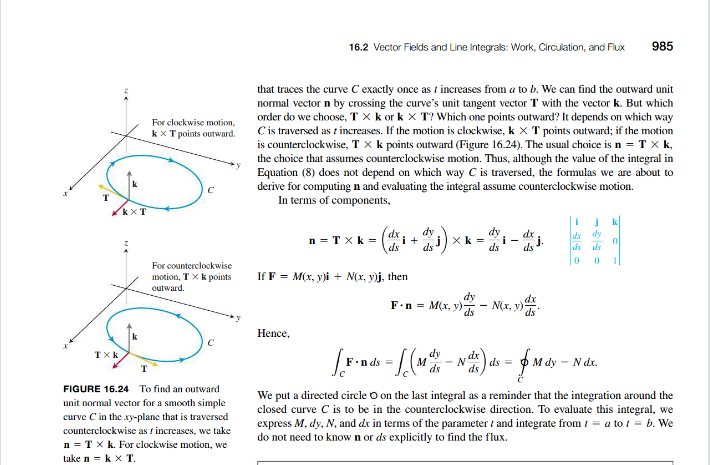
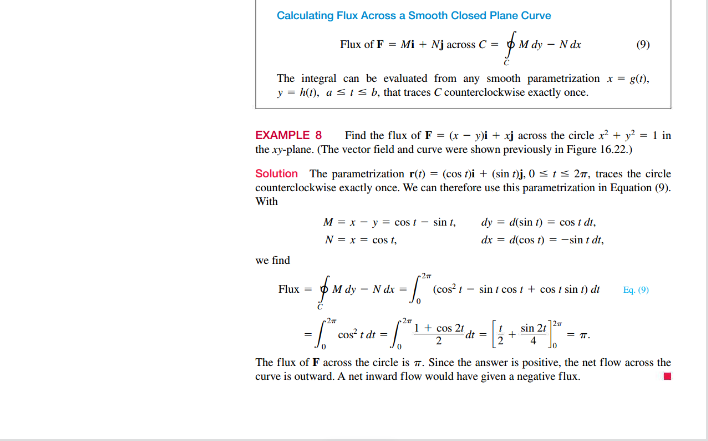
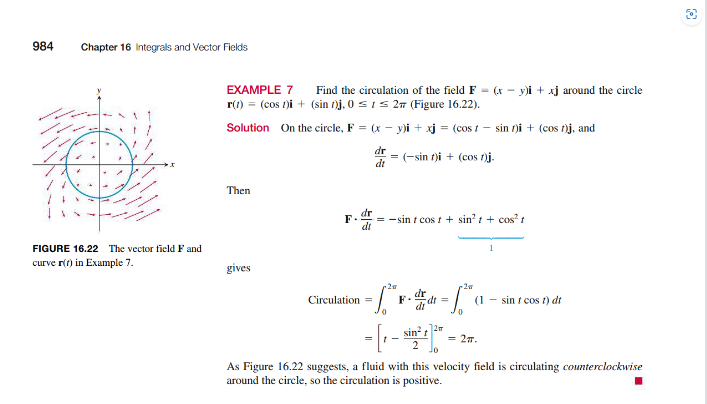
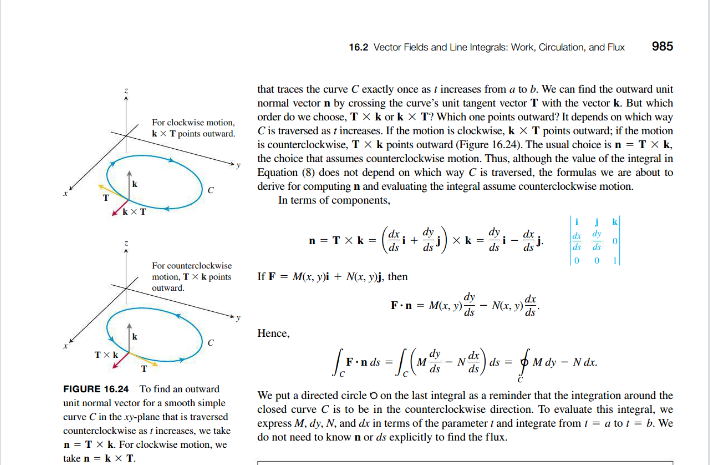
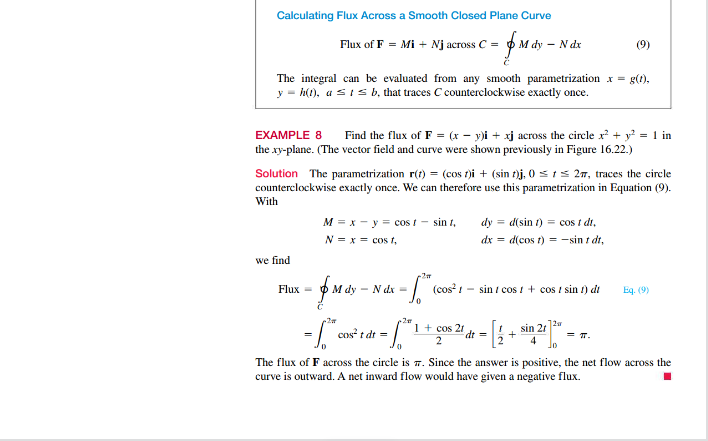
984 Chapter 16 Integrals and Vector Fields EXAMPLE 7 Find the circulation of the field F = (x - y)i + xj around the circle r() = (cos /)i + (sinn)j. 0 = / = 2x (Figure 16.22). Solution On the circle, F = (x - y)i + xj = (cost - sin ni + (cos nj, and de = (-sin ni + (cos nj- Then F. dr = -sin / cos r + sin f + cos r FIGURE 16.22 The vector field F and 1 curve r(f) in Example 7. gives Circulation ddr di (1 - sin r cos ?) di sin' t 2 = 25. As Figure 16.22 suggests, a fluid with this velocity field is circulating counterclockwise around the circle, so the circulation is positive.Flux Across a Simple Closed Plane Curve A curve in the xy-plane is simple if it does not cross itself (Figure 16.23). When a curve starts and ends at the same point, it is a closed curve or loop. To find the rate at which a fluid is entering or leaving a region enclosed by a smooth simple closed curve C in the xy- plane, we calculate the line integral over C of F- n. the scalar component of the fluid's Simple. Simple, velocity field in the direction of the curve's outward-pointing normal vector, We use only not closed closed the normal component of F, while ignoring the tangential component, because the normal component leads to the flow across C. The value of this integral is the flux of F across C. Flux is Latin for flow, but many flux calculations involve no motion at all. When F is an electric or magnetic field, for instance, the integral of F . n is still called the flux of the Not simple, Not simple, field across C. not closed closed FIGURE 16.23 Distinguishing curves that are simple or closed. Closed curves DEFINITION If C is a smooth simple closed curve in the domain of a continu- are also called loops. ous vector field F = M(x, y)i + M(x, y)j in the plane, and if n is the outward- pointing unit normal vector on C, the flux of F across C is Flux of F across C = / F.ads. (8) Notice the difference between flux and circulation. The flux of F across C is the line integral with respect to are length of F. n, the scalar component of F in the direction of the outward normal. The circulation of F around C is the line integral with respect to arc length of F - T, the scalar component of F in the direction of the unit tangent vector. Flux is the integral of the normal component of F; circulation is the integral of the tangential component of F. In Section 16.6 we define flux across a surface. To evaluate the integral for flux in Equation (8), we begin with a smooth parametrization x = g(1). y = h(t). asisb,16.2 Vector Fields and Line Integrals: Work, Circulation, and Flux 985 that traces the curve C exactly once as / increases from a to b. We can find the outward unit normal vector n by crossing the curve's unit tangent vector T with the vector k. But which For clockwise motion, order do we choose, T X k or k X T! Which one points outward? It depends on which way k X T points outward. C is traversed as / increases. If the motion is clockwise, k X T points outward; if the motion is counterclockwise, T X k points outward (Figure 16.24). The usual choice is n = T X k, the choice that assumes counterclockwise motion. Thus, although the value of the integral in Equation (8) does not depend on which way C is traversed, the formulas we are about to derive for computing n and evaluating the integral assume counterclockwise motion. In terms of components. EXT dy n = T X k = X k dx ds the J. d's 0 For counterclockwise motion, T x k points If F = M(x, y)i + M(x, y)j, then outward. dy F . n = M(x, y) dx - N(x, y) Is Hence, TX K [Ends = [(MX - Nds) as = Mdy - Ndz. FIGURE 16.24 To find an outward We put a directed circle O on the last integral as a reminder that the integration around the unit normal vector for a smooth simple curve C in the xy-plane that is traversed closed curve C is to be in the counterclockwise direction. To evaluate this integral, we counterclockwise as f increases, we take express M. dy, N, and it in terms of the parameter / and integrate from ? = a to f = b. We do not need to know n or as explicitly to find the flux. n = T X k. For clockwise motion, we take n = k x T.Calculating Flux Across a Smooth Closed Plane Curve Flux of F = Mi + Nj across C = > M dy - N dx (9) The integral can be evaluated from any smooth parametrization x = g(), y - h(0), a s is b, that traces C counterclockwise exactly once. EXAMPLE 8 Find the flux of F = (x - y)i + xj across the circle x + y = 1 in the xy-plane. (The vector field and curve were shown previously in Figure 16.22.) Solution The parametrization r() = (cos nji + (sinn)j. 0 s r = 2w, traces the circle counterclockwise exactly once. We can therefore use this parametrization in Equation (9). With M= x - y = cos I - sin 1, dy = d(sin () = cost di. N = x = cost, dx = d(cost) = -sint di, we find Flux - Mdy - Nedx - ( (cos' : - sini cost + cos / sin !) di Eq. (9) - 1 . " cost sat = [ " 1 + cos 21 dt + sin 21 20 2 4 = T. The flux of F across the circle is w. Since the answer is positive, the net flow across the curve is outward. A net inward flow would have given a negative flux
Step by Step Solution
There are 3 Steps involved in it

Get step-by-step solutions from verified subject matter experts
 Study Help