







Question: Problem 4 (SUFFICIENT STATISTICS) Let X2n = (X1, X2, . . ., Xn, Xn+1, ..., X2n) are i.i.d random variables with Pr [Xi = 1]
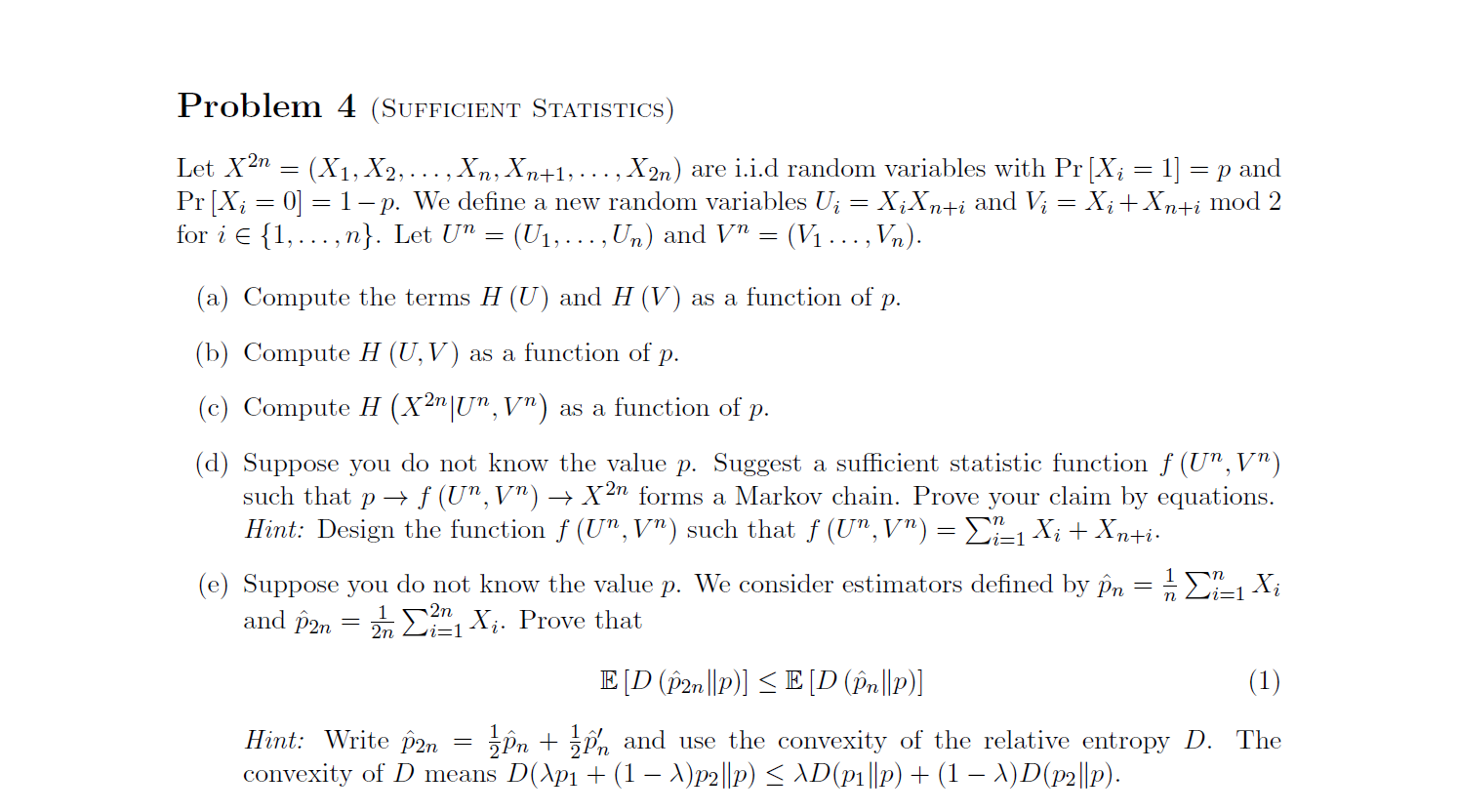
Problem 4 (SUFFICIENT STATISTICS) Let X2n = (X1, X2, . . ., Xn, Xn+1, ..., X2n) are i.i.d random variables with Pr [Xi = 1] = p and Pr [Xi = 0] =1-p. We define a new random variables Ui = XiXnti and Vi = Xi+ Xnti mod 2 for i E {1, ..., n}. Let Un = (U1, . .., Un) and Vn = (V1 . . ., Vn). (a) Compute the terms H (U) and H (V) as a function of p. (b) Compute H (U, V) as a function of p. (c) Compute H (X2n Un, Vn) as a function of p. (d) Suppose you do not know the value p. Suggest a sufficient statistic function f (Un, Vn) such that p - f (Un, Vn) - X2n forms a Markov chain. Prove your claim by equations. Hint: Design the function f (Un, Vn) such that f (Un, Vn) = Et, Xi + Xnti. (e) Suppose you do not know the value p. We consider estimators defined by pn = , Et-1 Xi and p2n = i21 Xi Prove that E [D (P2n | |p)]
Step by Step Solution
There are 3 Steps involved in it

Get step-by-step solutions from verified subject matter experts
 Study Help