


Question: Problem 4: Suppose that ? = {w1, w2, wa}. Assume that P is a prob measure on $2 such that P(w) > 0 for all
Problem 4: Suppose that ? = {w1, w2, wa}. Assume
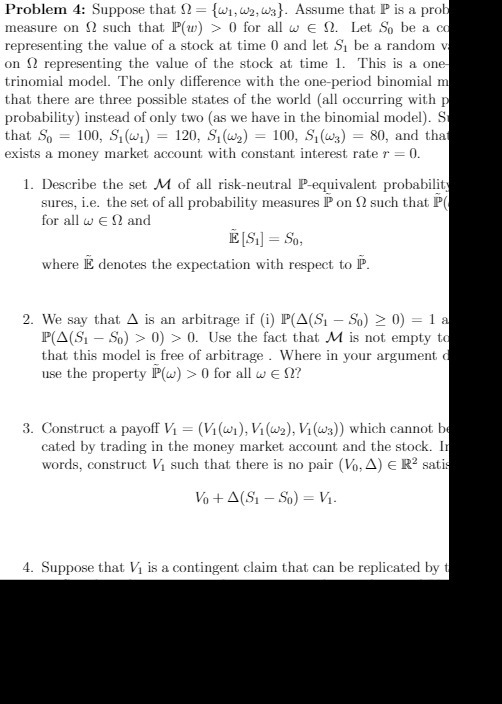
Problem 4: Suppose that ? = {w1, w2, wa}. Assume that P is a prob measure on $2 such that P(w) > 0 for all we 2. Let So be a co representing the value of a stock at time 0 and let S, be a random v on $2 representing the value of the stock at time 1. This is a one trinomial model. The only difference with the one-period binomial m that there are three possible states of the world (all occurring with p probability) instead of only two (as we have in the binomial model). S that So = 100, S,(w,) = 120, S, (w2) = 100, S,(w3) = 80, and that exists a money market account with constant interest rate r = 0. 1. Describe the set M of all risk-neutral P-equivalent probability sures, i.e. the set of all probability measures P on ? such that P( for all we ? and E [Si] = So, where E denotes the expectation with respect to P. 2. We say that A is an arbitrage if (i) P(A(S1 - So) > 0) = 1 a P((S1 - So) >0) > 0. Use the fact that M is not empty to that this model is free of arbitrage . Where in your argument d use the property P(w) > 0 for all we!? 3. Construct a payoff Vi = (Vi(w1), Vi(w2), Vi(w3)) which cannot be cated by trading in the money market account and the stock. In words, construct Vi such that there is no pair (Vo, A) E R2 satis Vo + (S1 - So) = Vi. 4. Suppose that Vi is a contingent claim that can be replicated by

Step by Step Solution

There are 3 Steps involved in it

1 Expert Approved Answer
Step: 1 Unlock blur-text-image

Question Has Been Solved by an Expert!

Get step-by-step solutions from verified subject matter experts

Step: 2 Unlock
Step: 3 Unlock

Students Have Also Explored These Related Mathematics Questions!