







Question: Problem 4: Work done by gravity and change in gravitational potential energy In problem 3, the box was moving in a horizontal direction, and
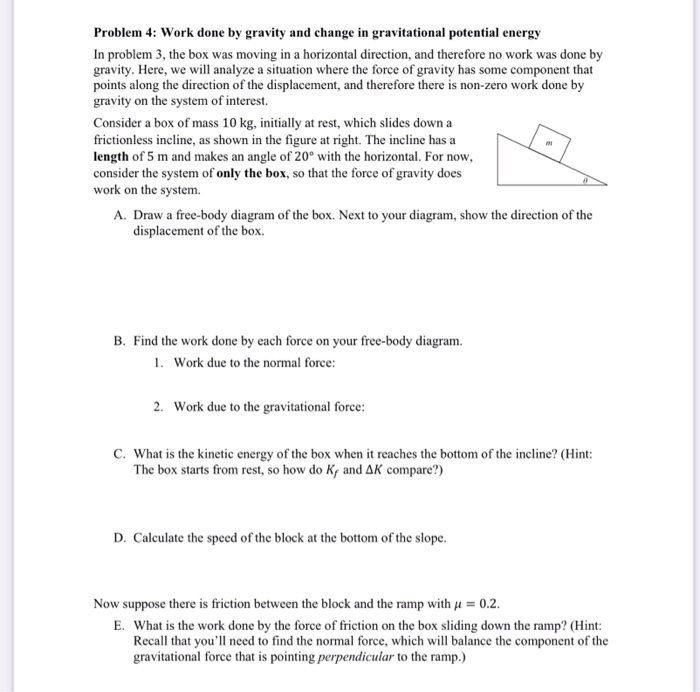
Problem 4: Work done by gravity and change in gravitational potential energy In problem 3, the box was moving in a horizontal direction, and therefore no work was done by gravity. Here, we will analyze a situation where the force of gravity has some component that points along the direction of the displacement, and therefore there is non-zero work done by gravity on the system of interest. Consider a box of mass 10 kg, initially at rest, which slides down a frictionless incline, as shown in the figure at right. The incline has a length of 5 m and makes an angle of 20 with the horizontal. For now, consider the system of only the box, so that the force of gravity does work on the system. A. Draw a free-body diagram of the box. Next to your diagram, show the direction of the displacement of the box. B. Find the work done by each force on your free-body diagram. 1. Work due to the normal force: 2. Work due to the gravitational force: C. What is the kinetic energy of the box when it reaches the bottom of the incline? (Hint: The box starts from rest, so how do Ky and AK compare?) D. Calculate the speed of the block at the bottom of the slope. Now suppose there is friction between the block and the ramp with = 0.2. E. What is the work done by the force of friction on the box sliding down the ramp? (Hint: Recall that you'll need to find the normal force, which will balance the component of the gravitational force that is pointing perpendicular to the ramp.) F. Use the work done by friction and your previous results to determine the speed of the block at the bottom of the slope in this case. Is it bigger or smaller than what you got without friction? Does your answer make sense? G. If the friction force is large enough, the block will slide at constant speed down the ramp, and thus AK = 0. 1. For this to be true, how much work must be done by the friction force? 2. Use your answer and the length of the ramp to determine the magnitude of the friction force for the block to move at constant speed. 3. Check your answer by using Newton's 2nd law to find the friction force such that there will be no acceleration down the ramp. Finally, let's consider the system of the block plus the earth, so that gravity is no longer an external force. Recall that the gravitational potential energy is given by Ug = mgy, where y is the vertical position of the box (pick whatever origin you want). H. What is the change in the potential energy (AU) of the box as it slides from the top to the bottom of the incline? 1. How does your answer compare to the work done by gravity that you found in part B?
Step by Step Solution
3.40 Rating (163 Votes )
There are 3 Steps involved in it

Get step-by-step solutions from verified subject matter experts
 Study Help