







Question: Problem 5 ( 1 0 points ) - Energy Balance with Water and P - v diagram A piston - cylinder assembly contains water as
Problem points Energy Balance with Water and diagram
A pistoncylinder assembly contains water as shown on the right. Stops are
located within the cylinder such that the piston cannot lower past the stops.
There is kg of water in the assembly at an initial pressure of MPa and
an initial temperature of Celsius. You may assume that changes in kinetic
and potential energy in this problem are negligible. The pistoncylinder
assembly goes through a step process:
Process : The water goes through a constantpressure cooling process
until the piston contacts the stops. The volume in State is half of the volume
in State
Process : While the piston remains in contact with the stops, the water
goes throrgh a constantvolume cooling process until the water cools to
degrees Celsius.
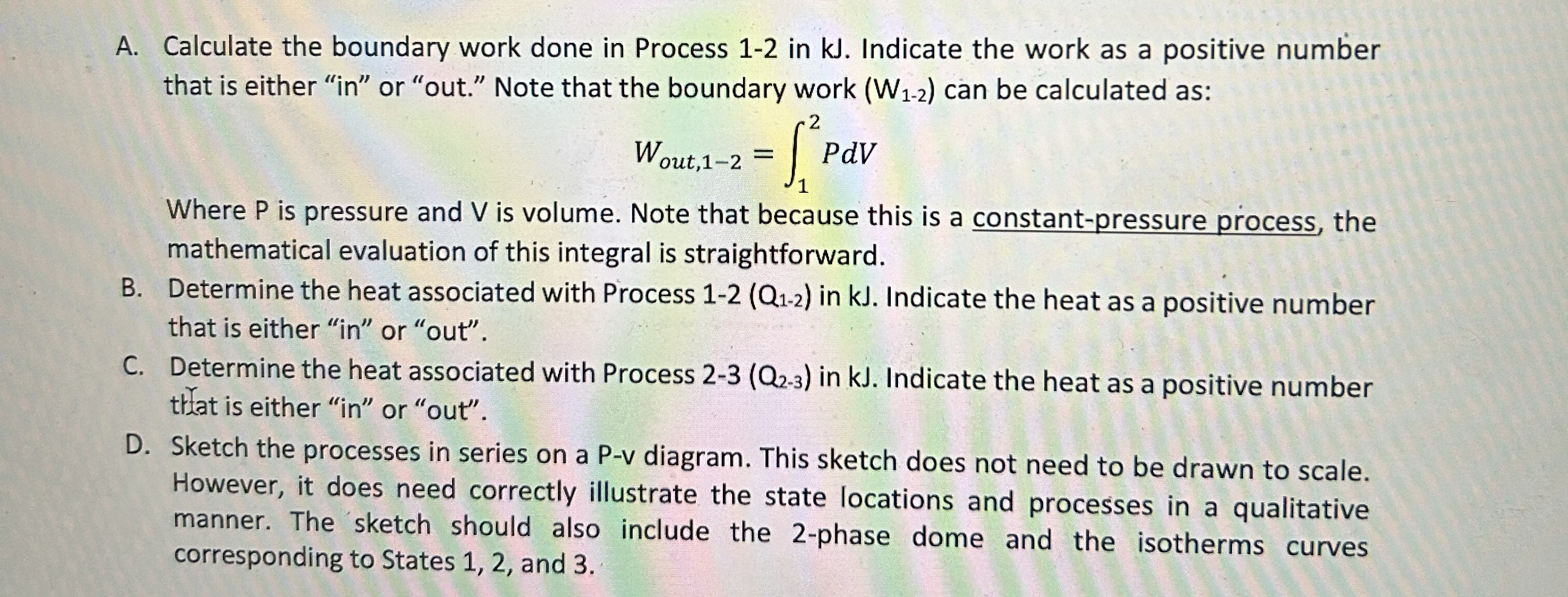
A Calculate the boundary work done in Process in kJ Indicate the work as a positive number
that is either in or "out." Note that the boundary work can be calculated as:
Where is pressure and is volume. Note that because this is a constantpressure process, the
mathematical evaluation of this integral is straightforward.
B Determine the heat associated with Process in kJ Indicate the heat as a positive number
that is either in or "out".
C Determine the heat associated with Process in kJ Indicate the heat as a positive number
trfat is either in or "out".
D Sketch the processes in series on a Pv diagram. This sketch does not need to be drawn to scale.
However, it does need correctly illustrate the state locations and processes in a qualitative
manner. The sketch should also include the phase dome and the isotherms curves
corresponding to States and
Problem points Energy Balance with Water and diagram
A pistoncylinder assembly contains water as shown on the right. Stops are
located within the cylinder such that the piston cannot lower past the stops.
There is kg of water in the assembly at an initial pressure of MPa and
an initial temperature of Celsius. You may assume that changes in kinetic
and potential energy in this problem are negligible. The pistoncylinder
assembly goes through a step process:
Process : The water goes through a constantpressure cooling process
until the piston contacts the stops. The volume in State is half of the volume
in State
Process : While the piston remains in contact with the stops, the water
goes through a constantvolume cooling process until the water cools to
degrees Celsius.
Problem points Energy Balance with Water and diagram
A pistoncylinder assembly contains water as shown on the right. Stops are
located within the cylinder such that the piston cannot lower past the stops.
There is kg of water in the assembly at an initial pressure of MPa and
an initial temperature of Celsius. You may assume that changes in kinetic
and potential energy in this problem are negligible. The pistoncylinder
assembly goes through a step process:
Process : The water goes through a constantpressure cooling process
until the piston contacts the stops. The volume in State is half of the volume
in State
Process : While the piston remains in contact with the stops, the water
goes through a constantvolume cooling process until the water cools to
degrees Celsius.
A Calculate the boundary work done in Process in kJ Indicate the work as a positive number
that is either in or "out." Note that the boundary work can be calculated as:
Where is pressure and is volume. Note that because this is a constantpressure process, the
mathematical evaluation of this integral is straightforward.
B Determine the heat associated with Process in kJ Indicate the heat as a positive number
that is either in or "out".
C Determine the heat associated with Process in kJ Indicate the heat as a positive number
thlat is either in or "out".
D Sketch the processes in series on a Pv diagram. This sketch does not need to be drawn to scale.
However, it does need correctly illustrate the state locations and processes in a qualitative
manner. The sketch should also include the phase dome and the isotherms curves
corresponding to States and
A Calculate
Step by Step Solution
There are 3 Steps involved in it
1 Expert Approved Answer
Step: 1 Unlock

Question Has Been Solved by an Expert!
Get step-by-step solutions from verified subject matter experts
Step: 2 Unlock
Step: 3 Unlock
 Study Help