







Question: Problem 5: Consider the two-class classification example from lecture, where P(Y=0)=P(Y=1)=1/2, and XY=0Norm(0,1),XY=1Norm(2,1), so that fXY=0(x)21ex2/2,fXY=1(x)21e(x2)2/2. The unconditional density of X can then be written
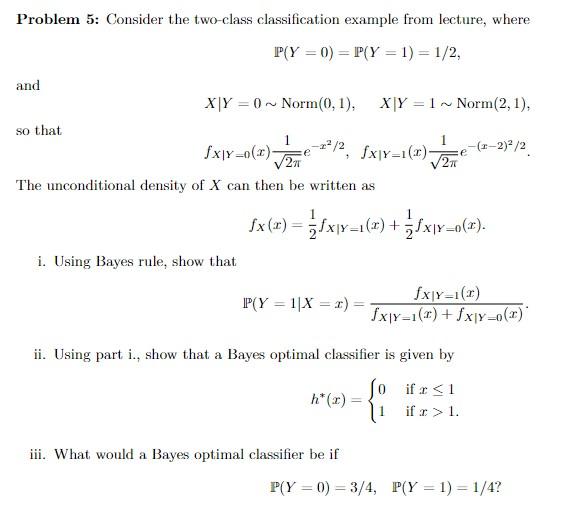
Problem 5: Consider the two-class classification example from lecture, where P(Y=0)=P(Y=1)=1/2, and XY=0Norm(0,1),XY=1Norm(2,1), so that fXY=0(x)21ex2/2,fXY=1(x)21e(x2)2/2. The unconditional density of X can then be written as fX(x)=21fXY=1(x)+21fXY=0(x). i. Using Bayes rule, show that P(Y=1X=x)=fXY=1(x)+fXY=0(x)fXY=1(x). ii. Using part i., show that a Bayes optimal classifier is given by h(x)={01ifx1ifx>1 iii. What would a Bayes optimal classifier be if P(Y=0)=3/4,P(Y=1)=1/4
Step by Step Solution
There are 3 Steps involved in it
1 Expert Approved Answer
Step: 1 Unlock

Question Has Been Solved by an Expert!
Get step-by-step solutions from verified subject matter experts
Step: 2 Unlock
Step: 3 Unlock
 Study Help