







Question: Problem 5 Imagine an academic network, where new students join the network from time to time by connecting to their advisors. New edges are also
Problem
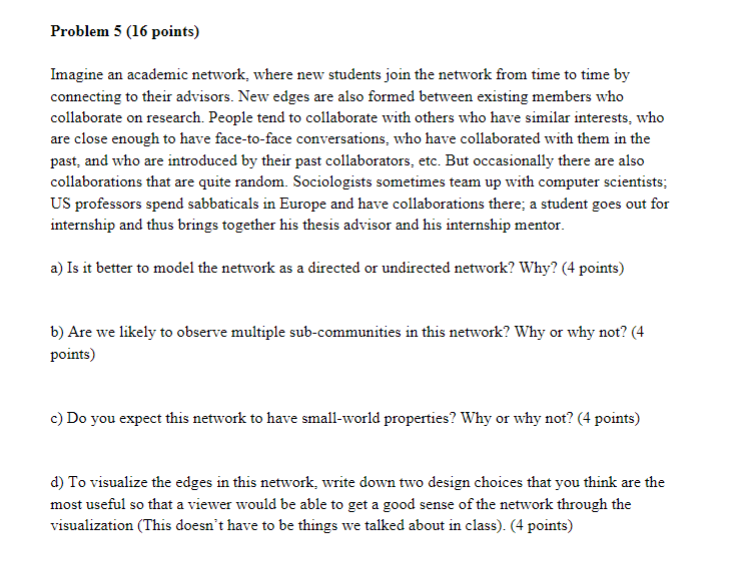
Imagine an academic network, where new students join the network from time to time by
connecting to their advisors. New edges are also formed between existing members who
collaborate on research. People tend to collaborate with others who have similar interests, who
are close enough to have facetoface conversations, who have collaborated with them in the
past, and who are introduced by their past collaborators, etc. But occasionally there are also
collaborations that are quite random. Sociologists sometimes team up with computer scientists;
US professors spend sabbaticals in Europe and have collaborations there; a student goes out for
internship and thus brings together his thesis advisor and his internship mentor.
a Is it better to model the network as a directed or undirected network? Why? points
b Are we likely to observe multiple subcommunities in this network? Why or why not?
points
c Do you expect this network to have smallworld properties? Why or why not? points
d To visualize the edges in this network, write down two design choices that you think are the
most useful so that a viewer would be able to get a good sense of the network through the
visualization points
Step by Step Solution
There are 3 Steps involved in it
1 Expert Approved Answer
Step: 1 Unlock

Question Has Been Solved by an Expert!
Get step-by-step solutions from verified subject matter experts
Step: 2 Unlock
Step: 3 Unlock
 Study Help