







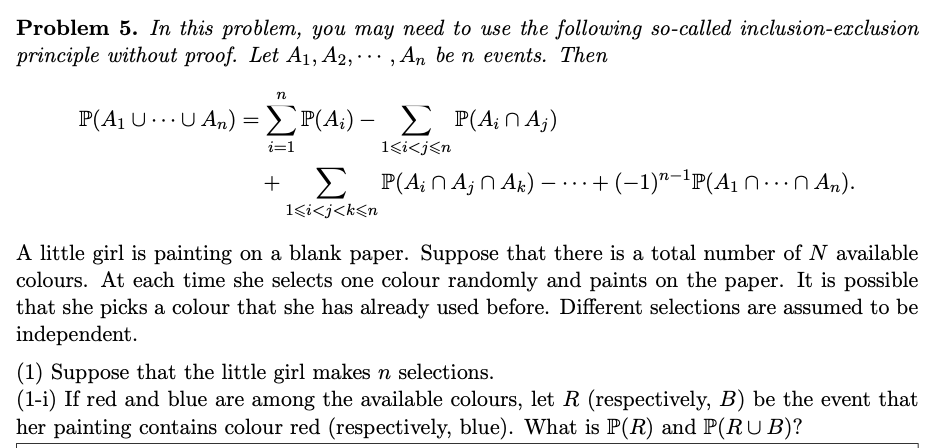
Question: Problem 5. In this problem, you may need to use the following so-called inclusion-exclusion principle without proof. Let A1, A2, . . . , An

![that N (3-ii) Consider E[T] as a function of N. Show that](https://dsd5zvtm8ll6.cloudfront.net/si.experts.images/questions/2024/11/6732e158b3b89_7366732e158a07b1.jpg)
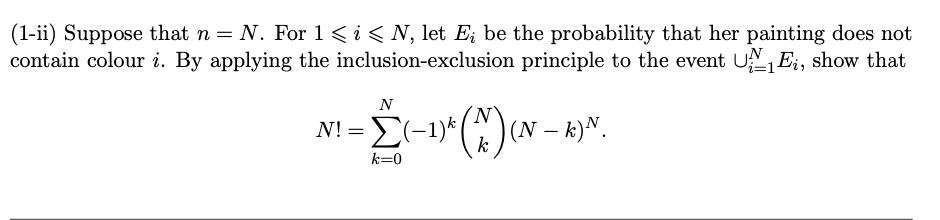
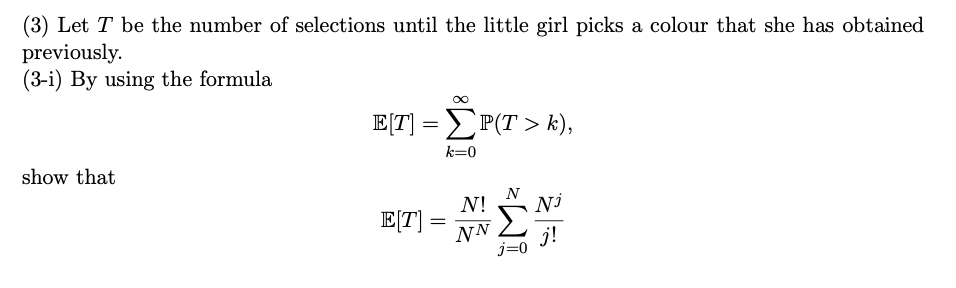
Problem 5. In this problem, you may need to use the following so-called inclusion-exclusion principle without proof. Let A1, A2, . . . , An be n events. Then n P(Al U . . . UAn) = P(Ai) - > P(AinA; ) i=1 1 k), k=0 Show that N (3-ii) Consider E[T] as a function of N. Show that ET] ~ TN 2 as N -> co. Here the notation an ~ by means limN-co by ON = 1. Hint: Try to use the central limit theorem in a suitable context.]
Step by Step Solution
There are 3 Steps involved in it
1 Expert Approved Answer
Step: 1 Unlock

Question Has Been Solved by an Expert!
Get step-by-step solutions from verified subject matter experts
Step: 2 Unlock
Step: 3 Unlock
 Study Help