Question: Problem 5 Introducing the king: the normal distribution N and his princessses: the lognormal distri- bution LogN. chi-squared distribution xi, Student's T distribution T) and
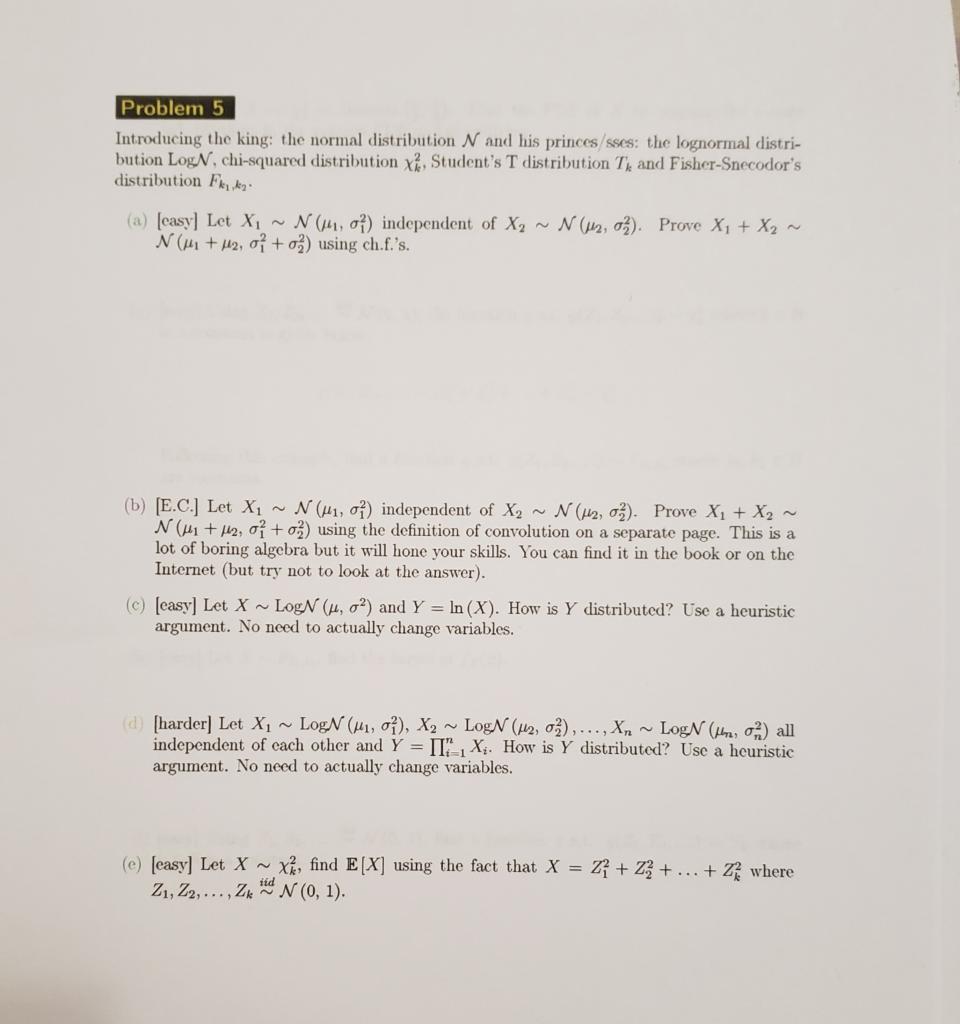
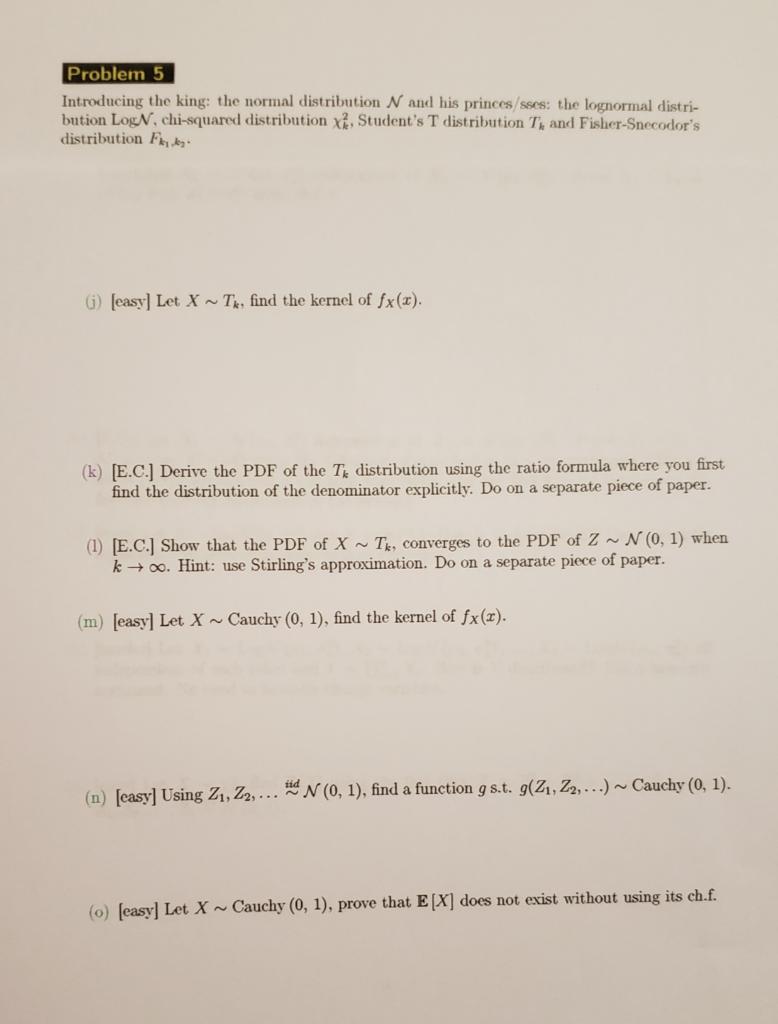
Problem 5 Introducing the king: the normal distribution N and his princessses: the lognormal distri- bution LogN. chi-squared distribution xi, Student's T distribution T) and Fisher-Snecodor's distribution Flak (a) [casy) Let Xi ~ N (4, 0) independent of X, ~ N (M2, o). Prove X1 + X2 ~ N (M + m2, o; + o) using ch.f.'s. (b) [E.C.] Let X1 ~ N(ui, g) independent of X, ~ N(H2, o). Prove X1 + X2 ~ N (ui + M2, o + o) using the definition of convolution on a separate page. This is a lot of boring algebra but it will hone your skills. You can find it in the book or on the Internet (but try not to look at the answer). (C) (easy) Let X LogN (, 02) and Y = In (X). How is Y distributed? Use a heuristic argument. No need to actually change variables. d [harder] Let X; ~ LogN (M1, o), X2 ~ LogN (M2, o), ..., XnLogN (pera, 0) all independent of each other and Y = 11-1 X.. How is Y distributed? Use a heuristic argument. No need to actually change variables. (e) (easy) Let X ~ x, find E[X] using the fact that X = Z + Z3 + ... + 27 where 21, 22, ..., Zid N (0,1). Problem 5 Introducing the king: the normal distribution N and his princes/sses: the lognormal distri- bution LogN. chi-squared distribution x. Student's T distribution T, and Fisher-Snecodor's distribution Fly G) (easy) Let X ~ T*. find the kernel of fx(x). (k) [E.C.) Derive the PDF of the Tit distribution using the ratio formula where you first find the distribution of the denominator explicitly. Do on a separate piece of paper. (1) [E.C.) Show that the PDF of XT, converges to the PDF of Z ~ N (0, 1) when k + o. Hint: use Stirling's approximation. Do on a separate piece of paper. (m) [easy] Let X ~ Cauchy (0, 1), find the kernel of fx(1). (n) [easy) Using 21, 22, ... N (0, 1), find a function gs.t. 9(21,22,...) ~ Cauchy (0, 1). (o) [easy] Let X ~ Cauchy (0, 1), prove that E[X] does not exist without using its ch.f. Problem 5 Introducing the king: the normal distribution N and his princessses: the lognormal distri- bution LogN. chi-squared distribution xi, Student's T distribution T) and Fisher-Snecodor's distribution Flak (a) [casy) Let Xi ~ N (4, 0) independent of X, ~ N (M2, o). Prove X1 + X2 ~ N (M + m2, o; + o) using ch.f.'s. (b) [E.C.] Let X1 ~ N(ui, g) independent of X, ~ N(H2, o). Prove X1 + X2 ~ N (ui + M2, o + o) using the definition of convolution on a separate page. This is a lot of boring algebra but it will hone your skills. You can find it in the book or on the Internet (but try not to look at the answer). (C) (easy) Let X LogN (, 02) and Y = In (X). How is Y distributed? Use a heuristic argument. No need to actually change variables. d [harder] Let X; ~ LogN (M1, o), X2 ~ LogN (M2, o), ..., XnLogN (pera, 0) all independent of each other and Y = 11-1 X.. How is Y distributed? Use a heuristic argument. No need to actually change variables. (e) (easy) Let X ~ x, find E[X] using the fact that X = Z + Z3 + ... + 27 where 21, 22, ..., Zid N (0,1). Problem 5 Introducing the king: the normal distribution N and his princes/sses: the lognormal distri- bution LogN. chi-squared distribution x. Student's T distribution T, and Fisher-Snecodor's distribution Fly G) (easy) Let X ~ T*. find the kernel of fx(x). (k) [E.C.) Derive the PDF of the Tit distribution using the ratio formula where you first find the distribution of the denominator explicitly. Do on a separate piece of paper. (1) [E.C.) Show that the PDF of XT, converges to the PDF of Z ~ N (0, 1) when k + o. Hint: use Stirling's approximation. Do on a separate piece of paper. (m) [easy] Let X ~ Cauchy (0, 1), find the kernel of fx(1). (n) [easy) Using 21, 22, ... N (0, 1), find a function gs.t. 9(21,22,...) ~ Cauchy (0, 1). (o) [easy] Let X ~ Cauchy (0, 1), prove that E[X] does not exist without using its ch.f









 Study Help