







Question: Problem 5. The Black-Scholes formula is derived using C=e- C(T)) = e-TEP [(S(T) - K)+), that is, as the discounted expected call option payoff in
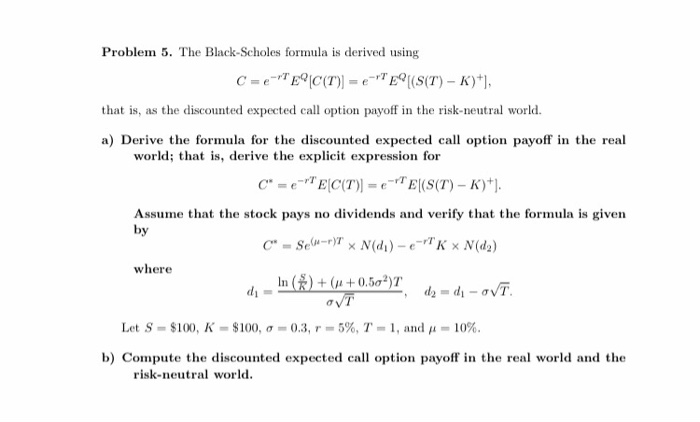
Problem 5. The Black-Scholes formula is derived using C=e- C(T)) = e-TEP [(S(T) - K)+), that is, as the discounted expected call option payoff in the risk-neutral world. a) Derive the formula for the discounted expected call option payoff in the real world; that is, derive the explicit expression for C" =-TEC(T)) = e-T (S(T) - K)+1. Assume that the stock pays no dividends and verify that the formula is given by C* -Se-r7 Nd)-e-K x N(da) where In ($) + ( + 0.50%) T idadi-VT. OVT Let S - $100, K - $100,0 -0.3, -5%, T-1, and -10%. b) Compute the discounted expected call option payoff in the real world and the risk-neutral world. Problem 5. The Black-Scholes formula is derived using C=e- C(T)) = e-TEP [(S(T) - K)+), that is, as the discounted expected call option payoff in the risk-neutral world. a) Derive the formula for the discounted expected call option payoff in the real world; that is, derive the explicit expression for C" =-TEC(T)) = e-T (S(T) - K)+1. Assume that the stock pays no dividends and verify that the formula is given by C* -Se-r7 Nd)-e-K x N(da) where In ($) + ( + 0.50%) T idadi-VT. OVT Let S - $100, K - $100,0 -0.3, -5%, T-1, and -10%. b) Compute the discounted expected call option payoff in the real world and the risk-neutral world
Step by Step Solution
There are 3 Steps involved in it

Get step-by-step solutions from verified subject matter experts
 Study Help