







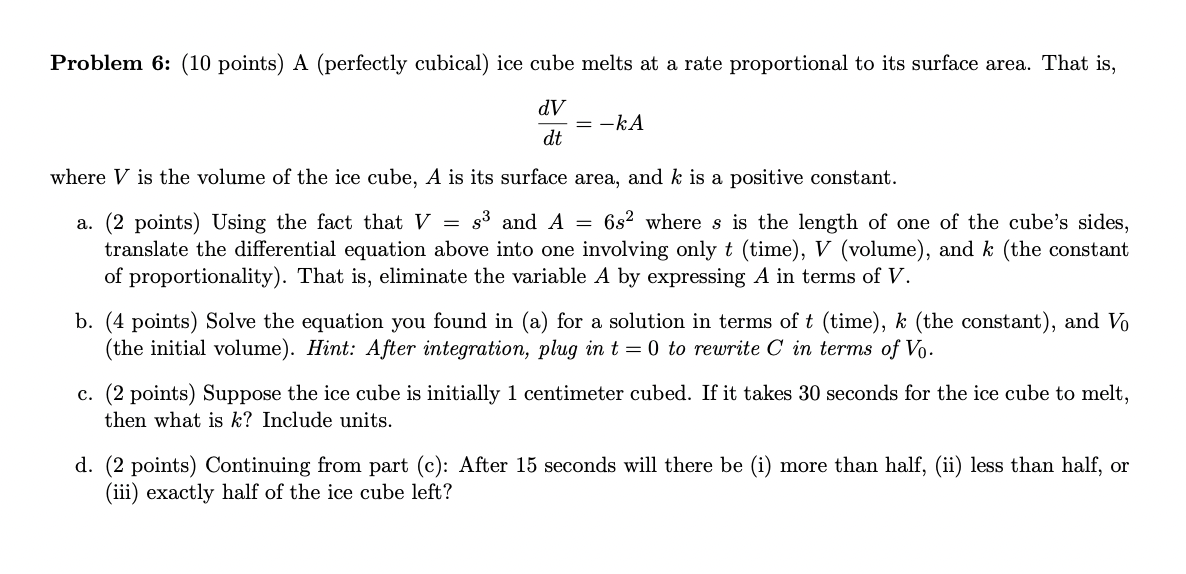
Question: Problem 6 : ( 1 0 points ) A ( perfectly cubical ) ice cube melts at a rate proportional to its surface area. That
Problem : points A perfectly cubical ice cube melts at a rate proportional to its surface area. That is
fracd Vd tk A
where V is the volume of the ice cube, A is its surface area, and k is a positive constant.
a points Using the fact that Vs and A s where s is the length of one of the cube's sides, translate the differential equation above into one involving only t time V volume and k the constant of proportionality That is eliminate the variable A by expressing A in terms of V
b points Solve the equation you found in a for a solution in terms of t time k the constant and Vthe initial volume Hint: After integration, plug in t to rewrite C in terms of V
c points Suppose the ice cube is initially centimeter cubed. If it takes seconds for the ice cube to melt, then what is k Include units.
d points Continuing from part c: After seconds will there be i more than half, ii less than half, or iii exactly half of the ice cube left?
Step by Step Solution
There are 3 Steps involved in it
1 Expert Approved Answer
Step: 1 Unlock

Question Has Been Solved by an Expert!
Get step-by-step solutions from verified subject matter experts
Step: 2 Unlock
Step: 3 Unlock
 Study Help