







Question: Problem 6 Arm BCD rotates about the z axis with angular velocity 1 of 5 r a d s which increases at the rate of
Problem
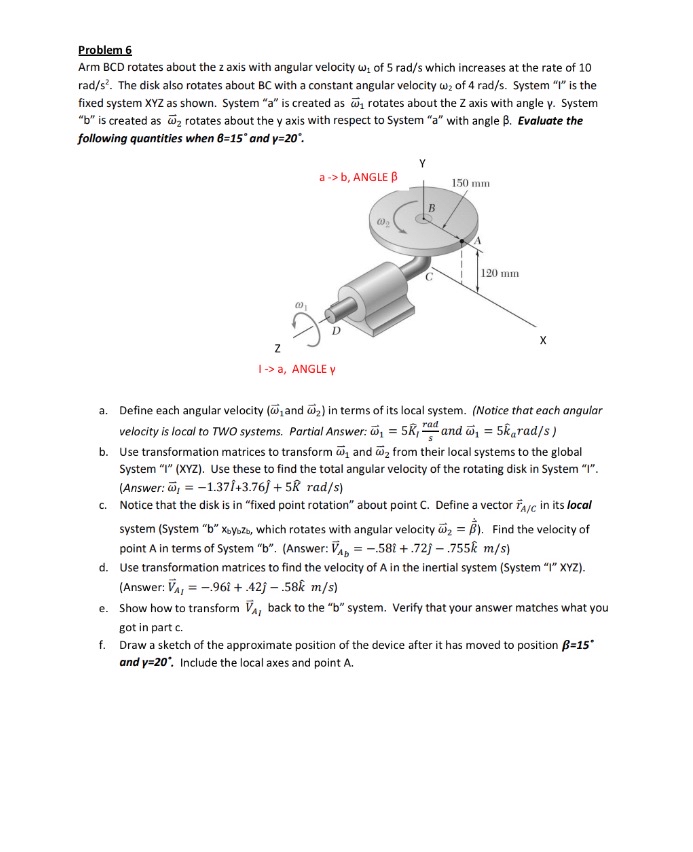
Arm BCD rotates about the axis with angular velocity of which increases at the rate of The disk also rotates about BC with a constant angular velocity of System is the fixed system as shown. System a is created as vec rotates about the axis with angle System b is created as vec rotates about the axis with respect to System a with angle Evaluate the following quantities when and
a Define each angular velocity vec and vec in terms of its local system. Notice that each angular velocity is local to TwO systems. Partial Answer: vechat and vechat
b Use transformation matrices to transform vec and vec from their local systems to the global System "I" XYZ Use these to find the total angular velocity of the rotating disk in System "I". Answer: vechathathat
c Notice that the disk is in "fixed point rotation" about point C Define a vector vec in its local system System which rotates with angular velocity vecvec Find the velocity of point A in terms of System bAnswer: vechathathat
d Use transformation matrices to find the velocity of A in the inertial system System "I" XYZAnswer: vechathathat
e Show how to transform vec back to the b system. Verify that your answer matches what you got in part c
f Draw a sketch of the approximate position of the device after it has moved to position and Include the local axes and point A
Step by Step Solution
There are 3 Steps involved in it
1 Expert Approved Answer
Step: 1 Unlock

Question Has Been Solved by an Expert!
Get step-by-step solutions from verified subject matter experts
Step: 2 Unlock
Step: 3 Unlock
 Study Help