







Question: Problem 6. (Clock spring) A type of cuckoo clock keeps time by having a mass bouncing on a spring, usually something cute like a cherub
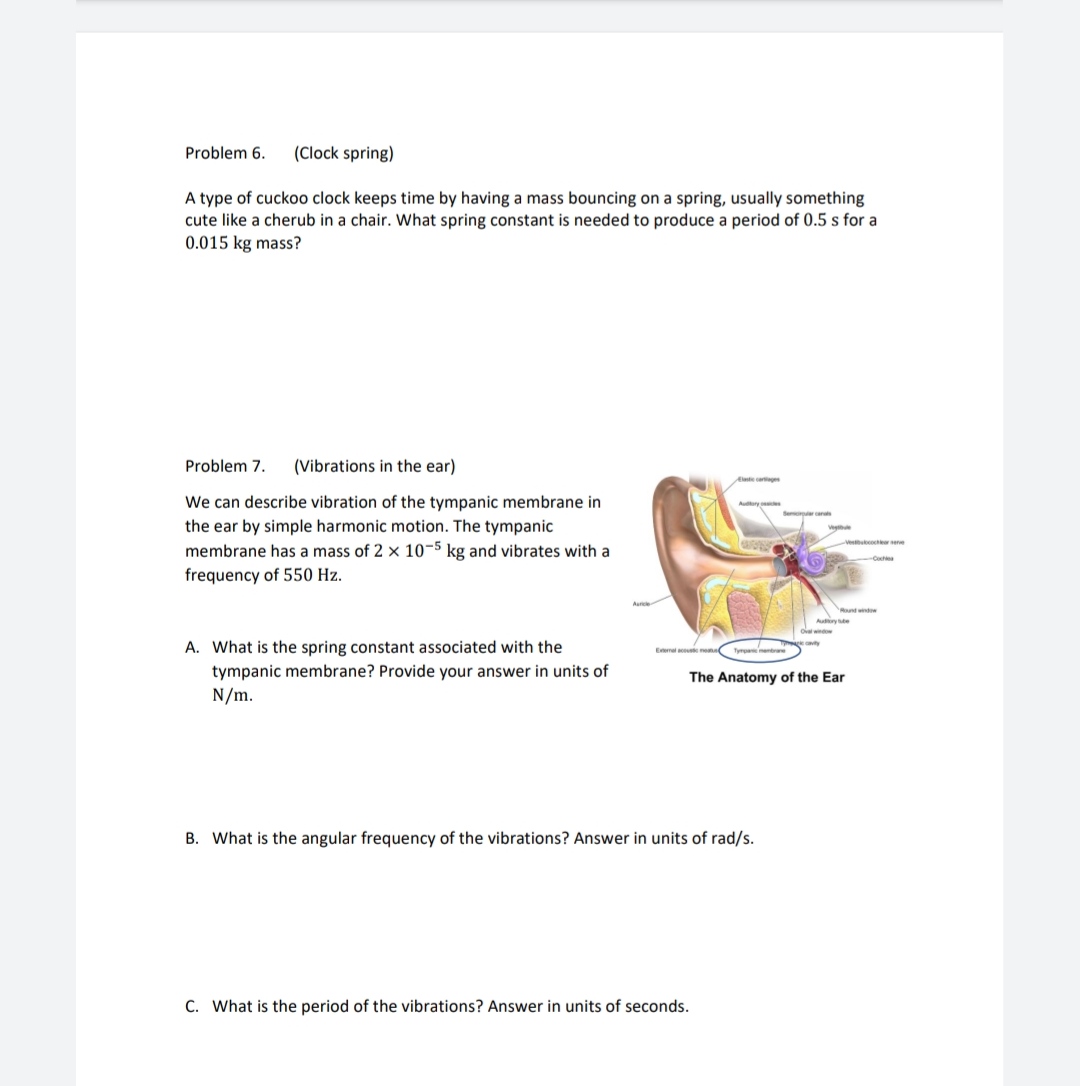
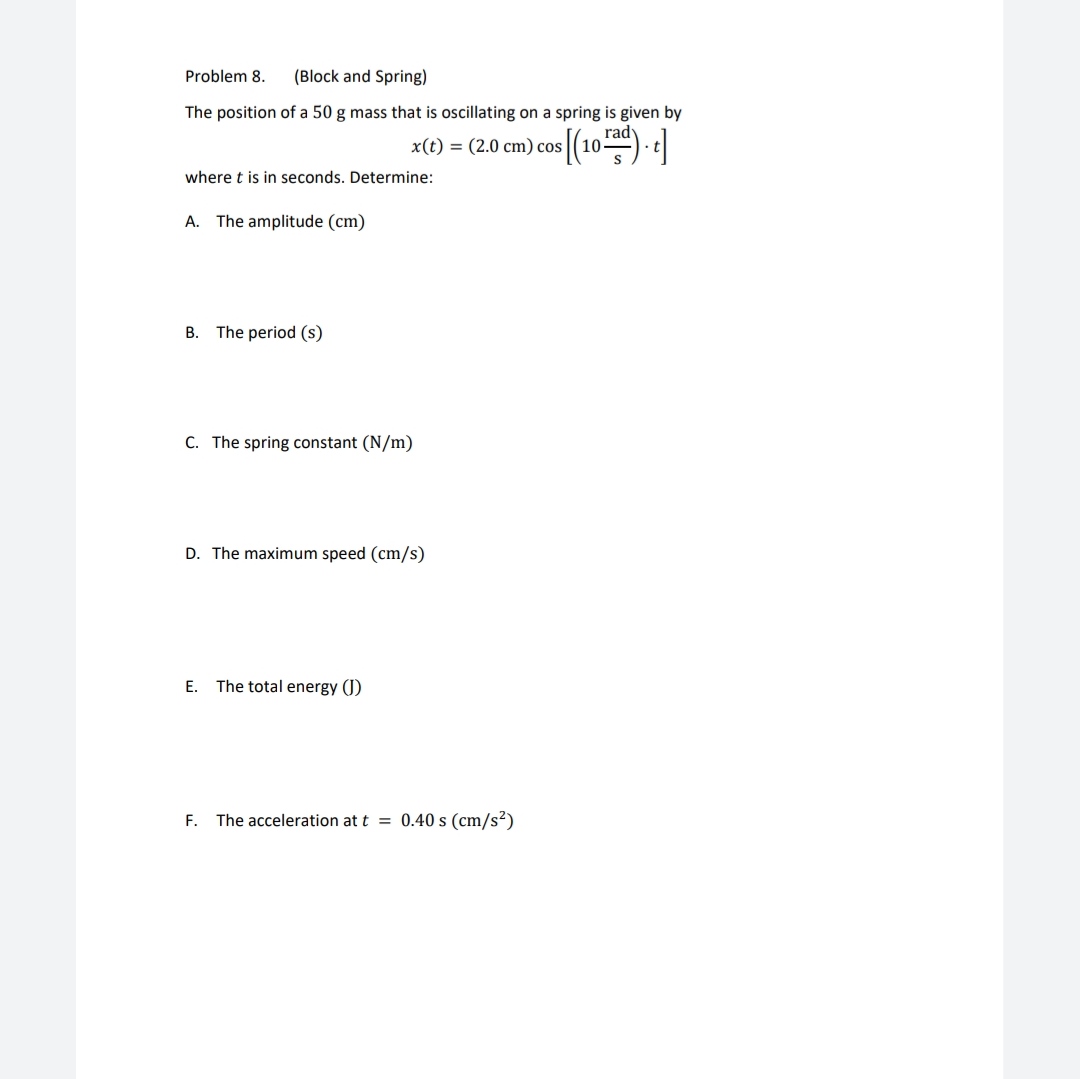
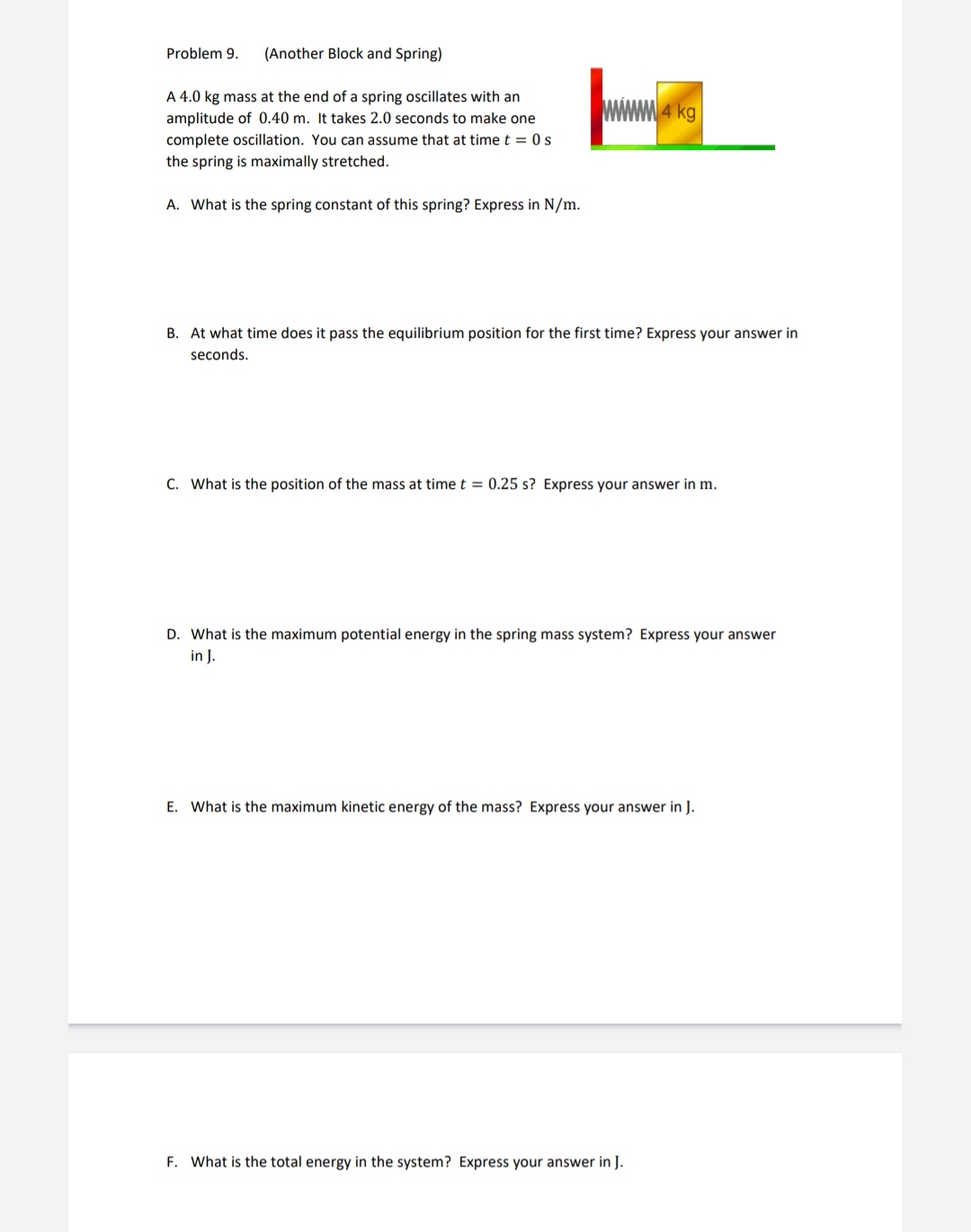
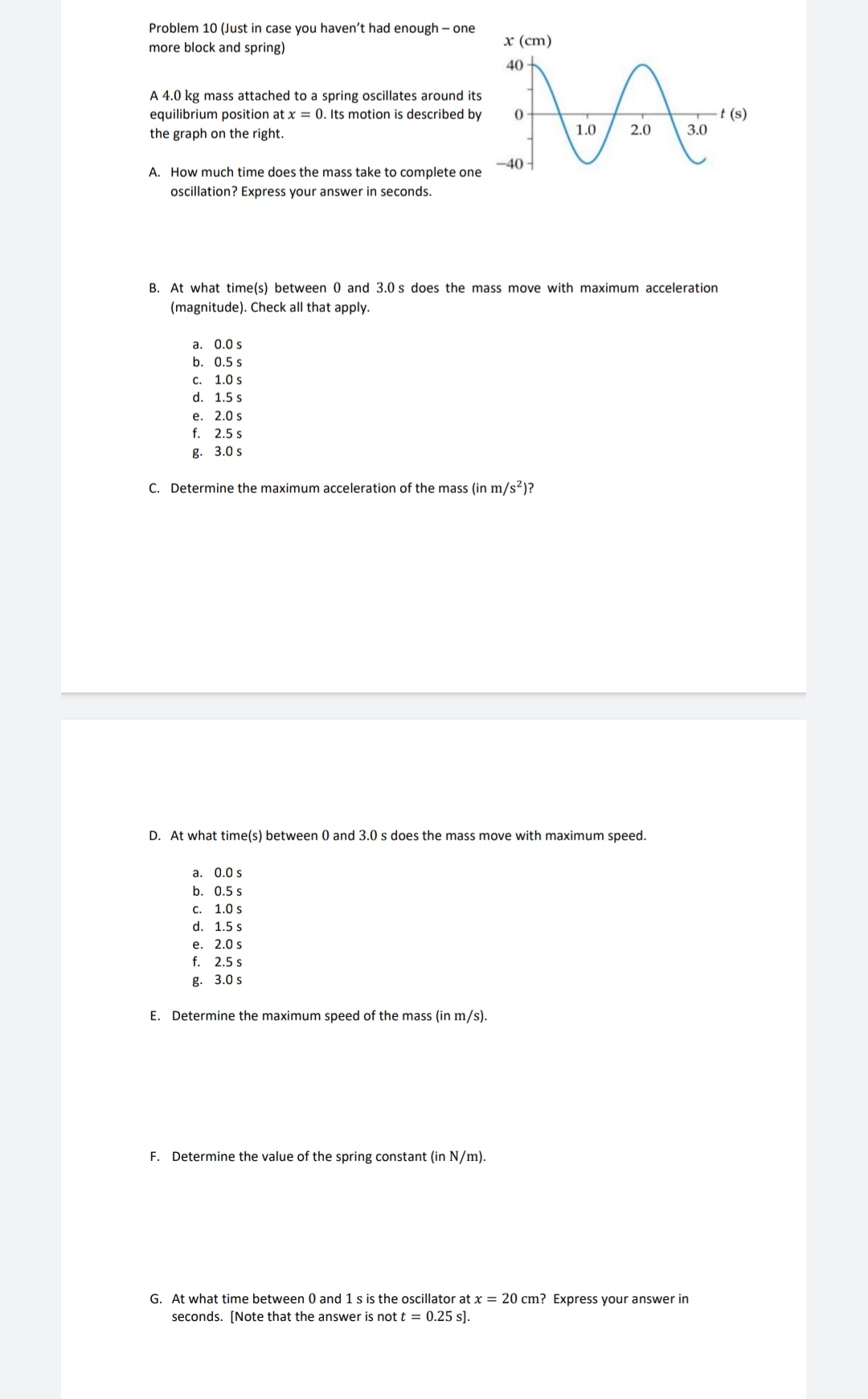
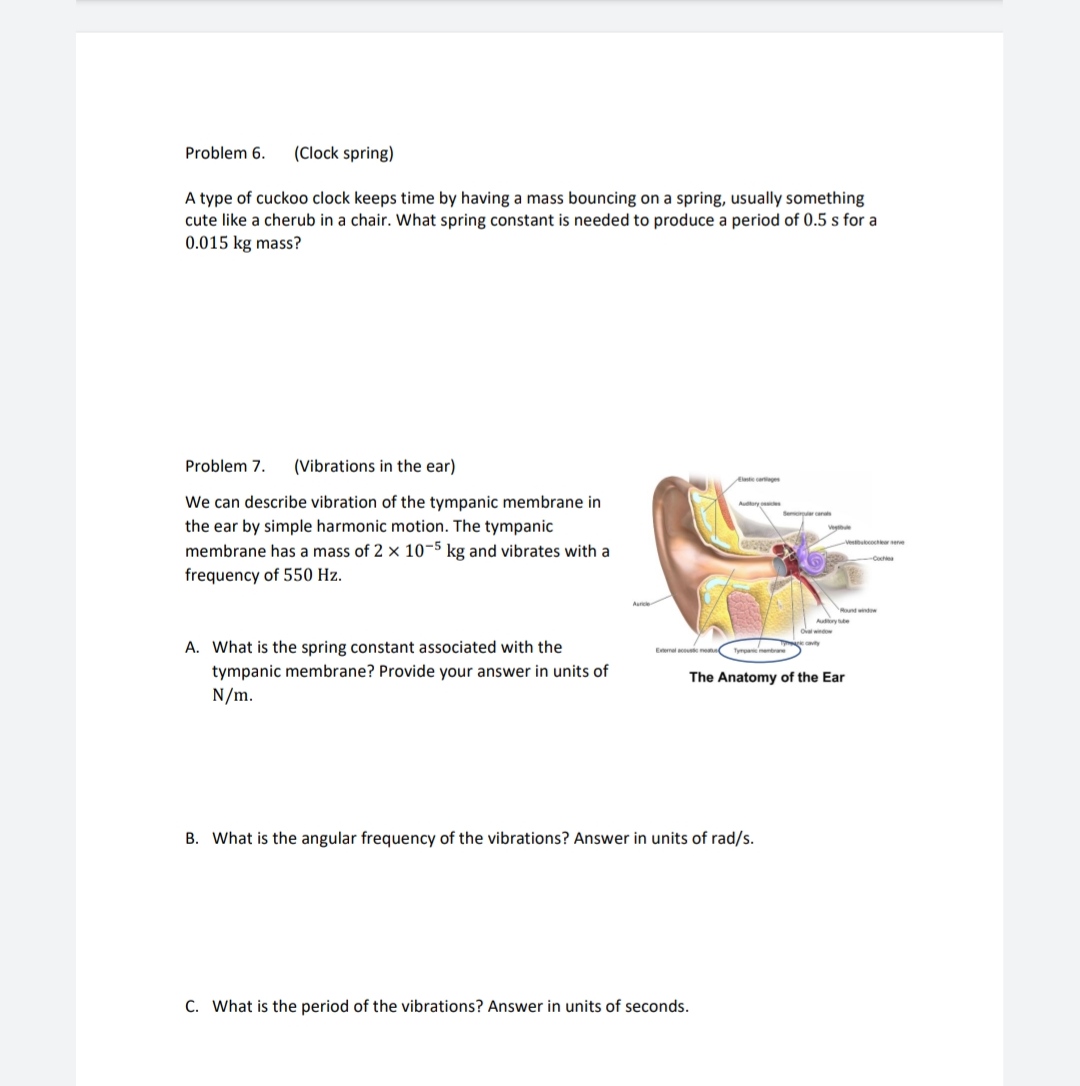
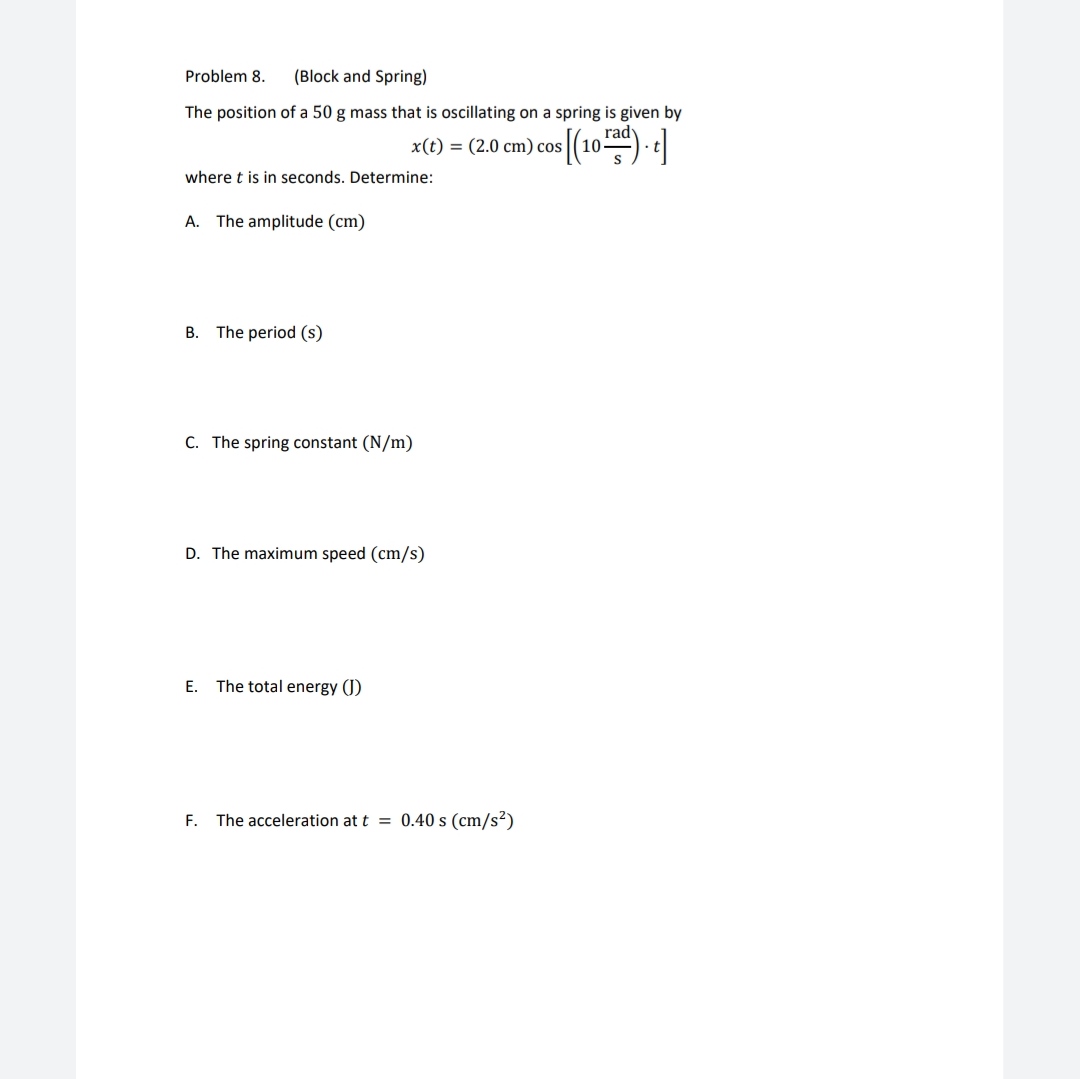
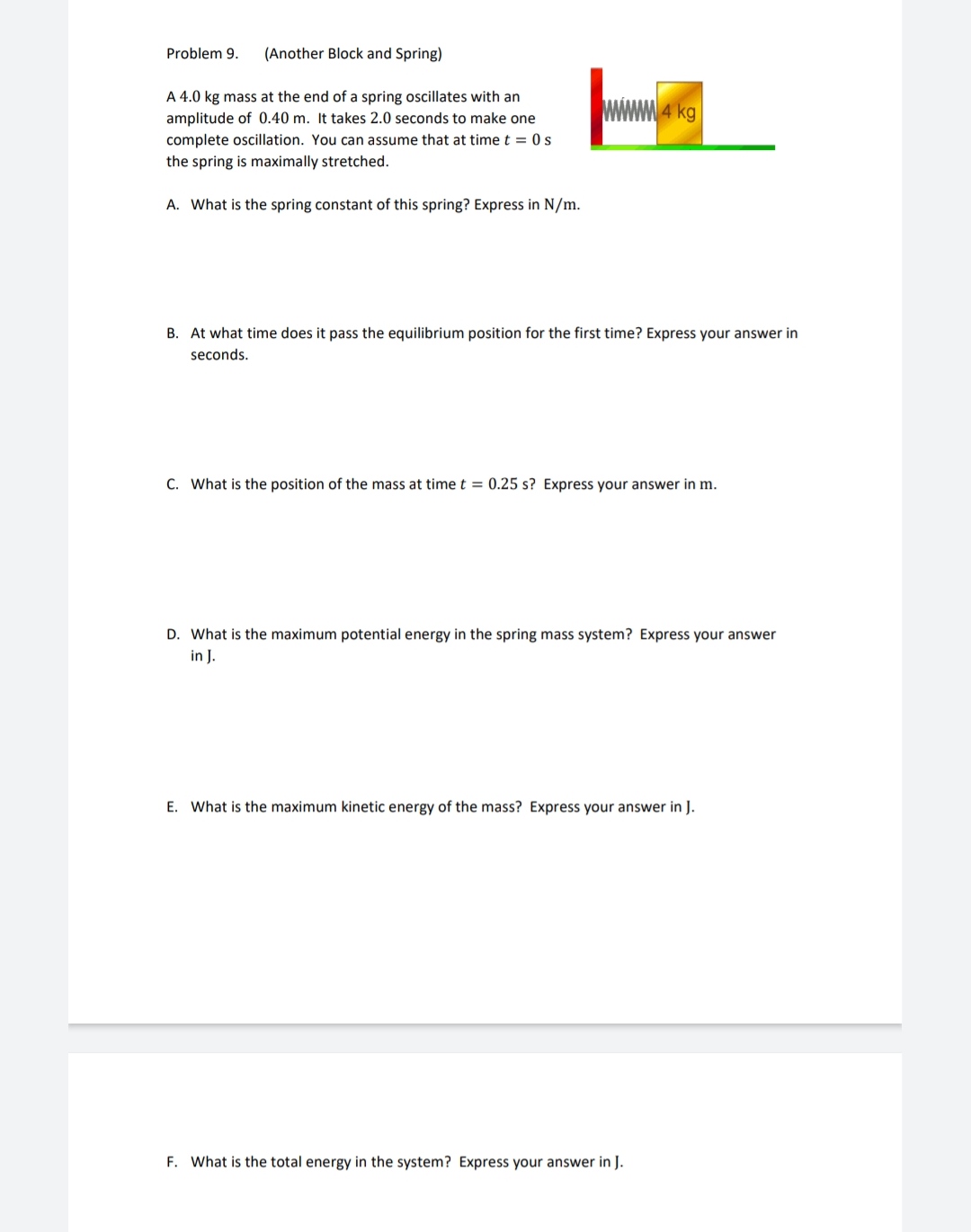
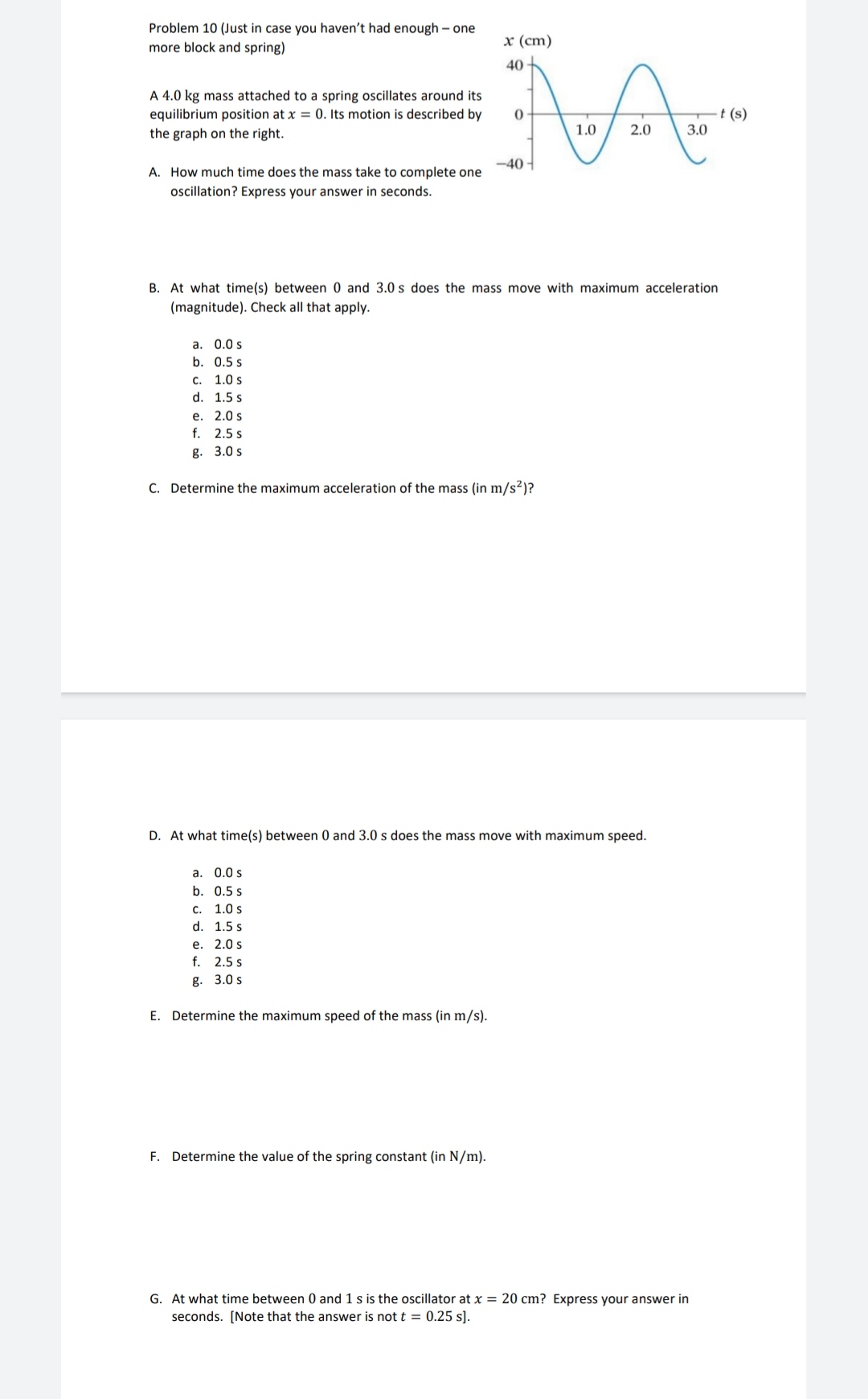
Problem 6. (Clock spring) A type of cuckoo clock keeps time by having a mass bouncing on a spring, usually something cute like a cherub in a chair. What spring constant is needed to produce a period of 0.5 s for a 0.015 kg mass? Problem 7. (Vibrations in the ear} We can describe vibration of the tympanic membrane in the ear by simple harmonic motion. The tympanic membrane has a mass of2 x 10'5 kg and vibrates with a frequency of 550 Hz. A. What is the spring constant associated with the tympanic membrane? Provide your answer in units of N/m. B. What is the angular frequency of the vibrations? Answer in units of rad/s. C. What is the period of the vibrations? Answer in units of seconds. Problem 8. (Block and Spring] The Position of a 50 g mass that is oscillating on a spring is given by rad x(t) = (2.0 cm} cos [(10 T) - t] where t is in seconds. Determine: A. The amplitude (cm) B. The period (5) C. The spring constant (N/m) D. The maximum speed (cm/s) E. The total energyr (I) F. The acceleration at t = 0.40 s (cm/32) Problem 9. (Another Block and Spring) A 4.0 kg mass at the end of a spring oscillates with an amplitude of 0.40 m. It takes 2.0 seconds to make one complete oscillation. You can assume that at time t = 0 s the spring is maximally stretched. A What is the spring constant of this spring? Express in N (m. B. At what time does it pass the equilibrium position for the first time? Express your answer in seconds. C. What Is the position of the mass at time t = 0.25 s? Express your answer in m. D. What is the maximum potential energy In the sprlng mass system? Express your answer In J. E. What is the maximum kinetic energy of the mass? Express your answer in l. F. What Is the total energy in the system? Express your answer in]. Problem 10 (Just in case you haven't had enough - one more block and spring) x (cm) 40 A 4.0 kg mass attached to a spring oscillates around its equilibrium position at x = 0. Its motion is described by - t (s) the graph on the right. 1.0 2.0 3.0 A. How much time does the mass take to complete one -40 oscillation? Express your answer in seconds. B. At what time(s) between 0 and 3.0 s does the mass move with maximum acceleration (magnitude). Check all that apply. a. 0.0 s b. 0.5 s c. 1.0 S d. 1.5 s e. 2.0 s f. 2.5 s g. 3.0 s C. Determine the maximum acceleration of the mass (in m/s2)? D. At what time(s) between 0 and 3.0 s does the mass move with maximum speed. a. 0.0 s b. 0.5 s c. 1.0 s d. 1.5 s e. 2.0 s f. 2.5 s g. 3.0 s E. Determine the maximum speed of the mass (in m/s). F. Determine the value of the spring constant (in N/m). G. At what time between 0 and 1 s is the oscillator at x = 20 cm? Express your answer in seconds. [Note that the answer is not t = 0.25 s]
Step by Step Solution
There are 3 Steps involved in it

Get step-by-step solutions from verified subject matter experts
 Study Help