







Question: Problem 6 is attatched for reference. Please include as many code comments as possible for problem 5. Problem 5: Write a MATLAB function called compute_dft.m
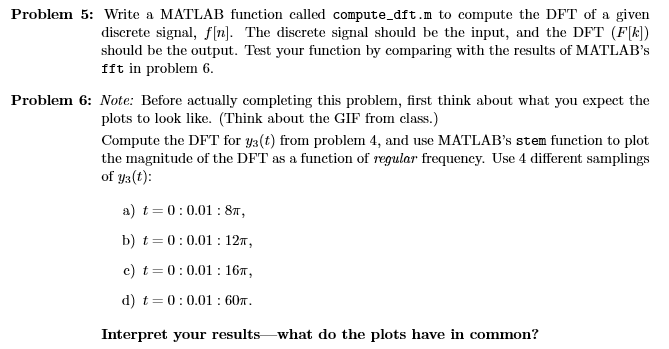
Problem 6 is attatched for reference. Please include as many code comments as possible for problem 5.
Problem 5: Write a MATLAB function called compute_dft.m to compute the DFT of a given discrete signal, f[n]. The discrete signal should be the input, and the DFT (FPD should be the output. Test your function by comparing with the results of MATLAB's fft in problem 6 lem, first think abo plots to look like. (Think about the GIF from class.) Compute the DFT for ya(t) from problem 4, and use MATLAB's stem function to plot the magnitude of the DFT as a function of regular frequeney. Use 4 different samplings of ys(t): a) t = 0 : 0.01 : 87 b) t= 0 : 0.01 : 12m, c) 0:0.01 : 16T, d) t 0 : 0.01 : 607 Interpret your results what do the plots have in common? Problem 5: Write a MATLAB function called compute_dft.m to compute the DFT of a given discrete signal, f[n]. The discrete signal should be the input, and the DFT (FPD should be the output. Test your function by comparing with the results of MATLAB's fft in problem 6 lem, first think abo plots to look like. (Think about the GIF from class.) Compute the DFT for ya(t) from problem 4, and use MATLAB's stem function to plot the magnitude of the DFT as a function of regular frequeney. Use 4 different samplings of ys(t): a) t = 0 : 0.01 : 87 b) t= 0 : 0.01 : 12m, c) 0:0.01 : 16T, d) t 0 : 0.01 : 607 Interpret your results what do the plots have in common
Step by Step Solution
There are 3 Steps involved in it

Get step-by-step solutions from verified subject matter experts
 Study Help