Question: Problem 6 (Reorder Point Ordering-1) Annual demand (D) for a condenser microphone is 5,475 units. Lead time (LT) is 6 days (constant). Find safety stock
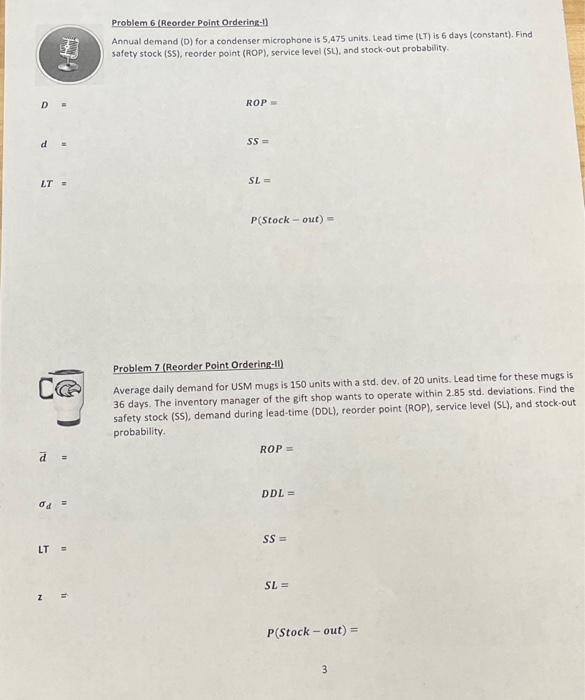
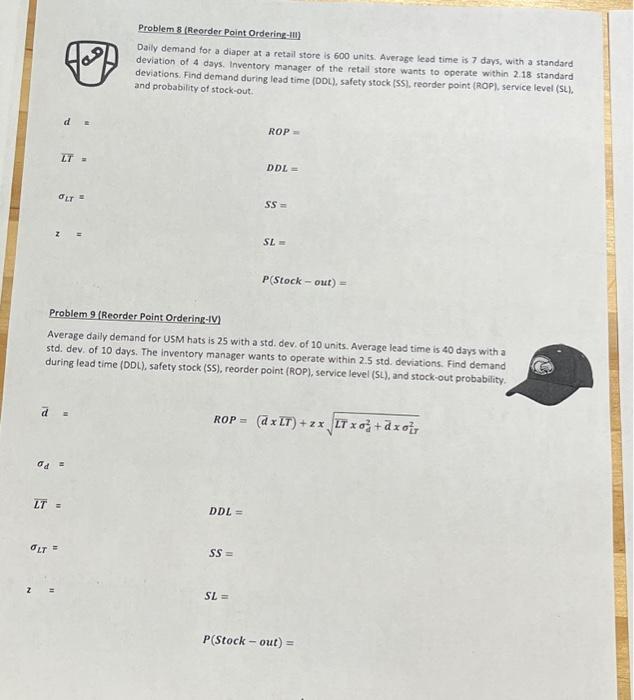
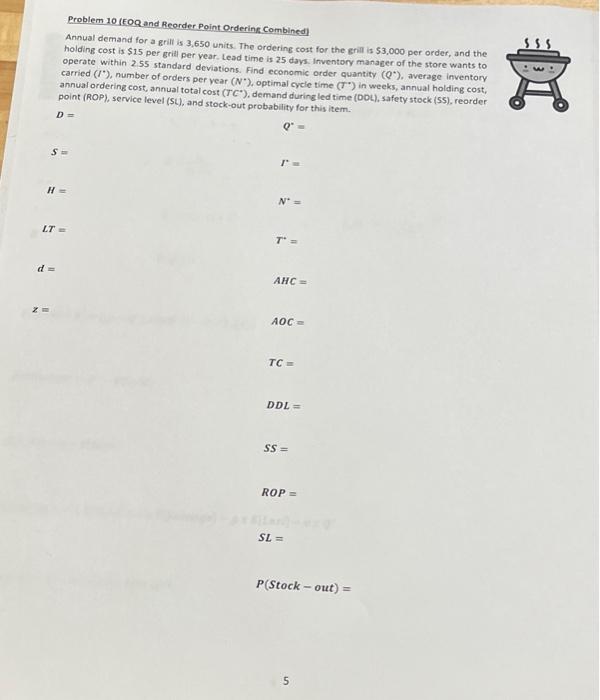
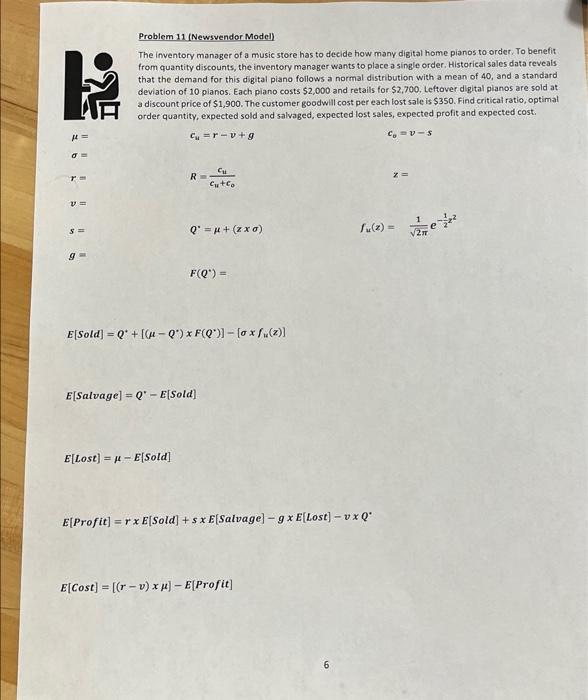
Problem 6 (Reorder Point Ordering-1) Annual demand (D) for a condenser microphone is 5,475 units. Lead time (LT) is 6 days (constant). Find safety stock (SS), reorder point (ROP), service level (SL), and stock-out probability. D= ROP= d.= SS= LT= SL= P(Stockout)= Problem 7 (Reorder Point Ordering-11) Average daily demand for USM mugs is 150 units with a std, dev, of 20 units. Lead time for these mugs is 36 days. The inventory manager of the gift shop wants to operate within 2.85 std. deviations. Find the safety stock (SS), demand during lead-time (DDL), reorder point (ROP), service level (SL), and stock-out probability. d= ROP= d= DDL= LT = SS= Problem 8 (Feorder Point Ordering =11 ) Daily demand for a diaper at a retail store is 600 units. Average leod time is 7 days, with a standard deviation of 4 days. Inventory manager of the retall store wants to operate within 2.18 standard deviations. Find demand during lead time (DDL), safety stock [SS), reorder point (ROPI, service level (SC), and probability of stock-out. d=LT=LT=z=ROP=DDL=SS=SL=P(Stock-out)= Problem 9 (Reorder Point Ordering-IV) Average daily demand for USM hats is 25 with a std. dev. of 10 units. Average lead time is 40 days with a std. dev. of 10 days. The inventory manager wants to operate within 2.5 std. deviations. Find demand during lead time (DDL), safety stock (SS), reorder point (ROP), service level (SL), and stock-out probability. d=d= DDL= = SL= P(Stock-out)= Rroblem 10 (FOQ and Reender Point Ordering Combined) Annual demand for a grill is 3,650 units. The ordering cost for the grill is 53,000 per order, and the holding cost is $15 per grill per vear. Lead time is 25 days. Inventery manaeer of the store wants to operate within 2.55 standard deviations. Find economic order quantity (Q), average inventory carried (I), number of orders per year (N), optimal cycle time (T) in weeks, annual holding cost, annual ordering cost, annual total cost (TC), demand duringled time (DDL), safety stock (S5), reorder point (ROP), service level (St), and stock-out probability for this item. D= Q= s= I= H= N= LT= T= d= AHC= z= AOC= TC= DDL= SS= ROP= SL= P(Stockout)= Problem 11 (Newssvender Model) The inventory manager of a music store has to decide how many digital home pianos to order. To benefit from quantity discounts, the inventory manager wants to place a single order. Historical sales data reveals that the demand for this digital piano follows a normal distribution with a mean of 40 , and a standard deviation of 10 pianos. Each piano costs $2,000 and retails for $2,700, Leftover digital pianos are sold at a discount price of $1,900. The customer goodwill cost per each lost sale is $350. Find critical ratio, optimal order quantity, expected sold and salvaged, expected lost sales, expected profit and expected cost. ==r=v=s=g=cu=rv+gR=cu+c0cuQ=+(zx)fu(z)=21e21z2F(Q)=c0=vsz= E[Sold]=Q+[(Q)F(Q)][fu(z)] E[Salvage]=QE[Sold] E[Lost]=E[Sold] E[Profit]=rE[Sold]+sE[Salvage]gE[Lost]vQ E[Cost]=[(rv)x]E[Profit] Problem 6 (Reorder Point Ordering-1) Annual demand (D) for a condenser microphone is 5,475 units. Lead time (LT) is 6 days (constant). Find safety stock (SS), reorder point (ROP), service level (SL), and stock-out probability. D= ROP= d.= SS= LT= SL= P(Stockout)= Problem 7 (Reorder Point Ordering-11) Average daily demand for USM mugs is 150 units with a std, dev, of 20 units. Lead time for these mugs is 36 days. The inventory manager of the gift shop wants to operate within 2.85 std. deviations. Find the safety stock (SS), demand during lead-time (DDL), reorder point (ROP), service level (SL), and stock-out probability. d= ROP= d= DDL= LT = SS= Problem 8 (Feorder Point Ordering =11 ) Daily demand for a diaper at a retail store is 600 units. Average leod time is 7 days, with a standard deviation of 4 days. Inventory manager of the retall store wants to operate within 2.18 standard deviations. Find demand during lead time (DDL), safety stock [SS), reorder point (ROPI, service level (SC), and probability of stock-out. d=LT=LT=z=ROP=DDL=SS=SL=P(Stock-out)= Problem 9 (Reorder Point Ordering-IV) Average daily demand for USM hats is 25 with a std. dev. of 10 units. Average lead time is 40 days with a std. dev. of 10 days. The inventory manager wants to operate within 2.5 std. deviations. Find demand during lead time (DDL), safety stock (SS), reorder point (ROP), service level (SL), and stock-out probability. d=d= DDL= = SL= P(Stock-out)= Rroblem 10 (FOQ and Reender Point Ordering Combined) Annual demand for a grill is 3,650 units. The ordering cost for the grill is 53,000 per order, and the holding cost is $15 per grill per vear. Lead time is 25 days. Inventery manaeer of the store wants to operate within 2.55 standard deviations. Find economic order quantity (Q), average inventory carried (I), number of orders per year (N), optimal cycle time (T) in weeks, annual holding cost, annual ordering cost, annual total cost (TC), demand duringled time (DDL), safety stock (S5), reorder point (ROP), service level (St), and stock-out probability for this item. D= Q= s= I= H= N= LT= T= d= AHC= z= AOC= TC= DDL= SS= ROP= SL= P(Stockout)= Problem 11 (Newssvender Model) The inventory manager of a music store has to decide how many digital home pianos to order. To benefit from quantity discounts, the inventory manager wants to place a single order. Historical sales data reveals that the demand for this digital piano follows a normal distribution with a mean of 40 , and a standard deviation of 10 pianos. Each piano costs $2,000 and retails for $2,700, Leftover digital pianos are sold at a discount price of $1,900. The customer goodwill cost per each lost sale is $350. Find critical ratio, optimal order quantity, expected sold and salvaged, expected lost sales, expected profit and expected cost. ==r=v=s=g=cu=rv+gR=cu+c0cuQ=+(zx)fu(z)=21e21z2F(Q)=c0=vsz= E[Sold]=Q+[(Q)F(Q)][fu(z)] E[Salvage]=QE[Sold] E[Lost]=E[Sold] E[Profit]=rE[Sold]+sE[Salvage]gE[Lost]vQ E[Cost]=[(rv)x]E[Profit]









 Study Help