





Question: Problem 7 (1 point for a); 4 points for 1)) Difculty level: (a) easy, (b) medium (a) You are tossing a fair coin 10 times.
Problem 7 (1 point for a); 4 points for 1))
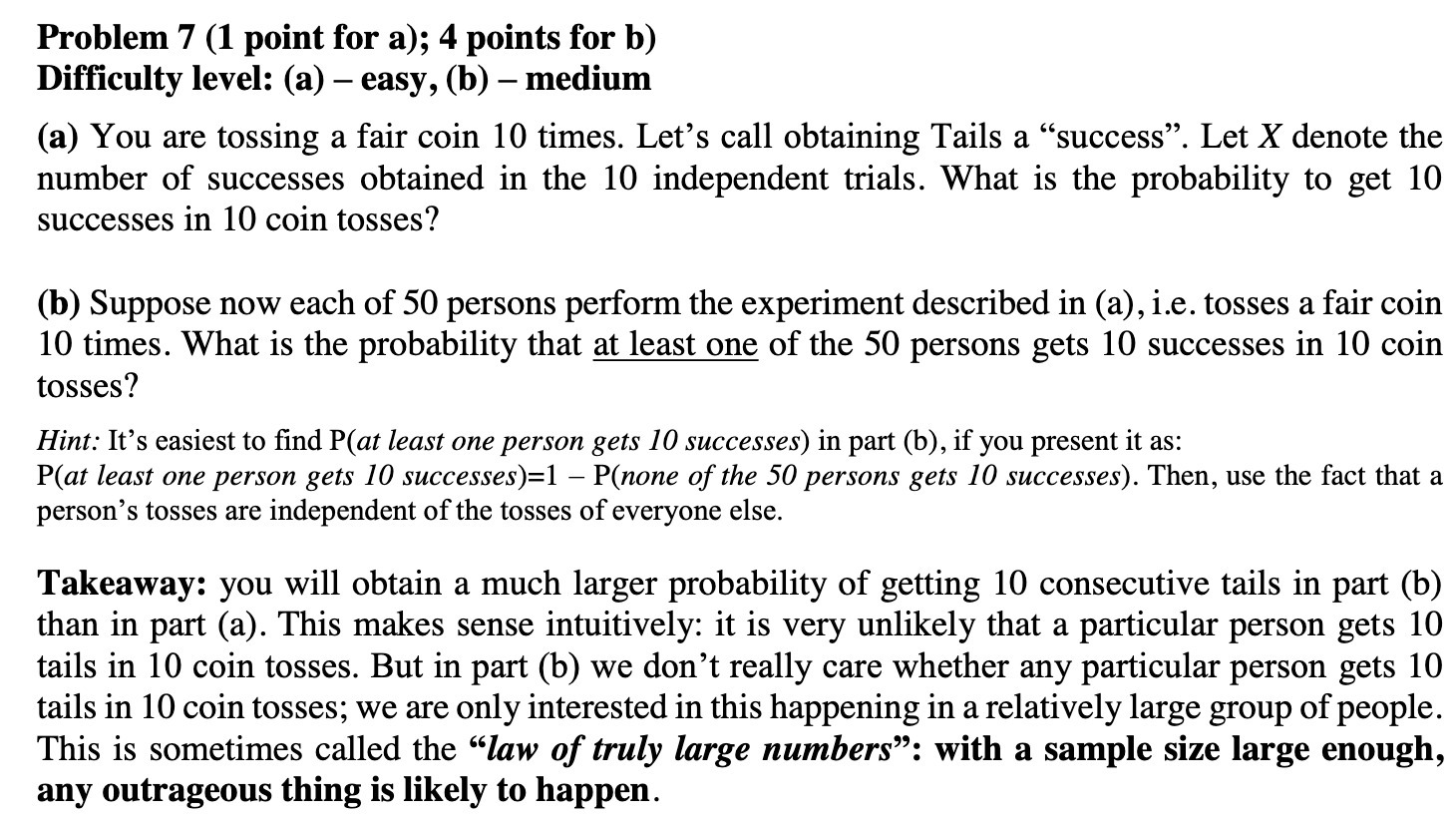
Problem 7 (1 point for a); 4 points for 1)) Difculty level: (a) easy, (b) medium (a) You are tossing a fair coin 10 times. Let's call obtaining Tails a \"success\". Let X denote the number of successes obtained in the 10 independent trials. What is the probability to get 10 successes in 10 coin tosses? (b) Suppose now each of 50 persons perform the experiment described in (a), i.e. tosses a fair coin 10 times. What is the probability that at least one of the 50 persons gets 10 successes in 10 coin tosses? Hint: It's easiest to nd P(at least one person gets 10 successes) in part (b), if you present it as: P(at least one person gets 10 successes)=1 P(none of the 50 persons gets 10 successes). Then, use the fact that a person's tosses are independent of the tosses of everyone else. Takeaway: you will obtain a much larger probability of getting 10 consecutive tails in part (b) than in part (a). This makes sense intuitively: it is very unhkely that a particular person gets 10 tails in 10 coin tosses. But in part (b) we don't really care whether any particular person gets 10 tails in 10 coin tosses; we are only interested in this happening in a relatively large group of people. This is sometimes called the \"law of truly large numbers\": with a sample size large enough, any outrageous thing is likely to happen

Step by Step Solution

There are 3 Steps involved in it

1 Expert Approved Answer
Step: 1 Unlock blur-text-image

Question Has Been Solved by an Expert!

Get step-by-step solutions from verified subject matter experts

Step: 2 Unlock
Step: 3 Unlock

Students Have Also Explored These Related Mathematics Questions!