







Question: Problem 7. Consider a cake-cutting problem with three agents and the fol- lowing protocol. First, Alice cuts the cake into three pieces that she regards
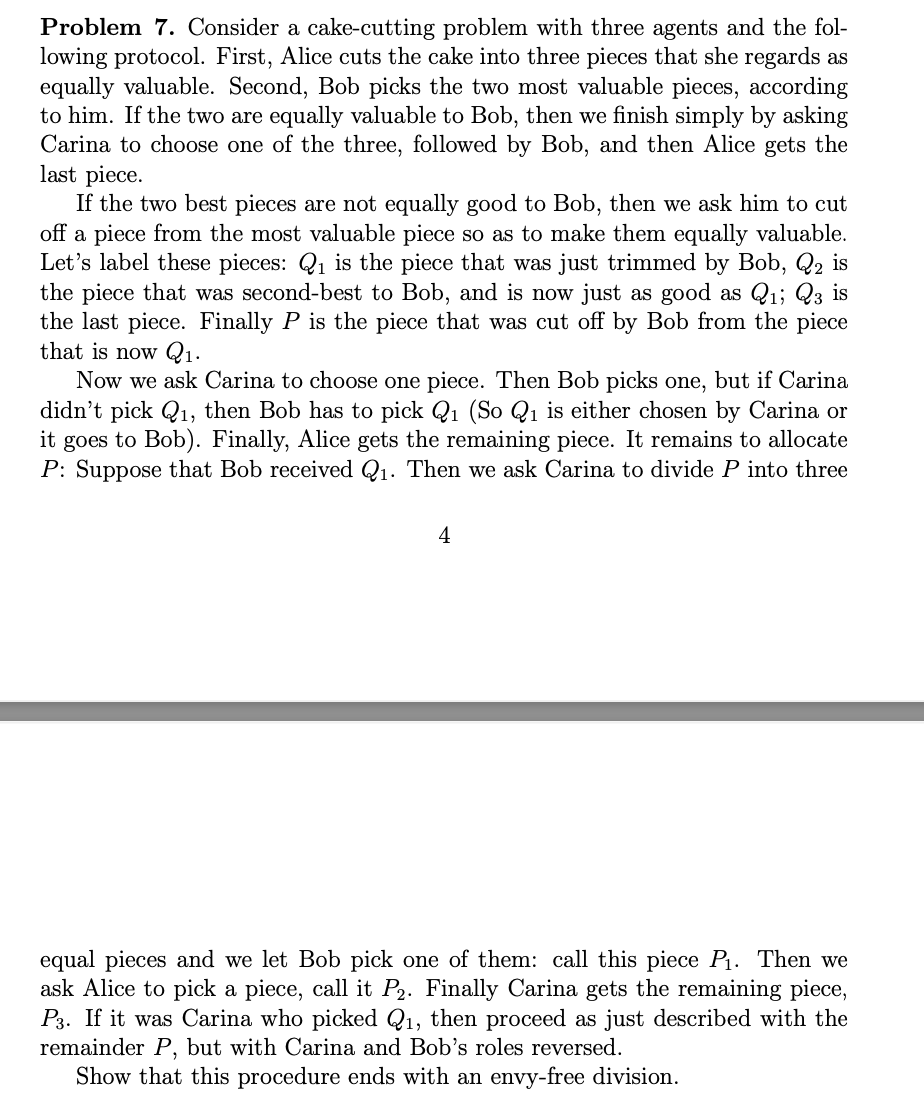
Problem 7. Consider a cake-cutting problem with three agents and the fol- lowing protocol. First, Alice cuts the cake into three pieces that she regards as equally valuable. Second, Bob picks the two most valuable pieces, according to him. If the two are equally valuable to Bob, then we finish simply by asking Carina to choose one of the three, followed by Bob, and then Alice gets the last piece. If the two best pieces are not equally good to Bob, then we ask him to cut off a piece from the most valuable piece so as to make them equally valuable. Let's label these pieces: (Q; is the piece that was just trimmed by Bob, @ is the piece that was second-best to Bob, and is now just as good as Q;; Q3 is the last piece. Finally P is the piece that was cut off by Bob from the piece that is now ;. Now we ask Carina to choose one piece. Then Bob picks one, but if Carina didn't pick @1, then Bob has to pick @1 (So Q1 is either chosen by Carina or it goes to Bob). Finally, Alice gets the remaining piece. It remains to allocate P: Suppose that Bob received ;. Then we ask Carina to divide P into three 4 equal pieces and we let Bob pick one of them: call this piece P;. Then we ask Alice to pick a piece, call it P,. Finally Carina gets the remaining piece, P;. If it was Carina who picked ()1, then proceed as just described with the remainder P, but with Carina and Bob's roles reversed. Show that this procedure ends with an envy-free division
Step by Step Solution
There are 3 Steps involved in it

Get step-by-step solutions from verified subject matter experts
 Study Help