







Question: Problem 6. Consider a cake-cutting problem with n = 3. First Alice cuts the cake in two equal (to her) pieces. Then Bob picks one
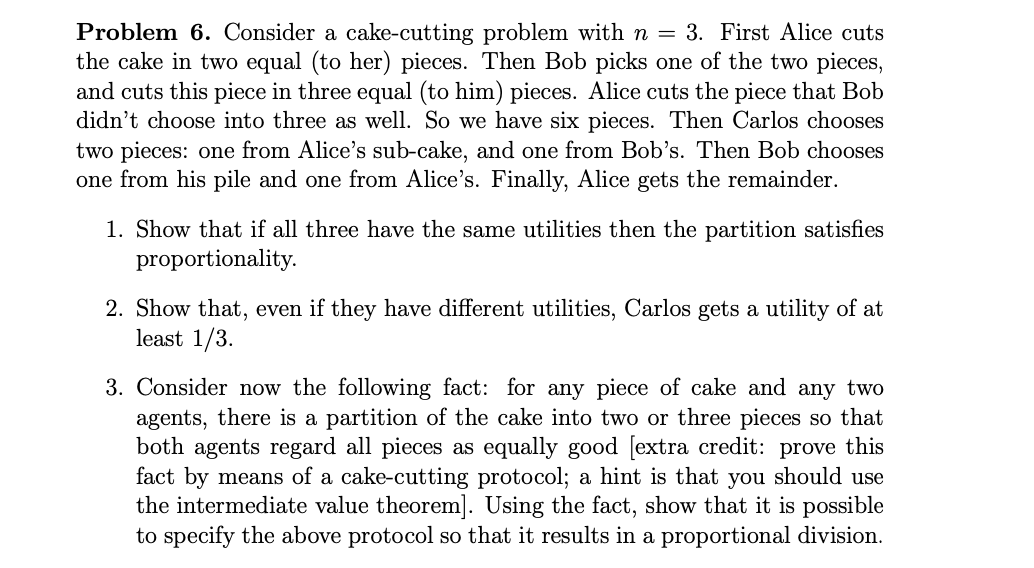
Problem 6. Consider a cake-cutting problem with n = 3. First Alice cuts the cake in two equal (to her) pieces. Then Bob picks one of the two pieces, and cuts this piece in three equal (to him) pieces. Alice cuts the piece that Bob didn't choose into three as well. So we have six pieces. Then Carlos chooses two pieces: one from Alice's sub-cake, and one from Bob's. Then Bob chooses one from his pile and one from Alice's. Finally, Alice gets the remainder. 1. Show that if all three have the same utilities then the partition satisfies proportionality. 2. Show that, even if they have different utilities, Carlos gets a utility of at least 1/3. 3. Consider now the following fact: for any piece of cake and any two agents, there is a partition of the cake into two or three pieces so that both agents regard all pieces as equally good [extra credit: prove this fact by means of a cake-cutting protocol; a hint is that you should use the intermediate value theorem|. Using the fact, show that it is possible to specify the above protocol so that it results in a proportional division
Step by Step Solution
There are 3 Steps involved in it

Get step-by-step solutions from verified subject matter experts
 Study Help