







Question: Problem 7.05 (Bond Valuation) eBook Problem Walk-Through investor has two bonds in his portfolio that have a face value of $1,000 and pay on 11%
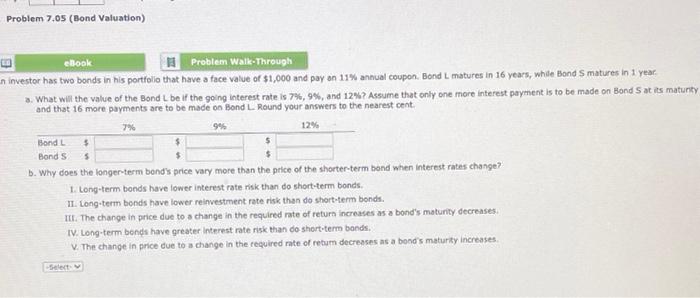
Problem 7.05 (Bond Valuation) eBook Problem Walk-Through investor has two bonds in his portfolio that have a face value of $1,000 and pay on 11% annual coupon. Bond L. matures in 16 years, while Bond S matures in 1 year. 2. What will the value of the Bond L be if the going interest rate is 7%, 9%, and 12%? Assume that only one more interest payment is to be made on Bond S at its maturity and that 16 more payments are to be made on Bond L Round your answers to the nearest cent 7% 9% 12% Bond L $ Bond S 5 b. Why does the longer-term bond's price vary more than the price of the shorter-term bond when interest rates change? 1. Long-term bonds have lower interest rate risk than do short-term bonds 11. Long-term bonds have lower reinvestment rate risk than do short-term bonds. TIL. The change in price due to a change in the required rate of return increases as a bond's maturity decreases IV. Long-term bonds have greater Interest rate risk than do short-term bands. V. The change in price due to a change in the required rate of retum decreases as a bond's maturity increases Select
Step by Step Solution
There are 3 Steps involved in it

Get step-by-step solutions from verified subject matter experts
 Study Help