



Question: Problem 7.1. with the parameters given and hydraulic retention time= 1d, change the question to : 1) what is the BODL concentration in the aerated
Problem 7.1. with the parameters given and hydraulic retention time= 1d, change the question to :
1) what is the BODL concentration in the aerated lagoon?
2) what is the concentration of volatile suspended solids (Xv) in the lagoon?
DO NOT ANSWER THE ORIGINIAL QUESTION. PLEASE ANSWER THE QUESTIONS GIVEN ABOVE!
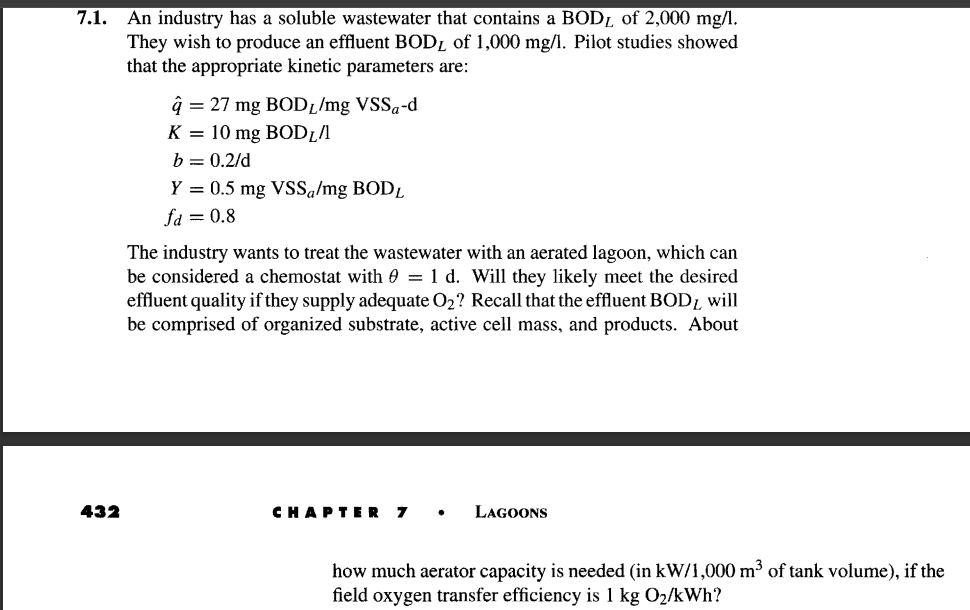
1. An industry has a soluble wastewater that contains a BODL of 2,000mg/l. They wish to produce an effluent BODL of 1,000mg/l. Pilot studies showed that the appropriate kinetic parameters are: q^KbYfd=27mgBODL/mgVSSad=10mgBODL/l=0.2/d=0.5mgVSSa/mgBODL=0.8 The industry wants to treat the wastewater with an aerated lagoon, which can be considered a chemostat with =1d. Will they likely meet the desired effluent quality if they supply adequate O2 ? Recall that the effluent BODL will be comprised of organized substrate, active cell mass, and products. About C HAPTER 7 - Lagoons how much aerator capacity is needed (in kW/1,000m3 of tank volume), if the field oxygen transfer efficiency is 1kgO2/kWh ? 1. An industry has a soluble wastewater that contains a BODL of 2,000mg/l. They wish to produce an effluent BODL of 1,000mg/l. Pilot studies showed that the appropriate kinetic parameters are: q^KbYfd=27mgBODL/mgVSSad=10mgBODL/l=0.2/d=0.5mgVSSa/mgBODL=0.8 The industry wants to treat the wastewater with an aerated lagoon, which can be considered a chemostat with =1d. Will they likely meet the desired effluent quality if they supply adequate O2 ? Recall that the effluent BODL will be comprised of organized substrate, active cell mass, and products. About C HAPTER 7 - Lagoons how much aerator capacity is needed (in kW/1,000m3 of tank volume), if the field oxygen transfer efficiency is 1kgO2/kWh
Step by Step Solution
There are 3 Steps involved in it

Get step-by-step solutions from verified subject matter experts